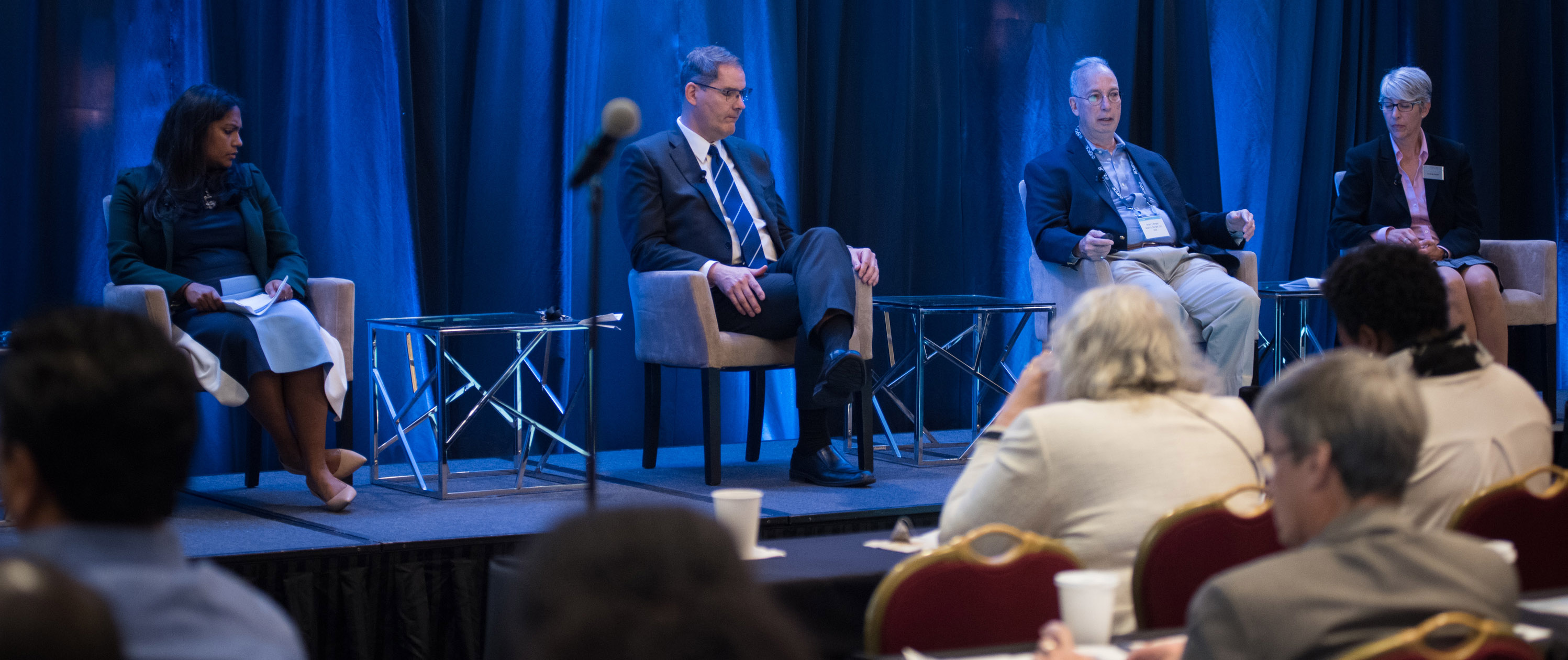
Real-world evidence on treatment outcomes can be an important aspect of the evidence basis for decision making if it is seen as credible. For real-world studies that are meant to test hypotheses about comparative-effectiveness or safety, a key aspect of credibility is that they are conducted transparently with tests that follow a prespecified analytic protocol. Preregistration of such study protocols on a public website would help build trust that their results can be used for decision-making purposes.
Establishing a Culture of Transparency for Real-World Evidence Studies...
The Real-World Evidence Transparency Initiative Partnership is a joint collaboration and ongoing effort between ISPOR, the International Society for Pharmacoepidemiology, the Duke-Margolis Center for Health Policy, and the National Pharmaceutical Council. The objective of this initiative is to establish a culture of transparency for study analysis and reporting of hypothesis evaluating real-world evidence studies on treatment effects.
Improving Transparency to Build Trust...
 The Real-World Evidence Transparency Initiative published a plan to encourage routine registration of noninterventional real-world evidence studies used to evaluate treatment effects. The report, “Improving Transparency to Build Trust in Real-World Secondary Data Studies for Hypothesis Testing—Why, What, and How: Recommendations and a Road Map from the Real-World Evidence Transparency Initiative,”
was published in the September 2020 issue of Value in Health.
The Real-World Evidence Transparency Initiative published a plan to encourage routine registration of noninterventional real-world evidence studies used to evaluate treatment effects. The report, “Improving Transparency to Build Trust in Real-World Secondary Data Studies for Hypothesis Testing—Why, What, and How: Recommendations and a Road Map from the Real-World Evidence Transparency Initiative,”
was published in the September 2020 issue of Value in Health.
More...
The report, “Improving Transparency to Build Trust in Real-World Secondary Data Studies for Hypothesis Testing—Why, What, and How: Recommendations and a Road Map from the Real-World Evidence Transparency Initiative,” was published in the September 2020 issue of Value in Health. The plan includes specifying the rationale for registering hypothesis-evaluating treatment effectiveness real-world evidence studies, the studies that should be registered, where and when these studies should be registered, how and when analytic deviations from protocols should be reported, how and when to publish results, and incentives to encourage registration.
Real-World Evidence Registry
The Real-World Evidence Registry provides researchers with a fit-for-purpose platform to register their study designs before they begin work to facilitate the transparency needed to elevate the trust in the study results.
More...
Real-world evidence studies can be used for hypothesis evaluation of treatment effects including safety (HETE studies). However these studies can also be perceived as less rigorous than clinical trials especially when not preregistered in a public setting such as ClinicalTrials.gov or the EU-PAS register.
ISPOR and its partners ISPE, NPC, and Duke Margolis have developed a simplified registration site especially for RWE HETE studies using secondary data. This searchable site provides a place for preregistration of studies that may not require registration for regulatory purposes but benefit from the rigor of transparent study methods and also provide a reference (such as a URL or doi) to share with peer reviewers, assessors, or other decision making bodies. Researchers can get started ‘here’ by creating a profile on the Open Sciences Framework and registering their study on the RWE Registry.
Shaking the Myth of Real-World Evidence
On-Demand Webinar
Learn more by watching the on-demand webinar, “Shaking the Myth of Real-World Evidence: Updates from the RWE Transparency Initiative.” This session provides updates from the initiative including a walk-through of the study registration site and updates on the special task force developing a standardized RWE protocol template.
Additional Resources
- Real-World Evidence Registry
- Good Practices Reports and Other ISPOR Reports from Value in Health
- HARmonized Protocol Template to Enhance Reproducibility of Hypothesis Evaluating Real-World Evidence Studies on Treatment Effects: A Good Practices Report of a Joint ISPE/ISPOR Task Force
- "Improving Transparency to Build Trust in Real-World Secondary Data Studies for Hypothesis Testing—Why, What, and How: Recommendations and a Road Map from the Real-World Evidence Transparency Initiative"
- "Good Practices for Real-World Data Studies of Treatment and/or Comparative Effectiveness"
- "Reporting to Improve Reproducibility and Facilitate Validity Assessment for Healthcare Database Studies V1.0"
- "Unlocking the Promise of Real-World Evidence" (Value & Outcomes Spotlight, Vol. 6, No. 5)
- ISPOR's Real-World Evidence Strategic Initiatives




Conferences & Summits

May 17, 2026
<h4>Explore how real-world data and evidence can support decision-making across the medical device and diagnostics lifecycle.<br /><strong></strong></h4><div><p data-start="273" data-end="962">Real-world data (RWD) and real-world evidence (RWE) are increasingly used to support regulatory, reimbursement, health technology assessment (HTA), and business decisions for medical devices and diagnostics (MDD). However, generating credible evidence for MDD presents unique challenges, including identifying devices in data sources, accounting for operator-related effects on outcomes, and addressing continuous device iterations. High-quality data and well-designed studies are essential to ensure the credibility and acceptance of RWD and RWE in this space.</p><p data-start="964" data-end="993"><strong data-start="964" data-end="993">Technical Topics Include:</strong></p><ul data-start="995" data-end="1448"><li data-start="995" data-end="1082"><p data-start="997" data-end="1082">Roles of RWD and RWE in regulatory, reimbursement, HTA, and market access decisions</p></li><li data-start="1083" data-end="1139"><p data-start="1085" data-end="1139">Secondary data sources commonly used for MDD studies</p></li><li data-start="1140" data-end="1225"><p data-start="1142" data-end="1225">Designing RWD studies across the medical device and diagnostics product lifecycle</p></li><li data-start="1226" data-end="1301"><p data-start="1228" data-end="1301">Methods for descriptive analyses and comparative effectiveness research</p></li><li data-start="1302" data-end="1384"><p data-start="1304" data-end="1384">Challenges unique to MDD, including device identification and operator effects</p></li><li data-start="1385" data-end="1448"><p data-start="1387" data-end="1448">Strategies to support evidence acceptance and market access</p></li></ul><p data-start="1450" data-end="1537"><strong data-start="1450" data-end="1537">This Course Includes Tools and Concepts That Can Be Immediately Applied, Including:</strong></p><ul data-start="1539" data-end="1825"><li data-start="1539" data-end="1605"><p data-start="1541" data-end="1605">Best practices for designing and executing RWD studies for MDD</p></li><li data-start="1606" data-end="1676"><p data-start="1608" data-end="1676">Practical approaches to generating high-quality, credible evidence</p></li><li data-start="1677" data-end="1740"><p data-start="1679" data-end="1740">Case studies spanning new and follow-on device technologies</p></li><li data-start="1741" data-end="1825"><p data-start="1743" data-end="1825">Real-world strategies to support evidence acceptance and market access expansion</p></li></ul><p data-start="1827" data-end="2019" data-is-last-node="" data-is-only-node="">Participants will gain practical insight into how RWD and RWE can be used to generate meaningful market insights and support evidence-based decision-making for medical devices and diagnostics.</p><div></div><div><p> </p></div></div><p><em fontscheme="2"></em><strong>LEVEL:</strong> Intermediate<strong><br />TRACK: </strong>Real World Data & Information Systems<br /><br />This short course is offered in-person at the ISPOR 2026 conference. Separate registration is required. Registration coming soon. <a href="/conferences-education/conferences/upcoming-conferences/ispor-2026">Visit the ISPOR 2026 Program page</a> to learn more.<strong><strong></strong></strong></p><p><strong style="background-color:transparent;color:inherit;font-size:inherit;text-align:inherit;text-transform:inherit;word-spacing:normal;caret-color:auto;white-space:inherit;">FACULTY MEMBERS</strong></p><div><strong></strong></div><div><strong></strong></div><div><strong></strong></div><div><strong></strong></div><div><strong fontscheme="2">Belinda A. Mohr, PhD</strong></div><div>Health Economics and Outcomes Research Consultant</div><div>Medtronic</div><div>Phoenix, AZ, USA</div><div fontscheme-block="2"><br /></div><div><strong fontscheme="2">Arthi Chandran, MPH, MS, DrPH</strong></div><div>Divisional VP Health Econ and Reimbursement</div><div>ABBOTT</div><div>Santa Clara, CA, USA</div><div fontscheme-block="2"><br /></div><div><strong fontscheme="2">Bijan Borah, MSc, PhD</strong></div><div>Professor, Endowed Scientific Director</div><div>Mayo Clinic College of Medicine</div><div>Edina, MN, USA</div><div><p><strong style="background-color:transparent;color:inherit;font-size:inherit;text-align:inherit;text-transform:inherit;word-spacing:normal;caret-color:auto;white-space:inherit;"> </strong></p><p><strong style="background-color:transparent;color:inherit;font-size:inherit;text-align:inherit;text-transform:inherit;word-spacing:normal;caret-color:auto;white-space:inherit;">Schedule:</strong></p></div><div><p><strong>LENGTH: </strong>4<strong> </strong>Hours | Course runs 1 day</p><p><strong>Sunday, 17 May 2026 | Course runs 1 Day<br /></strong><strong style="background-color:transparent;color:inherit;font-size:inherit;text-align:inherit;text-transform:inherit;word-spacing:normal;caret-color:auto;white-space:inherit;"></strong></p></div><p><strong><em>ISPOR short courses are designed to enhance knowledge and techniques in core health economics and outcomes research (HEOR) topics as well as emerging trends in the field. Short courses offer 4 or 8 hours of premium scientific education and an electronic course book. Active attendee participation combined with our expert faculty creates an immersive and impactful learning experience. Short courses are not recorded and are only available during the live course presentation.</em></strong></p>)
Short Courses & Webinars
May 17, 2026
<h4>Explore how real-world data and evidence can support decision-making across the medical device and diagnostics lifecycle.<br /><strong></strong></h4><div><p data-start="273" data-end="962">Real-world data (RWD) and real-world evidence (RWE) are increasingly used to support regulatory, reimbursement, health technology assessment (HTA), and business decisions for medical devices and diagnostics (MDD). However, generating credible evidence for MDD presents unique challenges, including identifying devices in data sources, accounting for operator-related effects on outcomes, and addressing continuous device iterations. High-quality data and well-designed studies are essential to ensure the credibility and acceptance of RWD and RWE in this space.</p><p data-start="964" data-end="993"><strong data-start="964" data-end="993">Technical Topics Include:</strong></p><ul data-start="995" data-end="1448"><li data-start="995" data-end="1082"><p data-start="997" data-end="1082">Roles of RWD and RWE in regulatory, reimbursement, HTA, and market access decisions</p></li><li data-start="1083" data-end="1139"><p data-start="1085" data-end="1139">Secondary data sources commonly used for MDD studies</p></li><li data-start="1140" data-end="1225"><p data-start="1142" data-end="1225">Designing RWD studies across the medical device and diagnostics product lifecycle</p></li><li data-start="1226" data-end="1301"><p data-start="1228" data-end="1301">Methods for descriptive analyses and comparative effectiveness research</p></li><li data-start="1302" data-end="1384"><p data-start="1304" data-end="1384">Challenges unique to MDD, including device identification and operator effects</p></li><li data-start="1385" data-end="1448"><p data-start="1387" data-end="1448">Strategies to support evidence acceptance and market access</p></li></ul><p data-start="1450" data-end="1537"><strong data-start="1450" data-end="1537">This Course Includes Tools and Concepts That Can Be Immediately Applied, Including:</strong></p><ul data-start="1539" data-end="1825"><li data-start="1539" data-end="1605"><p data-start="1541" data-end="1605">Best practices for designing and executing RWD studies for MDD</p></li><li data-start="1606" data-end="1676"><p data-start="1608" data-end="1676">Practical approaches to generating high-quality, credible evidence</p></li><li data-start="1677" data-end="1740"><p data-start="1679" data-end="1740">Case studies spanning new and follow-on device technologies</p></li><li data-start="1741" data-end="1825"><p data-start="1743" data-end="1825">Real-world strategies to support evidence acceptance and market access expansion</p></li></ul><p data-start="1827" data-end="2019" data-is-last-node="" data-is-only-node="">Participants will gain practical insight into how RWD and RWE can be used to generate meaningful market insights and support evidence-based decision-making for medical devices and diagnostics.</p><div></div><div><p> </p></div></div><p><em fontscheme="2"></em><strong>LEVEL:</strong> Intermediate<strong><br />TRACK: </strong>Real World Data & Information Systems<br /><br />This short course is offered in-person at the ISPOR 2026 conference. Separate registration is required. Registration coming soon. <a href="/conferences-education/conferences/upcoming-conferences/ispor-2026">Visit the ISPOR 2026 Program page</a> to learn more.<strong><strong></strong></strong></p><p><strong style="background-color:transparent;color:inherit;font-size:inherit;text-align:inherit;text-transform:inherit;word-spacing:normal;caret-color:auto;white-space:inherit;">FACULTY MEMBERS</strong></p><div><strong></strong></div><div><strong></strong></div><div><strong></strong></div><div><strong></strong></div><div><strong fontscheme="2">Belinda A. Mohr, PhD</strong></div><div>Health Economics and Outcomes Research Consultant</div><div>Medtronic</div><div>Phoenix, AZ, USA</div><div fontscheme-block="2"><br /></div><div><strong fontscheme="2">Arthi Chandran, MPH, MS, DrPH</strong></div><div>Divisional VP Health Econ and Reimbursement</div><div>ABBOTT</div><div>Santa Clara, CA, USA</div><div fontscheme-block="2"><br /></div><div><strong fontscheme="2">Bijan Borah, MSc, PhD</strong></div><div>Professor, Endowed Scientific Director</div><div>Mayo Clinic College of Medicine</div><div>Edina, MN, USA</div><div><p><strong style="background-color:transparent;color:inherit;font-size:inherit;text-align:inherit;text-transform:inherit;word-spacing:normal;caret-color:auto;white-space:inherit;"> </strong></p><p><strong style="background-color:transparent;color:inherit;font-size:inherit;text-align:inherit;text-transform:inherit;word-spacing:normal;caret-color:auto;white-space:inherit;">Schedule:</strong></p></div><div><p><strong>LENGTH: </strong>4<strong> </strong>Hours | Course runs 1 day</p><p><strong>Sunday, 17 May 2026 | Course runs 1 Day<br /></strong><strong style="background-color:transparent;color:inherit;font-size:inherit;text-align:inherit;text-transform:inherit;word-spacing:normal;caret-color:auto;white-space:inherit;"></strong></p></div><p><strong><em>ISPOR short courses are designed to enhance knowledge and techniques in core health economics and outcomes research (HEOR) topics as well as emerging trends in the field. Short courses offer 4 or 8 hours of premium scientific education and an electronic course book. Active attendee participation combined with our expert faculty creates an immersive and impactful learning experience. Short courses are not recorded and are only available during the live course presentation.</em></strong></p>)