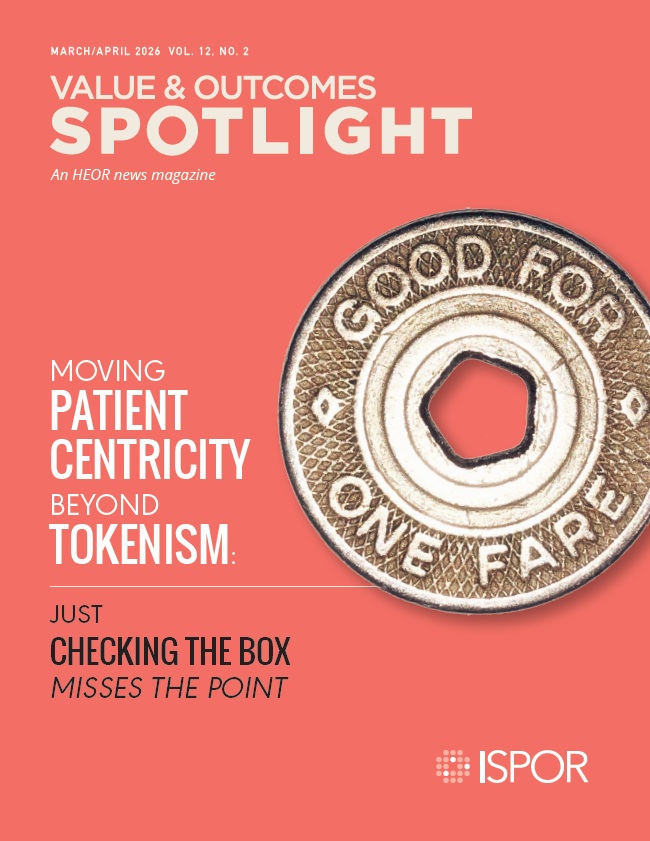
Moving From Aspirational to Operational Engagement of Patients in Healthcare Decisions
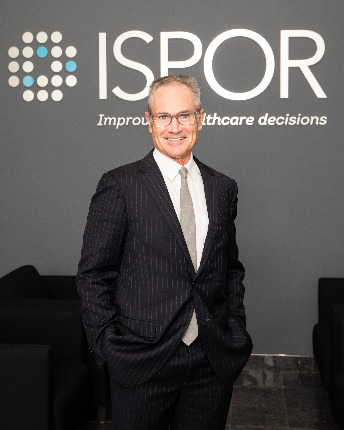
Rob Abbott, Chief Executive Officer, ISPOR
 The management scholar, Peter Drucker,
famously said, “Culture eats strategy for breakfast.” His point was that ideas
that seem obvious routinely fail because organizational culture prevents them
from happening. I’ve been thinking about this in the context of healthcare
because actively collaborating with patients as true partners seems intuitively
obvious, and yet the reality is often little more than tokenism. The “culture”
of healthcare ecosystems is eating the strategic idea of patient centricity for
breakfast. We can do better. We need to do better.
The management scholar, Peter Drucker,
famously said, “Culture eats strategy for breakfast.” His point was that ideas
that seem obvious routinely fail because organizational culture prevents them
from happening. I’ve been thinking about this in the context of healthcare
because actively collaborating with patients as true partners seems intuitively
obvious, and yet the reality is often little more than tokenism. The “culture”
of healthcare ecosystems is eating the strategic idea of patient centricity for
breakfast. We can do better. We need to do better.
This issue of Value & Outcomes Spotlight goes a long way toward answering the questions that lie at the heart of true patient centricity in healthcare. The papers collected here show how a mix of historical, structural, epistemic, and psychological factors has worked against meaningful integration of patients in healthcare decision making. Equally, they surface important ideas and use cases to demonstrate how these barriers can be overcome.
We must resist the reflexive urge to rely solely on clinical or academic “experts” and listen to what patients actually value.
Everything ISPOR does is ultimately in service of patients and their caregivers, friends, and families. Our vision of a world in which healthcare is accessible, effective, efficient, and affordable for all speaks to our desire to ensure that people across the world have access to the care they need, when they need it, at a price they can afford. How can we deliver on that vision if we marginalize the patient voice? We must resist the reflexive urge to rely solely on clinical or academic “experts” and listen to what patients actually value. Better still, we must shift the role of the patient from a passive subject to an active partner in the clinical and research process.
Happily, ISPOR has already made some important progress in this regard:
- ISPOR views patient engagement as a collaborative partnership in which patients and researchers work together across all stages of the research process. This includes identifying research questions that are meaningful to patients, rather than just focusing on clinical metrics. This is hard to implement in practice because most clinical systems are designed around throughput—short appointments, productivity metrics, and standardized pathways. Still, we passionately believe that meaningful patient engagement requires taking the time to explain options, explore patient values, and thoughtfully deliberate about tradeoffs.
- The ISPOR Roadmap for Patient Preferences provides guidance on how to conduct studies that quantify what tradeoffs patients are willing to make (eg, accepting higher medical risks for better quality of life).
- ISPOR has developed—and continues to evolve—“Good Practices Reports” for using patient-reported outcome instruments. These are tools designed to capture a patient’s health status directly from them, without interpretation by a clinician.
- ISPOR’s Patient Council is a global body that serves as a strategic advisory group to the ISPOR Board of Directors, ensuring that patient perspectives are integrated into the Society’s strategic initiatives, most notably our 2030 Strategy.
- For many years, ISPOR has convened patient roundtables in Europe, North America, Latin America, and the Asia-Pacific region to allow patient advocates to interact with other healthcare stakeholders like payers and manufacturers—and equally, to grow our own understanding of the issues that matter most to patients.
- ISPOR offers a specific membership category for patient representatives and provides travel grants to help them attend scientific conferences and share their expertise.
While the efforts mentioned above are encouraging, I would stress that healthcare systems as a whole are not yet ready to give patients a central role in value assessment. Progress is being made, and structural, methodological, and cultural barriers still limit full integration. While there are some encouraging case studies around the world, patient input too often supplements rather than drives value assessments.*
Why is that?
It is true that in some parts of the world, professional cultures still lean toward paternalism (the doctor knows best), and knowledge asymmetry makes engagement challenging and/or reduces it to consent versus collaboration. But perhaps the most important barrier is rooted in how reimbursement decisions are made. These decisions require consistent and comparable metrics and integrating qualitative patient insights into quantitative models is hard. At times it can seem like trying to fit the proverbial square peg in a round hole.
Health economic models rely heavily on measures such as quality-adjusted life years (QALYs) and standardized instruments such as EQ-5D.** While useful for comparability, these measures do not capture all aspects of the patient experience; they exclude treatment burden and social impacts; and they often simplify lived experience into a small number of domains.
Value needs to shift from clinical efficacy alone to overall quality of life and functional improvement for patients. To get there, we need to put patients at the center of our thinking and decision making and cocreate the future together.
So, how to move forward and ensure patient engagement goes beyond token participation?
We must move from symbolic inclusion or tokenism to meaningful partnership throughout the research life cycle. Tokenism is plainly evident when patients are consulted late, have little influence on decisions, or represent only a narrow patient voice. Among the steps that should be taken to make centricity a reality are:
- Identifying and engaging patients early in the research process. They should be shaping the research agenda and the questions to be answered
- Giving patients real decision-making roles
- Providing training and capacity building
- Compensating patients for their time and acknowledging their contributions in the same way we do for other “experts”
In view of ISPOR’s (and HEOR’s) focus on value, and our interest in expanding the definition of value to better reflect the things that matter most to patients, it seems only natural that we lean into all of the ways we might better integrate patients and their perspectives into health economics and outcomes research.
Traditionally, health economists have defined value based on clinical effectiveness and cost-effectiveness, as reflected in the oft-cited (and sometimes maligned) QALY. When patient experiences are incorporated into notions of value, the concept becomes broader, multidimensional, and more patient-centric. Suddenly, we lift our gaze from a singular focus on outcomes such as survival, disease progression, and clinical biomarkers to consider outcomes that matter in daily life, such as the ability to work or attend school, independence in daily activities, emotional well-being, and social participation—the simple, regular things that shape an individual’s life.
I think many of us in the health economics and outcomes research field know that value needs to shift from clinical efficacy alone to overall quality of life and functional improvement for patients. To get there, we need to put patients at the center of our thinking and decision making and cocreate the future together.
I’m proud of the work ISPOR has already done in this regard, and as your CEO, I pledge to keep pushing forward to ensure that we are genuinely moving from aspiration (“talking a good game”) to operational engagement (“walking the talk”).
* The Patient-Centered Outcomes Research Institute (PCORI) in the United States requires patient engagement in funded research, and the National Institute for Health and Care Excellence in the United Kingdom includes patient testimonies and patient organization submissions in its appraisal processes. Canada’s Drug Agency (formerly the Canadian Agency for Drugs and Technologies in Health) integrates patient input into drug reimbursement reviews.
** EQ-5D is a standardized self-report questionnaire designed by the EuroQol Group to measure health-related quality of life across 5 dimensions: mobility, self-care, usual activities, pain/discomfort, and anxiety/depression. It provides a simple, generic index for assessing patient health status and outcomes, and is routinely used in clinical trials and health economic evaluations.