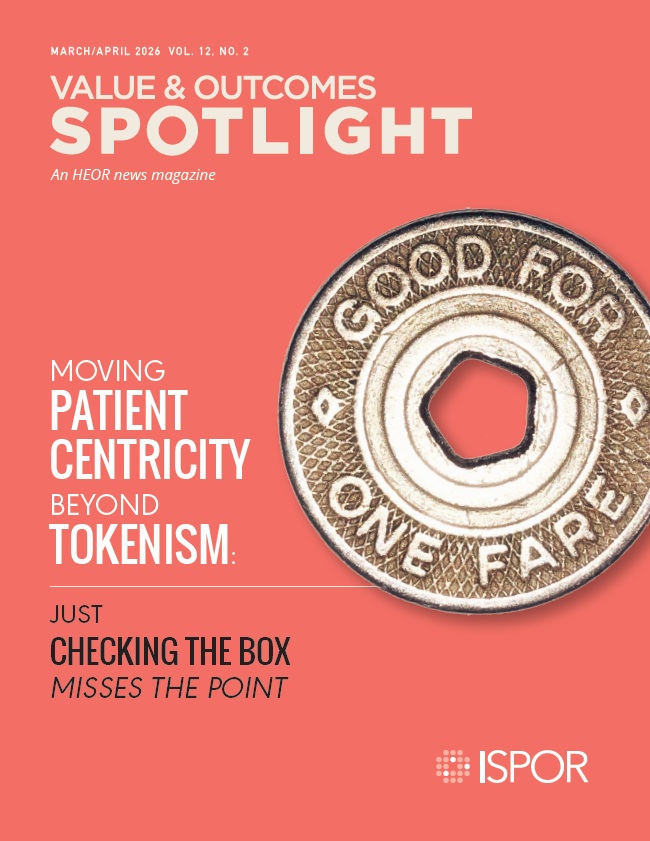
More Than Slogans: Making Patient Centricity Real in Healthcare
Zeba M. Khan, RPh, PhD, Editor-in-Chief, Value & Outcomes Spotlight
 “Patient centricity” seems to be a ubiquitous slogan in healthcare. It often appears in strategy documents, conference themes, regulatory guidance, corporate mission statements, and corporate responsibility. Yet its very popularity raises a critical question: Is patient centricity a substantive reorientation of healthcare around people’s needs and values, or is it “tokenism,” at risk of becoming an empty label attached to business as usual?
At its core, patient centricity refers to care that is respectful of and responsive to individual patient preferences, needs, and values, and decisions guided by those values. It implies a shift from a paternalistic model—in which clinicians and systems largely define problems and solutions—to a partnership model. In this view, patients are not passive recipients of services, but active participants in decisions, codesigners of services, and increasingly cocreators of research that informs clinical practice.
Patient centricity involves organizing care and research around what matters most to patients, rather than around professional convenience, historical practice, or purely clinical endpoints.
Conceptually, patient centricity involves organizing care and research around what matters most to patients, rather than around professional convenience, historical practice, or purely clinical endpoints. This includes respect for individual preferences and values, shared decision making, and a holistic consideration of physical, psychological, and social well-being. It is no longer sufficient for systems, researchers, and payers to claim that patients are “at the center”; they are increasingly required to demonstrate how patients’ preferences, experiences, and priorities shape evidence generation and decision making.
There are several pillars of this approach.
- Shared decision making is frequently described as foundational: Clinicians present options, clarify risks and benefits, and explore what matters most to the patient, aiming for a joint decision rather than unilateral prescribing.
- Patient-reported outcomes (PROs) and experiences extend this logic by systematically capturing symptoms, functional status, and perceptions of care directly from patients, and using those data to guide clinical decisions and evaluate performance.
- Codesign efforts seek to involve patients in planning care pathways, digital tools, and clinics themselves, to ensure services reflect lived realities rather than professional assumptions.
Evidence of impact is encouraging but nuanced. Studies of shared decision making and decision aids generally show improved knowledge, reduced decisional conflict, and, in some cases, better alignment between treatments and patient preferences.1 Routine collection and use of PROs have been associated with improved symptom control, higher satisfaction, and even survival benefits in some oncology settings.2 Interventions that support self-management and engagement often improve adherence to medications and lifestyle recommendations for chronic conditions.3 However, effects on healthcare utilization and costs are mixed, and benefits are highly dependent on implementation quality.
Crucially, patient centricity is not merely about individual clinician behavior; it is a property of systems and organizations. Stress is placed on the importance of governance structures that include patient voices, metrics and incentives aligned with outcomes and experiences that matter to patients, and interdisciplinary teamwork that supports continuity and coordination of care. Digital tools—patient portals, telehealth, mobile apps, and remote monitoring—are often presented as enablers, providing greater access to information, communication, and self-management resources. At the same time, they raise concerns around usability, information overload, privacy, and the risk of exacerbating the digital divide.
As multiple articles in this issue of Value & Outcomes Spotlight suggest, governance and process changes are shaping a more patient-centric environment. Regulators and health technology assessment (HTA) agencies increasingly solicit structured patient input through submissions, advisory panels, and participation in committee deliberations. Patients are also engaged earlier in the research cycle, contributing to the definition of research questions, endpoint selection, and study design. Empirical studies indicate that such engagement can alter priorities, bringing under-recognized outcomes—like daily functioning or psychological impact—into sharper focus.
Despite progress, several gaps persist. Patient engagement and data collection often underrepresent marginalized or less-connected populations, raising concerns about equity and generalizability. Standardization of best practices for PROs, preference study design, and integration into economic models continues to evolve. Moreover, institutional incentives and decision frameworks may lag methodological advances, leading to situations where patient-focused evidence is generated but has limited influence on final coverage or pricing decisions.
Patient engagement and data collection often underrepresent marginalized or less-connected populations, raising concerns about equity and generalizability.
The gap between rhetoric and reality remains a central challenge. Many healthcare organizations endorse patient centricity in principle but struggle to embed it meaningfully in practice. Time pressures, workload, and reimbursement models that favor volume over deliberation are repeatedly cited as barriers. Clinicians may feel they are already working at capacity and see shared decision making or detailed explanations as aspirational but impractical for tightly scheduled appointments. Organizational cultures that value throughput and technical performance over listening and partnership can further limit progress.
Measurement is another tension point. Policy makers and payers increasingly rely on patient experience surveys and other metrics to assess and incentivize patient-centered care. While measurement can drive attention and accountability, it also risks reducing a complex concept to checklists and scores. Overemphasis on easily measured elements (for example, satisfaction with waiting times) may crowd out less tangible yet crucial aspects such as feeling heard, respected, and involved in decisions. There is an ongoing debate over how to capture what matters to patients without oversimplifying outcome measures or encouraging superficial compliance.
Equity concerns cut across all of this. Patient-centric approaches often assume a certain level of health literacy, confidence, and digital access. Without deliberate attention to inclusion, they may preferentially benefit those who are already better positioned to navigate healthcare—educated, affluent, digitally connected—while leaving behind people with language barriers, limited literacy, unstable housing, or distrust of institutions. Similarly, patient involvement in governance and research can devolve into tokenism if only a narrow, relatively privileged subset of patients is engaged and if their input has limited influence on decisions.
Overall, indications are that patient centricity is both an ethical imperative and a technical agenda. It requires rigorous methods for capturing patient experience and preferences, transparent incorporation of these data into economic evaluations, and governance structures that give patients a meaningful role in shaping the evidence base. The field is moving from rhetoric toward implementation, but realizing the full potential of patient centricity will depend on sustained methodological innovation, inclusive engagement, and alignment of incentives across stakeholders—including patients.
The future of patient centricity will likely hinge on whether it can move from aspiration and rhetoric to grounded, equitable practice. That requires aligning payment and performance systems with patient-defined outcomes, investing in communication and health literacy, designing digital tools with and for diverse users, and sharing power with patients in governance and research. It also requires acknowledging trade-offs: authentic partnership can be time-consuming, uncomfortable, and occasionally at odds with efficiency metrics.
As a guiding principle, patient centricity retains strong intuitive and ethical appeal. The key test for health systems, professionals, and life-science organizations is whether they are prepared to redesign structures, workflows, and incentives to make it real—beyond slogans, checklists, and campaigns—especially for those patients who have historically waited longest for their voices to be heard.
As always, I welcome input from our readers. Please feel free to email me at zeba.m.khan@hotmail.com.
References
- Hoque F. Shared decision-making in patient care: advantages, barriers and potential solutions. Brown Hospital Medicine. 2024; 3(4):13-15. doi:10.56305/001c.122787
- Di Maio M, Basch E, Denis F, et al. The role of patient-reported outcome measures in the continuum of cancer clinical care: ESMO Clinical Practice Guideline. Ann Oncol. 2022;33(9):878-892. doi:10.1016/j.annonc.2022.04.007
- Allegrante JP, Wells MT, Peterson JC. Interventions to support behavioral self-management of chronic diseases. Annu Rev Public Health. 2019;40:127-146. doi:10.1146/annurev-publhealth-040218-044008