Advancement of Hepatitis C Elimination in the United States Earns Inaugural ISPOR Impact Award
Jagpreet Chhatwal, PhD, Mass General Brigham and Harvard Medical School, Boston, MA, and Rachael Fleurence, PhD, former Senior Advisor to National Institutes of Health Director and Senior Health Policy Advisor to the White House
(currently with Apodexis Strategies, LLC, Bethesda, MD)
The ISPOR Impact Award established in 2025 recognizes health economics and outcomes research (HEOR) that measurably improves health and healthcare. The inaugural award honored Jagpreet Chhatwal and Rachael Fleurence for a multiyear collaboration that translated rigorous HEOR work into national policy action aimed at eliminating hepatitis C virus in the United States. Their work provided the quantitative backbone used for initial discussions at the White House to define the national hepatitis C elimination plan, and subsequently with the US Congressional Budget Office (CBO) to determine the potential budgetary impact of the “Cure Hepatitis C Act of 2025.”
How It Started
The story behind the importance of this work and award starts in 2015, when highly effective direct-acting antivirals (DAAs) for hepatitis C arrived with cure rates near 95% but price tags of about $84,000 per treatment course. At that time, more than 3 million people were infected with HCV, the leading cause of hepatocellular carcinoma and the most common indication for liver transplantation. But despite the clear clinical benefit offered by DAAs, more than 35 state Medicaid programs severely restricted access, fearing budget blowouts. Chhatwal and colleagues published the first comprehensive cost-effectiveness and budget impact analysis, showing that DAAs were cost-effective even at premium prices, but raising tough questions about affordability and implementation at scale.1
That initial analysis did more than demonstrate good value. It framed the central policy paradox: How do we pay for cures today to avoid even greater downstream costs tomorrow? The work influenced payer–manufacturer negotiations, while also attracting broad media attention in outlets like the Wall Street Journal and Forbes. This early phase already encapsulated a core lesson of the award: HEOR has greatest impact when it explicitly addresses the decision context, not just the average cost per quality-adjusted life year.
Building Tools That Put Modeling Power in Policy Makers’ Hands
Recognizing that journal articles alone could not meet the needs of policy makers in diverse health systems, Chhatwal’s team invested in designing accessible decision-support platforms for both the United States and globally.
Decision-support tools for stakeholders democratize the use of HEOR by removing the need for in-house modeling expertise while retaining methodological rigor.
The Hep C Calculator, developed with the World Health Organization, allows users in more than 28 countries—representing roughly 70% of the global hepatitis C burden—to input their own epidemiology and cost data, then immediately see cost-effectiveness outputs for alternative strategies.2 Since its 2017 launch, it has directly supported price negotiations and treatment scale-up decisions in many middle- and low-income settings.
Next, in collaboration with the Centers for Disease Control & Prevention, the team developed The Hep C State Policy Simulator, which enables all 50 US states and the District of Columbia to model the epidemiologic and budgetary consequences of policies such as universal screening, different treatment targets, or drug price scenarios tailored to each state’s baseline burden and payer mix.
These tools democratize the use of HEOR by removing the need for in-house modeling expertise, while retaining methodological rigor. For state Medicaid programs and ministries of health, “running the model” becomes as simple as adjusting sliders, rather than commissioning a new analysis every time priorities shift. This approach also illustrates a powerful template for other disease areas to potentially build sharable, parameterized models that can be localized quickly for new stakeholders and settings.
From Feasibility Studies to the Cure Hepatitis C Act
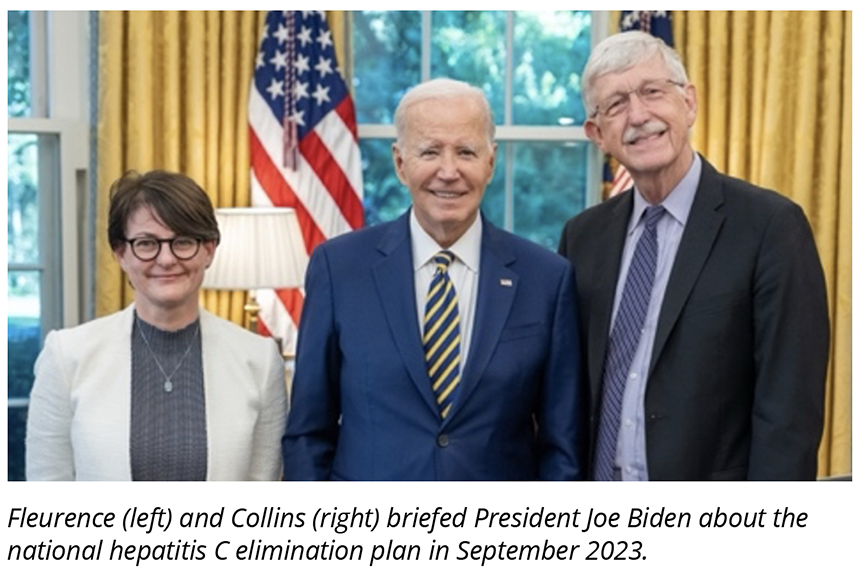
The next chapter of the story involves key contributions from Fleurence, who served as Senior Advisor to Francis Collins, MD, PhD, Director of the National Institutes of Health and Acting Science Advisor to President Joe Biden. In 2023, she coauthored a JAMA perspective with Collins titled “A National Hepatitis C Elimination Program in the United States: A Historic Opportunity,” which laid out a clear operational framework for elimination based on 3 pillars: accelerated screening, a federal subscription model for curative medicines, and widespread point-of-care diagnostics.3 This article became a touchstone in Congressional hearings and helped shape the narrative that hepatitis C elimination is both morally urgent and fiscally responsible.
By preventing downstream and related illnesses, the initiative is projected to save $17.7 billion in healthcare spending, of which $12.2 billion would accrue to the federal government.
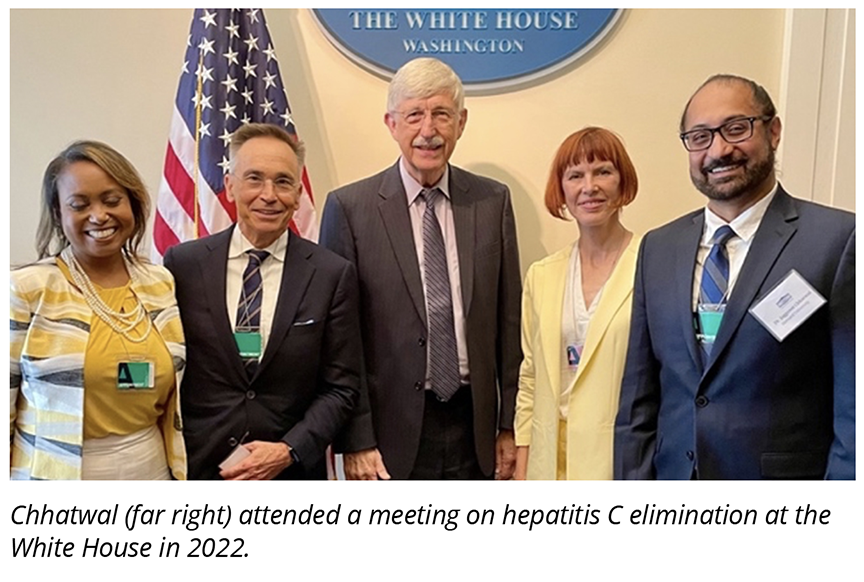
Fleurence worked with Chhatwal to adapt their models for the specific technical and political questions facing the White House and Congress, along with Josh Sharfstein, MD, and Risha Irvin, MD, from Johns Hopkins University. This partnership connected academic modeling with the realities of federal appropriations, program design, and regulatory timing.
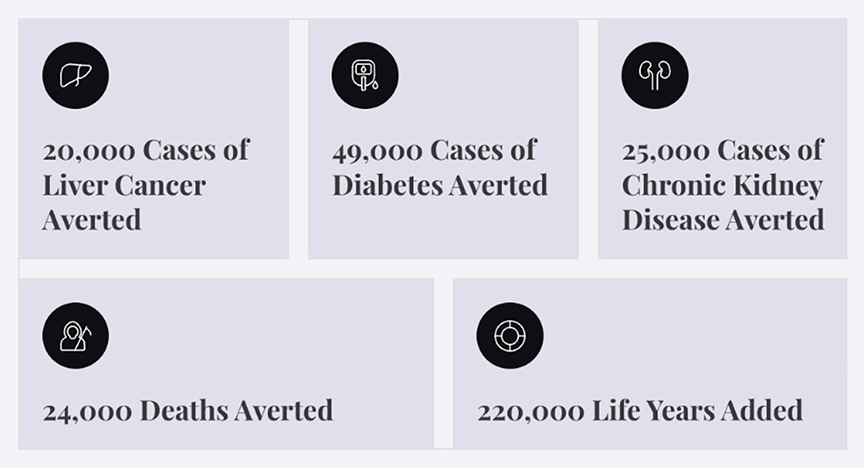
This evidence base set the stage for the centerpiece of the impact story: the Cure Hepatitis C Act of 2025, bipartisan legislation introduced by Senators Bill Cassidy, MD, (R, Louisiana) and Chris Van Hollen (D, Maryland). The CBO relied directly on Chhatwal’s National Bureau of Economic Research working paper (Projected Health Benefits and Health Care Savings from the United States National Hepatitis C Elimination Initiative4) to estimate the bill’s fiscal effects. The modeling projected that a national elimination initiative could avert 20,000 cases of liver cancer, 49,000 cases of diabetes, 25,000 cases of chronic kidney disease, and 24,000 deaths, and add 220,000 life years within 10 years. By preventing downstream and related illnesses, the initiative is projected to save $17.7 billion in healthcare spending, of which $12.2 billion would accrue to the federal government.
Figure. Compared with the status quo, the initiative is projected to avert significant disease burden and add life years within 10 years.
The CBO’s work was not just a technical exercise; it was essential for Congressional consideration of the Act. Throughout the process, Chhatwal, Sharfstein, Fleurence, and Irwin provided clarifications, scenario analyses, and technical consultation to align modeling assumptions with CBO’s requirements. In this way, HEOR moved from the margins to the center of legislative deliberation, shaping legislators’ understanding of the long-term budgetary implications of a “cure now, save later” strategy.
Combining rigorous modeling with strategic policy partnerships and user-centered tools can move evidence from journal pages to legislative text and, ultimately, to fewer preventable deaths.
This work also provided important training opportunities for students and early career researchers to contribute to research with direct policy impact. Several trainees played key roles in the development and implementation of the hepatitis C models. In particular, Alec Aaron and Huaiyang Zhong interacted directly with the CBO, while Quishi Chen, Madeline Adee, and Yueran Zhuo contributed to earlier generations of the hepatitis C models that provided the foundation for the analyses used in the policy discussions.
At the same time, Fleurence helped coordinate the National Institute for Biomedical Imaging and Bioengineering (NIBIB)’s Rapid Acceleration of Diagnostics (RADx) program’s collaboration with the US Food and Drug Administration (FDA) to address a critical bottleneck: lack of rapid, point-of-care hepatitis C RNA testing. In June 2024, FDA approved the first point-of-care hepatitis C RNA test in the United States. Here again, HEOR directly informed regulatory prioritization and underscored that access to diagnostics is as central to elimination as drug coverage.
The team’s combined efforts extended to communication with state officials, international partners, and the public, and included White House briefings, technical consultations with Medicaid directors, and frequent media engagement on the promise and challenges of hepatitis C elimination.
Lessons Learned
Hepatitis C presented a paradox familiar to many payers: a curative therapy with compelling cost-effectiveness but high upfront costs and diffuse long-term benefits. Early responses focused on restricting access to protect short-term budgets, especially in Medicaid populations, prisons, and safety-net programs. This clash between clinical possibility and budgetary constraint created a unique opening for HEOR to redefine the policy conversation.
The work conducted by Chhatwal, Fleurence, and colleagues addressed this gap on several fronts. First, rigorous cost-effectiveness and budget impact models quantified how scaling up treatment would change infection rates, complication rates, and costs over decades, not just within one budget cycle. Second, the team translated these models into practical tools—the Hep C Calculator and the Hep C State Policy Simulator—that allowed policy makers to explore their own “what if” questions without needing to commission new analyses. Finally, they deliberately embedded this work in the policy process: adapting models for CBO scoring and informing White House deliberations.
Several lessons emerge for the HEOR community. One is that timing and format matter as much as methodological elegance: By working iteratively with policy makers, we ensured that the models answered the questions on the table and used inputs that agencies could recognize and trust. Another is that scalable impact often requires products, not just publications; interactive calculators and simulators can be reused, adapted, and localized far beyond the original study setting. A third lesson is the value of sustained engagement: over a decade of modeling, communication, and partnership laid the groundwork for the rapid uptake of the Cure Hepatitis C Act. For HEOR professionals working in other disease areas, this case suggests that combining rigorous modeling with strategic policy partnerships and user-centered tools can move evidence from journal pages to legislative text and, ultimately, to fewer preventable deaths.
Implications for Key Stakeholders
- Policy makers: For legislators and government agencies, this work illustrates how rigorous modeling can inform national strategies and budget decisions. Evidence-based policy frameworks can enable large-scale public health initiatives while ensuring fiscal sustainability.
- Healthcare payers: Economic analyses demonstrating long-term savings provide payers with the evidence needed to support broader access to curative therapies.
- Public health agencies: Interactive modeling tools empower health departments to tailor elimination strategies to local conditions and resource constraints.
- Patients and advocacy groups: Expanded screening and treatment access could prevent tens of thousands of premature deaths while dramatically reducing hepatitis C disease burden.
Acknowledgements: The authors wish to thank Francis Collins, MD, PhD, former NIH Director and former Acting Science Advisor to the President; Josh Sharfstein, MD; and Risha Irvin, MD, who all played key roles in this endeavor.
References
- Chhatwal J, Kanwal F, Roberts MS, Dunn MA. Cost-effectiveness and budget impact of hepatitis C virus treatment with sofosbuvir and ledipasvir in the United States. Ann Intern Med. 2015;162(6):397-406. doi: 10.7326/M14-1336
- Chhatwal J, Chen Q, Bethea E, et al. Hep C Calculator: an online tool for cost-effectiveness analysis of DAAs. Lancet Gastroenterol Hepatol. 2018;3(12):819. https://doi.org/10.1016/S2468-1253(18)30281-4.
- Fleurence RL, Collins FS. A National Hepatitis C Elimination Program in the United States: A Historic Opportunity. JAMA 2023. DOI: 10.1001/jama.2023.3692.
- Chhatwal J, Aaron A, Zhong H, et al. Projected Health Benefits and Health Care Savings from the United States National Hepatitis C Elimination Initiative. NBER Working Paper 31139. National Bureau of Economic Research. https://www.nber.org/system/files/working_papers/w31139/w31139.pdf Published April 2023. Accessed March 17, 2026.