
When Worlds Converge: How Most-Favored-Nation Policy and International Reference Pricing Reshape Global Market Access Interdependencies
 Erika Wissinger, PhD, Cencora, Boston, MA, USA; David Ringger, PhD, Cencora, Bern, Switzerland; Casper Paardekooper, MSc, Cencora, Voorburg, The Netherlands; Diane Smith, PhD, Cencora, New York, NY, USA; Rafael de Alencar, MSc, Cencora, Munich, Germany
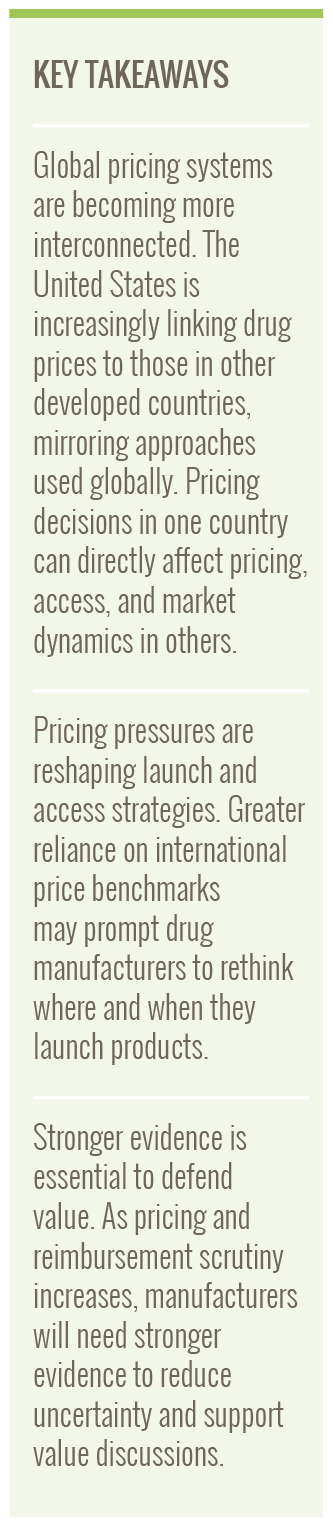 Global government drug pricing and access policies have been undergoing significant changes over the past year. While some countries in Europe have implemented reforms that shift away from international reference pricing (IRP), the United States has moved toward IRP through Most Favored Nation (MFN).
This shift in US drug pricing policy creates a convergence of pharmaceutical pricing systems that once operated in distinct spheres, which could broadly impact affordability, access, and innovation. By linking US reimbursement to ex-US price benchmarks, MFN adds complexities for manufacturers, policy makers, and healthcare systems that will need to be carefully observed and managed. Increasingly, pricing decisions in one country will influence others through reference baskets (groups of socioeconomically comparable countries), benchmarking formulas, and pricing revision cycles.1
Complex and Colliding Pricing and Access Policie
Governments across more than 75 countries have long used IRP as one policy tool to inform or regulate medicine prices, although its role varies by market and is often applied alongside other pricing and reimbursement considerations.2 These market-level differences in how IRP is applied create a complex landscape for pricing negotiations, necessitating continual adjustments and frequent updates to IRP models.
Key elements include:
• the basket size, or the number of reference countries included;
• whether referencing is applied at launch only or updated periodically;
• benchmark methodology, such as average, median, or lowest price;
• adjustment factors, such as purchasing power parity to account for differences in general cost of living across countries or exchange-rate considerations; and
• price level referenced (ex-manufacturer or wholesale price).
Countries frequently change how they structure their IRP policies, and some have sought amendments related to drug pricing. For example, an amendment to Germany’s Medical Research Act introduced optional confidential discounted reimbursement to allow companies to keep their reimbursement price negotiations with statutory insurance funds private, so they won’t affect negotiations with other countries, thereby impacting reference baskets.3 Another amendment to the Act removes IRP as a key mechanism for price negotiations. Switzerland has also pushed toward confidential price models to ensure access to innovative medicines.4,5
"Market-level differences in how international reference pricing is applied create a complex landscape for pricing negotiations, necessitating continual adjustments and frequent updates to models."
Now, with MFN, the United States is added to the mix of nations applying IRP principles. MFN was issued by President Trump as an Executive Order in May 2025 and seeks to tie US drug prices to those in similarly developed countries.6
A voluntary Centers for Medicare & Medicaid Services (CMS) model called GENEROUS (GENErating cost Reductions fOr US Medicaid) model7 adjusts Medicaid pricing based on manufacturer-reported average prices from 8 countries: the United Kingdom, France, Germany, Italy, Canada, Japan, Denmark, and Switzerland.
In December 2025, CMS announced 2 proposed mandatory IRP-style initiatives aimed at reducing costs for beneficiaries:
- The Global Benchmark for Efficient Drug Pricing (GLOBE) Model, which would assess a rebate for certain drugs payable under Medicare Part B if the prices exceed those paid in economically comparable countries.8
- The Guarding US Medicare Against Rising Drug Costs (GUARD) Model, which would assess rebates for certain drugs payable under Medicare Part D if the prices exceed those paid in economically comparable countries.9
Both of these models use a 19-country reference basket for MFN benchmarking. Both GLOBE and GUARD include 2 IRP benchmarks: a default CMS-derived international benchmark that is based on international pricing data sources, and an optional manufacturer-submitted volume-weighted average net price benchmark.10
However, there is still uncertainty as to how GUARD and GLOBE will evolve, since both are currently pilot models and cover about 25% of the Medicare Part D and Part B population. The impact of GENEROUS, meanwhile, will depend on how many states choose to participate.
MFN’s implications across the US healthcare ecosystem, particularly for products largely used outside the Medicare and Medicaid populations, remain uncertain.
Implications for Global Drug Pricing Policy
Reference pricing can influence a company’s launch sequence and price corridor for a new product. If a product faces a mandated low price in a country, the company could choose to delay launching the product in that country or even avoid that market entirely to avoid causing the price to decrease in other countries that use reference pricing. In Europe, for example, lower-income countries face delays or even no access at all because pricing is anchored to countries that can afford to pay more for the product.11
Now, in response to the deployment of MFN in the United States, some manufacturers are delaying European launches, opting not to launch, and even withdrawing existing products from markets they believe will be lower priced because of price erosion in the United States.12,13 Instead, manufacturers of some products—particularly more costly, innovative products—are opting to launch first in other markets such as Japan, which offers incentives for innovation and poses a lower risk of IRP spillover than European markets.14
Implications for HEOR, Market Access, and Commercial Teams
These dynamic developments across global healthcare environments create new and, as yet, unclear complications for different stakeholders, including health economics and outcomes research (HEOR) teams. As reference pricing increases downward pressure on prices, robust evidence becomes even more important to demonstrate product value and reduce uncertainty in pricing and reimbursement discussions.
"Greater pricing and reimbursement scrutiny will put pressure on HEOR teams to quantify incremental health benefits alongside healthcare resource-use offsets, comparator and downstream treatment cost savings, and affordability and budget impact."
In response, HEOR professionals will need to proactively adapt their strategies to mitigate the fallout from reference pricing and anticipate common evidence critiques from payers and health technology assessment bodies across markets. These critiques include inappropriate comparators, nonrepresentative populations, immature or non–clinically meaningful endpoints, limitations in indirect treatment comparisons or external controls, insufficiently reliable real-world data (RWD) sources, and uncertainty regarding long-term outcomes.
There are several key steps HEOR professionals can take to respond to this changing environment.
Build an integrated evidence-planning strategy with both access and approval in mind. The comparator strategy, patient-relevant endpoints and patient-reported outcomes, and plans for long-term follow-up will need to facilitate robust evidence generation. Where data are immature, extrapolation should be clinically anchored, transparently tested, and complemented where possible by fit-for-purpose RWD from comparable patient populations to strengthen external validity and reduce uncertainty.
Strengthen value demonstration for decision makers. Greater pricing and reimbursement scrutiny will put pressure on HEOR teams to quantify incremental health benefits alongside healthcare resource-use offsets, comparator and downstream treatment cost savings, and affordability and budget impact. Where credible, the value case should also capture broader elements such as productivity, caregiver quality of life, environmental impacts, and other societal benefits, reflecting the continued expansion of value assessment frameworks beyond traditional clinical and cost-effectiveness metrics.
Minimize uncertainty in long-term benefits by designing postlaunch evidence gathering from the outset. Where randomized controls are not feasible (for example, advanced therapy medicinal products for rare diseases), natural history studies and other external comparator approaches may be required. These must be methodologically rigorous and supported by fit-for-purpose data infrastructure. Post launch, HEOR teams can further shape long-term data collection (eg, durability extrapolation, registry strategy), and guide managed access or outcomes-based agreements by clearly defining the target population, clinically meaningful outcomes, assessment timing, data sources, governance, and the economic consequences of success or failure.
Test pricing and launch sequencing scenarios. HEOR teams should continue to assess price potential and willingness to pay for the product’s target markets through comprehensive economic modeling, particularly considering the additional complexities of launch sequencing in the MFN era. By comparing the projected commercial opportunities and associated risks of different launch sequence scenarios, HEOR professionals can inform decisions about optimal launch sequences.
Conclusion
The anticipated convergence of pricing responses to MFN has the potential to become a self-reinforcing feedback loop in which decisions in one market ripple through reference baskets and revision cycles to affect affordability, access, and incentives for innovation elsewhere.
The near-term impact of MFN remains difficult to predict. Manufacturers should be prepared to take steps to reduce payer uncertainty and defend product value.
Manufacturers and HEOR teams should also expand stakeholder engagement and prepare for more HTA-like value expectations in the United States, including expectations related to product value in terms of broader societal and caregiver impacts where relevant. The downstream effects of CMS models, adoption of confidential net pricing, and further shifts in launch timing or market-entry decisions driven by cross-country price referencing will be top of mind for all manufacturers.
Disclaimer:
The information provided in this article does not constitute legal advice. Cencora, Inc., strongly encourages readers to review available information related to the topics discussed and rely on their own experience and expertise in making decisions related thereto.
References
1. Grueger J, Martin K, Sullivan SD. Referencing drug prices of other countries may not sustainably lower prices in the United States: Lessons from Europe. Value Health. 2025;28(9):1305-1308. doi: 10.1016/j.jval.2025.06.010
2. Watt A. International Reference Pricing (IRP) 2024: A year in review. Pharmaceutical Technology. https://www.pharmaceutical-technology.com/analyst-comment/international-reference-pricing-irp-2024/ Published March 20, 2025. Accessed May 19, 2026.
3. Melck B. All change in Germany – confidential pricing in, IRP out. Pharmaceutical Technology. https://www.pharmaceutical-technology.com/analyst-comment/all-change-germany-confidential-pricing-irp/ Published January 2025. Accessed 23 April 2026.
4. Mumford A, Ringger D. Increased legal certainty surrounding medicine discounting may increase Switzerland’s attractiveness as an early launch country [ISPOR abstract HTA76]. Value Health. 2023;26(6):S2. doi: 10.1016/j.jval.2023.03.1505
5. Schott M, Brupbacher O, Batache D. Consultation opened on amendments to pharmaceutical pricing. Bär & Karrer Briefing. https://www.baerkarrer.ch/userdata/ 20260318-ld-briefing-revision-kvv-klv.pdf Published March 2026. Accessed May 19, 2026.
6. Trump DJ. The White House: Delivering Most Favored Nation Prescription Drug Pricing to American Patients [executive order]. https://www.whitehouse.gov/presidential-actions/2025/05/delivering-most-favored-nation-prescription-drug-pricing-to-american-patients/. Published May 12, 2025. Accessed 23 April 2026.
7. Centers for Medicare & Medicaid Services. GENEROUS (GENErating cost Reductions fOr U.S. Medicaid) model. https://www.cms.gov/priorities/innovation/innovation-models/generous Last modified December 23, 2025. Accessed April 23, 2026.
8. Centers for Medicare & Medicaid Services. GLOBE (Global Benchmark for Efficient Drug Pricing) model. https://www.cms.gov/priorities/innovation/innovation-models/globe Last modified December 29, 2025. Accessed April 23, 2026.
9. Centers for Medicare & Medicaid Services. GUARD (Guarding U.S. Medicare Against Rising Drug Costs) model. https://www.cms.gov/priorities/innovation/innovation-models/guard Last modified December 29, 2025. Accessed April 23, 2026.
10. Sullivan SD, Grueger J, Martin K. International reference pricing comes to America: the MFN policies explained. Value Outcomes Spotlight. 2026;12(1).
11. Maini L, Pammolli F. Reference pricing as a deterrent to entry: Evidence from the European pharmaceutical market. AEJ Micro. 2023;15(2):345-383. doi: 10.1257/mic.20210053.
12. Kleja M. US cholesterol drug withdrawn in Denmark, MFN pricing policy blamed. Euractiv. https://www.euractiv.com/news/us-cholesterol-drug-withdrawn-in-denmark-mfn-pricing-policy-blamed/ Published March 6, 2026. Accessed May 8, 2026.
13. Fick M, Satija B, Patton D. Drugmakers delay some European launches with a wary eye on Trump’s pricing policies. Reuters. https://money.usnews.com/investing/news/articles/2026-03-31/drugmakers-delay-some-european-launches-with-a-wary-eye-on-trumps-pricing-policies Published March 31, 2026. Accessed May 19, 2026.
14. Takamura K, Jinnai G, Niwa Y, Kondoh M. Overview of the Japanese Rapid Introduction Premium as a drug pricing framework to enhance patient access to innovative drugs. Health Econ Rev. 2025;16:1. doi: 10.1186/s13561-025-00705-9