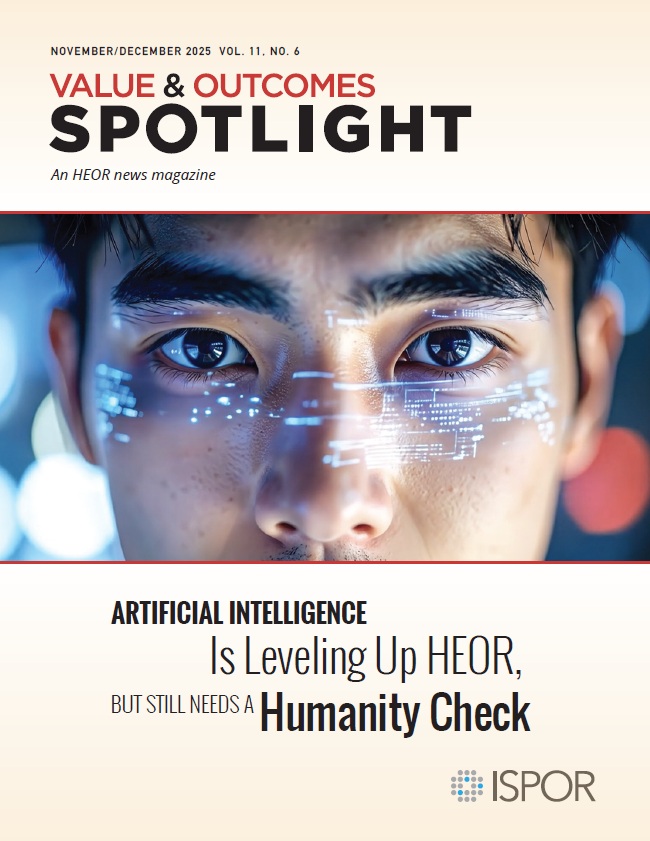
The Intelligent Frontier: Navigating AI’s Transformative Role in HEOR
 The development of artificial intelligence (AI) has progressed from an emerging concept to a vital instrument used in numerous industries, with significant impact observed within health economics and outcomes research (HEOR). Over the past 2 decades, AI has not merely streamlined HEOR workflows but has fundamentally reshaped how researchers approach data, evidence, and decision making. However, this profound promise comes hand-in-hand with significant ethical considerations and the urgent need for robust regulatory frameworks.
Initially, AI’s role in HEOR primarily involved machine learning for predictive and economic modeling. Today, the landscape is far more sophisticated, integrating generative AI, or large-language models, which can engage in text-based conversations, answer complex questions, and even draft research papers. Complementing this, agentic AI operates autonomously, gathering and analyzing data, setting goals, and learning from its experiences. These advancements are not theoretical; they are actively driving efficiency and insight.
AI can personalize interventions by tailoring treatment plans based on individual characteristics, optimize clinical trial design for greater efficiency, and even accelerate drug discovery by identifying potential candidates.
The utility of AI truly shines in evidence synthesis, a cornerstone of HEOR. Generative AI is proving invaluable for synthesizing complex literature, providing comprehensive overviews of research topics, and identifying crucial gaps in existing knowledge. AI excels at processing enormous quantities of diverse health data—from electronic health records and genomic information to real-world evidence. This allows researchers to quickly identify subtle patterns, correlations, and predictors that are often imperceptible to humans. In outcomes research, this translates to more accurate risk stratification, better prediction of treatment response, and deeper insights into disease progression and patient journeys. AI can personalize interventions by tailoring treatment plans based on individual characteristics, optimize clinical trial design for greater efficiency, and even accelerate drug discovery by identifying potential candidates. By automating data analysis and generating hypotheses, AI significantly reduces research time and costs, leading to faster evidence generation and, ultimately, improved patient care.
In particular, AI is revolutionizing next-generation sequencing (NGS) by dramatically enhancing the speed and accuracy of genomic data analysis. AI algorithms excel at processing the vast amounts of data generated by NGS, identifying subtle genetic variations, and interpreting complex genomic landscapes far more efficiently than traditional methods. This integration is profoundly impacting health outcomes by enabling faster, more precise disease diagnostics, particularly for rare diseases and cancer. It facilitates truly personalized medicine, guiding tailored treatments based on an individual’s unique genetic profile. Furthermore, AI-driven NGS accelerates drug discovery, identifies novel therapeutic targets, and improves our understanding of disease susceptibility and progression, ultimately leading to more effective interventions and improved patient care.
Despite its immense potential and impressive capabilities, AI in health outcomes research faces significant challenges. Primary concerns are data quality and inherent biases. If AI models are trained on data that reflect historical inequities or underrepresent certain populations, they can perpetuate or even amplify existing health disparities. The “black box” problem, where complex AI models lack transparency, makes it difficult to understand why a particular outcome is predicted, hindering trust and clinical adoption. Data privacy and security are paramount, given the highly sensitive nature of health information, requiring robust safeguards. Implementing AI solutions is also costly, demanding substantial investment in infrastructure, specialized expertise, and ongoing maintenance. Ethical considerations regarding accountability, informed consent, and potential unintended consequences also necessitate careful thought and robust regulatory frameworks.
The prevailing view that regulation consistently lags innovation underscores the necessity for proactive collaboration between AI leaders and policy makers regarding the technology’s use in healthcare and HEOR.
Several of these vulnerabilities highlight the essential role of including a “human-in-the-loop” element. As emphasized by Harlen Hays of Cardinal Health in our feature article, ongoing human engagement is necessary to verify accuracy, establish boundaries for autonomous agentic AI, and enforce privacy and security protocols when managing patient data. Additionally, the independence of agentic AI presents challenges in distinguishing authentic patterns from potential “hallucinations” by the system.
To address these multifaceted challenges, organizations like the World Health Organization (WHO) and ISPOR have begun publishing ethical frameworks for AI in healthcare and HEOR. These guidelines aim to provide direction for responsible AI deployment. However, the consensus from experts is that enforceable, global regulatory frameworks will ultimately be required to govern AI’s development and use. The prevailing view that regulation consistently lags innovation underscores the necessity for proactive collaboration between AI leaders and policy makers.
AI is undoubtedly a transformative force in HEOR, revolutionizing everything from NGS to evidence synthesis. Its capacity to enhance efficiency and uncover insights is unparalleled. Nevertheless, its responsible implementation depends on thoroughly resolving ethical issues and establishing comprehensive legal and regulatory frameworks. Navigating the future of AI in health outcomes research requires a balanced approach, harnessing its power while rigorously addressing its limitations and ethical implications to ensure equitable and effective advancements. The future of HEOR with AI is one of augmentation, where human expertise remains paramount.
As always, I welcome input from our readers. Please feel free to email me at zeba.m.khan@hotmail.com.
Zeba M. Khan, RPh, PhD, Editor-in-Chief, Value & Outcomes Spotlight