The Verification Era: Agentic AI and the Future of Evidence Generation in HEOR
Neil Warnock, MD, MS, MadeAi, Inc, Boston, MA, USA
Introduction
The health economics and outcomes research (HEOR) discipline has reached a paradoxical inflection point. While the global demand for robust, real-world evidence (RWE) and value demonstration has never been higher—driven by the implementation of the Inflation Reduction Act (IRA) in the United States and the Joint Clinical Assessment (JCA) in the European Union (EU)—the organizational structures supporting these efforts are being dismantled.
In the 2026 Tufts Center for the Evaluation of Value and Risk in Health HEOR Leaders Survey, nearly all of the 59 senior professionals from US-based pharmaceutical companies who were surveyed said their companies’ senior leaders believed HEOR was critical to the firm’s success and would become increasingly important in RWE-based strategic decisions. However, only 34% of the respondents (and fewer than 20% from large companies) expected the size of their team or their budget to increase as a result.
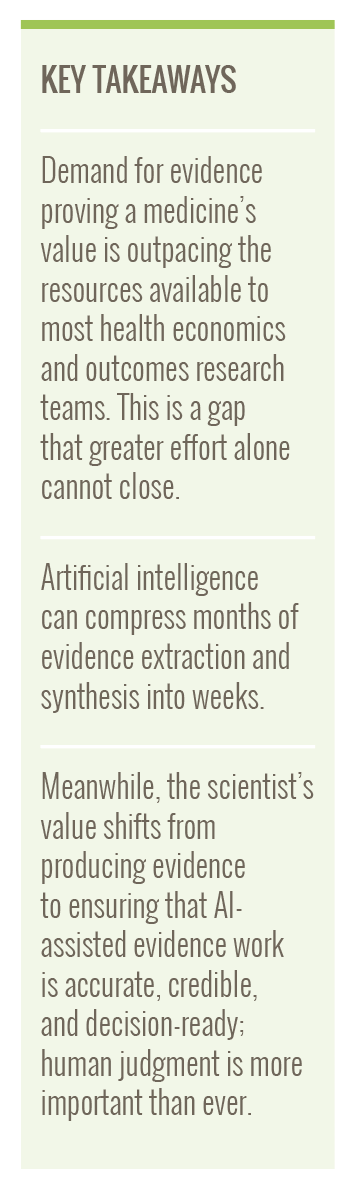
To survive this capacity problem, the field must embrace agentic artificial intelligence (AI) frameworks. In the current Verification Era, AI’s ability to generate large amounts of information increases the importance of verifying whether that information can be trusted. This transition redefines the HEOR scientist not as a manual data handler, but as a scientific governor of automated evidence pipelines.
In the Verification Era, AI is not merely an efficiency tool but a structural solution to a workforce capacity problem that has no purely human answer at current resourcing levels.
Convergence of Crisis: Why the Old Model is Failing
For decades, HEOR operated as the scientific engine of value demonstration. However, recent evidence marks a decisive inflection point: Traditional, manual workflows are no longer compatible with the pace of global market demands.
- The IRA and the QALY vacuum. The Inflation Reduction Act restricts the use of cost-per-quality-adjusted life year (QALY) and similar measures in Medicare price negotiations, creating a methodological vacuum for traditional value assessment frameworks. HEOR teams must now develop novel, product-specific value frameworks on accelerated timelines that they were not originally structured to meet. More than two thirds of HEOR leaders agree the IRA has driven a greater need for HEOR and RWE evidence generation.
- The end of sequential submissions. The EU Health Technology Assessment (HTA) Regulation’s JCA, operational for oncology since January 2025, requires a single coordinated submission across member states. Teams must simultaneously satisfy the diverse methodological standards of Germany’s IQWiG (Institute for Quality and Efficiency in Health Care), France’s Haute Autorite de Sante, and the United Kingdom’s National Institute for Health and Care Excellence (NICE). Evidence-generation plans designed around sequential national submissions are now structurally inadequate.
- The organizational paradox. Despite rising stakes, HEOR associates have been direct targets in recent restructuring cycles. Teams are being dispersed into Medical Affairs or Market Access structures, losing centralized strategic influence at the exact moment their expertise is most required.
The Solution: AI as Evidence Infrastructure
In the Verification Era, AI is not merely an efficiency tool but a structural solution to a workforce capacity problem that has no purely human answer at current resourcing levels. The focus has shifted toward agentic frameworks.
Agentic AI refers to coordinated systems of specialized AI agents that autonomously perform discrete research tasks—such as literature screening, data extraction, and evidence synthesis—under human oversight. These AI architectures have been validated for systematic literature reviews (SLRs) and RWE generation.
The role of the health economics and outcomes research professional is shifting from primary evidence producer to AI orchestrator and quality assurance architect.
Transforming SLRs
The SLR is the cornerstone of HEOR, yet it traditionally takes 4 months to 1 year or longer.
- The A4SLR framework, published in Value in Health in 2025, coordinates 7 specialized agents (search, inclusion/exclusion criteria deployment, abstract/full-text screening, text/table preprocessing, data extraction, risk of bias analysis, report) to handle the entire life cycle of an SLR.
- The framework achieves F1 screening scores of 0.917–0.977. F1 score combines precision (how often the AI’s selections are correct) and recall (how often it finds what it should) into a single 0-1 measure, with A4SLR’s scores indicating very high screening accuracy.
- Data extraction F-scores exceed 0.99.
- The process compresses the timeline from months to a 2- to 4-week window.
- Each agent produces traceable reasoning chains, providing the auditability required by HTA bodies like NICE and the European Medicines Agency.
Unlocking Unstructured Text
The importance of RWE is increasing, but extracting relevant information from health system databases is not always straightforward.
- Approximately 80% of clinically relevant outcome data reside in unstructured text, such as physician notes and pathology reports.
- Clinical large language models can convert these narratives into structured datasets, capturing side-effect burdens and quality-of-life proxies that traditional RWE pipelines miss.
- This capability represents a genuine expansion of the evidentiary universe without requiring additional study investment.
Defining the AI Orchestrator Role
The emergence of high-speed AI does not replace scientists; it elevates them. The HEOR professional’s role is shifting from primary evidence producer to AI orchestrator and quality assurance architect. For example, instead of manually building models, screening literature, and extracting evidence, the HEOR professional directs AI agents to perform these tasks at scale, then applies scientific judgment to validate the methods, outputs, and conclusions.
- Governance as a scientific competency. The primary risk of AI remains hallucination—the generation of plausible but fabricated data. HEOR experts must design the deterministic validation checks that ensure agentic extraction is accurate. A false-positive rate tolerable in early stage research is not acceptable in a final NICE submission; this judgment cannot be automated.
- Human-in-the-loop validation. The ISPOR ELEVATE-GenAI framework and Academy of Managed Care Pharmacy RWE standards emphasize that human-in-the-loop validation is a methodological requirement, not a best practice. The HEOR professional provides the irreplaceable quality assurance layer that makes AI-generated evidence credible to regulators and payers.
The Business Case: The Translation Imperative
The most existential challenge for HEOR is organizational. HEOR is no longer evaluated primarily on its ability to produce data, but on its ability to influence decisions under constraint.
- Closing the translation gap. Historically, HEOR teams have been poor at translating scientific output into the business case language that C-suite leaders use for resource decisions.
My own experience bears this out. Running an 8-member field team, I found our models were rarely the problem. The gap was between a defensible analysis and an argument an access lead could carry into a resource meeting.
AI changes this dynamic by allowing teams to generate executive-facing summaries that translate complex cost-effectiveness analyses into budget impact and revenue protection narratives.
- Demonstrating value. The reported efficiency gains are substantial. A time and motion analysis of HTA-standard SLRs found hybrid AI screening was 51.4% more efficient than manual methods, fully automated screening was 81.1% more efficient, and AI-assisted extraction was 93.1% more efficient for AI-assisted data extraction. An earlier case study completed a full systematic review in 2 weeks using automation tools (with experienced human reviewers in the loop at every decision point) versus a typical timeline of approximately 1 year.
Compression of this order can advance market access decisions by 1 or more review cycles—a concrete and communicable return on investment in AI-enabled evidence infrastructure.
The larger return is upstream in the development process. Evidence synthesis that takes a year is late by default—commissioned after the value story is set, defending decisions instead of shaping them. With a time frame of 2 weeks, evidence synthesis can start early and run continuously: competitor assumptions can be tested while trial design is still open and evidence gaps flagged while there is time to close them. Most of the evidence problems I have dealt with involved analysis that arrived too late to change anything.
Implications for HEOR Practice
The transition to AI-enabled evidence generation requires structural adjustments within HEOR organizations.
- Redefining the HEOR skill set. HEOR professionals will increasingly need competencies in AI governance, validation workflows, and computational research design in addition to traditional health economic modeling and epidemiology.
- Integrating AI into evidence-generation pipelines. Rather than treating AI tools as isolated productivity applications, organizations should integrate agentic AI systems directly into systematic literature review, evidence synthesis, and real-world data pipelines.
- Establishing methodological governance frameworks. Human-in-the-loop validation processes must be formally defined, including audit checkpoints for AI-assisted literature screening, data extraction, and outcome classification.
- Strengthening HEOR’s strategic role. AI-enabled efficiency allows HEOR teams to shift focus from manual evidence generation toward earlier strategic engagement in clinical development, pricing strategy, and payer evidence planning.
- Building the training pipeline. These competencies are not yet taught systematically, and most current practitioners will acquire them mid-career. Professional societies and employers will need to establish structured curricula and credentialing in areas such as AI validation and governance, rather than relying on self-directed learning.
Conclusion
HEOR functions are operating in an environment that demands more evidence, earlier, and at higher methodological standards—demands that are outpacing available resources. AI, deployed through validated agentic frameworks and governed by the methodological expertise of HEOR professionals, offers the only credible path forward. The Verification Era does not diminish the scientist; it redefines the role around the use of rigorous scientific judgment to govern AI-generated evidence.
The transition is not without risk. Reported screening gains come with low precision, and sufficiency measured without verification will be overstated.
The remedy is largely specified already: Canada’s Drug Agency and NICE require that AI use be declared, justified, and validated, the capable, informed human in the loop.
Teams that build in these controls from the outset will not have to retrofit them under submission pressures.