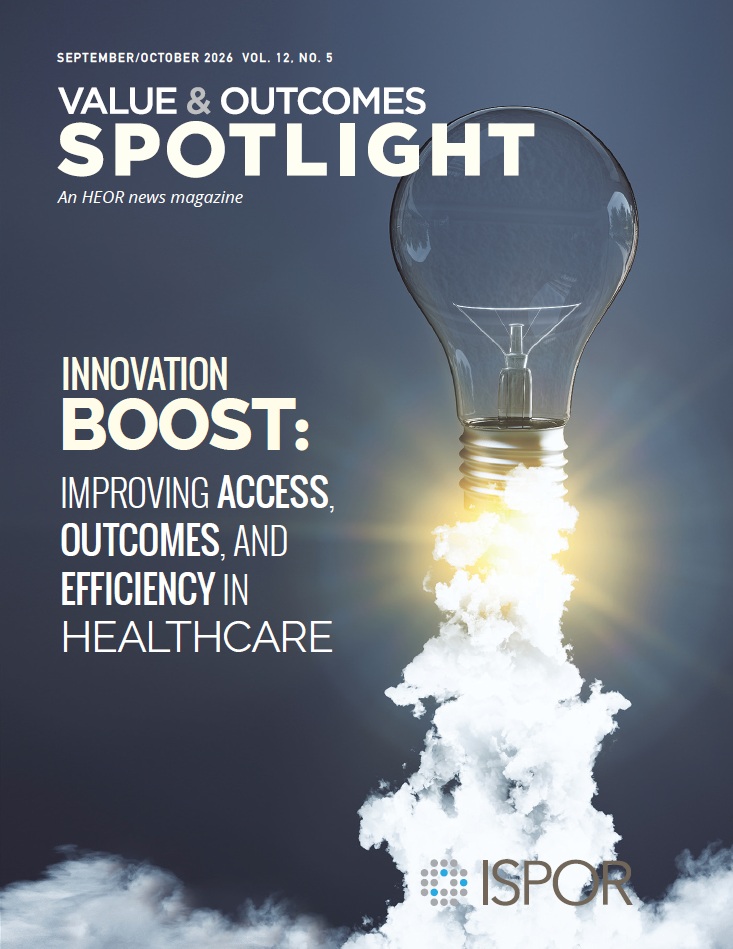
Stepping Onto the Frontier: Thoughts on the Importance of Innovation to the Future of HEOR
Rob Abbott, Chief Executive Officer, ISPOR
 What is innovation and why does it matter? There is perhaps no more vexing—or important—question in building a successful business or organization. The more specific question of how innovation applies to health economics and outcomes research (HEOR) is the focus of this issue of Value & Outcomes Spotlight—and one that has been an important part of my own HEOR journey.
When I interviewed for the CEO position at ISPOR, I told the hiring committee that the ceiling for our field was much higher than anyone had dared to imagine, but it would take innovative thinking—and application—to realize our full potential and truly transform healthcare decision making. It was time to embrace new technologies, data sources, and analytical frameworks to measure, prove, and communicate the clinical and economic value of medical interventions. For HEOR to adequately assess therapeutic innovations, such as one-time cell and gene therapies and faster drug-development cycles, we would need to revisit our historical reliance on clinical trial data and basic cost-effectiveness models and implement innovations of our own.
Often confused with invention (the creation of a new concept or device), innovation centers on how that new idea can be put into action to create value for customers and other stakeholders and/or to solve a specific problem. Common types of innovation include a new product or service offering that conveys more benefit to users, or improvements to internal workflows that save time and money. What is common across these innovations is a shared focus on streamlining operations, cutting costs, adapting to market changes, or gaining a competitive advantage. At its core, innovation draws together novelty and value as well as strategic growth to achieve something new: a step change in performance.
The ISPOR vision of a world in which healthcare is accessible, effective, efficient, and affordable for all demands nothing less than our complete investment in a true innovation agenda.
As the articles in this issue of Value & Outcomes Spotlight make clear, the metaphorical revolution is well underway in HEOR. Generative AI, natural language processing, and AI agents are increasingly being used to speed up literature reviews, automate economic modeling, prepare draft reports, and translate natural language into code. At the same time, the acceleration and maturation of real-world data and real-world evidence (RWE) have enabled HEOR to move beyond sole reliance on clinical trials to tap large, federated datasets such as Darwin EU and Sentinel to consider how medical interventions perform in everyday settings across diverse populations. We are also seeing that HEOR professionals have been quick to adapt traditional cost metrics to account for the unique, long-term benefits of rare disease and curative treatments, including societal impacts, health equity, and patient preferences.
Still, we are closer to the beginning of this “next phase” of HEOR than the finish, and there is still much to do. Insights like those in the papers collected here can guide us as we step a little deeper into the frontier of our profession.
I feel a real sense of urgency about the need to accelerate our collective innovation capacity because traditional value assessment frameworks are breaking down under the weight of a modernized healthcare paradigm. HEOR is facing unprecedented market pressures, including the arrival of curative but high-cost gene therapies, accelerated regulatory approvals based on surrogate endpoints, and a growing demand for RWE. If we rely on static, legacy models and frameworks, we risk becoming an administrative bottleneck rather than a strategic enabler of patient access and sustainable healthcare delivery. The ISPOR vision of a world in which healthcare is accessible, effective, efficient, and affordable for all demands nothing less than our complete investment in a true innovation agenda.
With the above in mind, it seems to me that innovation in HEOR must be expressed across 4 pillars: (1) methodological and analytical innovation, (2) technological and AI innovation, (3) data ecosystem innovation, and (4) commercial and policy innovation. Let me briefly discuss each of these in turn.
1. Methodological and Analytical Innovation
Traditional metrics, like the quality-adjusted life year, are increasingly viewed as too rigid or potentially discriminatory to capture the nuanced realities of modern medicine.
It therefore makes sense to me that alternative metrics—such as Equal Value of Life Years Gained or the Generalized Risk Adjusted Cost-Effectiveness—would be advanced to better quantify the value of complex interventions. And I would hope that additional new ideas will be forthcoming. Deploying advanced statistical tools such as mixture-cure models to accurately evaluate one-time, curative therapies that feature high upfront costs but delayed, lifetime patient benefits are also illustrative of the methodological and analytical innovation we need. So too with distributional cost-effectiveness analysis. While it may not be perfect, its attempt to incorporate health equity into the mathematical architecture of economic evaluations to see how resource allocation impacts underserved demographics is an important step forward.
2. Technological and AI Innovation
The sheer volume, speed, and fragmentation of modern medical data mean that human-only analysis is becoming a structural limitation. Using AI to automate the “fast science” components of HEOR—such as accelerating systematic literature reviews, structuring draft economic models, and auto-generating value narratives—is no longer a novel luxury but a day-to-day imperative. The same is true for the use of machine learning to construct high-fidelity synthetic patient cohorts. This enables researchers to simulate clinical scenarios and project outcomes without running afoul of privacy hurdles or data-scarcity issues.
3. Data Ecosystem Innovation
Evaluating long-term therapeutic value requires moving away from tightly controlled, localized data silos toward fluid, interconnected networks. This is why accelerating the adoption of decentralized data marketplaces (again, Darwin EU and Sentinel come to mind) is so important. It allows HEOR researchers to run analyses across massive, global real-world datasets without moving sensitive patient information out of its home jurisdiction. Of course, to achieve true data ecosystem innovation, we must address interoperability barriers by standardizing parameters that seamlessly link these diverse datasets.
4. Commercial and Policy Innovation
Over the past year, the most common question I’ve been asked as ISPOR CEO is why I’m placing such emphasis on policy innovation and impact (I can also add commercial innovation and impact here). My typical response is that it’s hard to improve healthcare decision making if you’re not intentional about engaging with the decision makers. The somewhat more nuanced response is this: proving value is only half the battle; HEOR must innovate to show how value translates into market dynamics and patient access.
This new approach opens up several exciting avenues for dialogue and research within our field, including:
- The design of risk-sharing reimbursement frameworks where a drug’s ultimate price or payout is structurally tethered to how well patients perform on objective, real-world metrics.
- The expansion of traditional value definitions to integrate socioeconomic factors such as “value of hope,” “insurance value,” and reduction of caregiver burden.
- Synchronizing early stage clinical pipeline modeling with external investment risk-return parameters to ensure that viable, cost-effective innovations receive the funding they need to make it to market. This was a topic at ISPOR’s recent Healthcare Investment Summit—a first of its kind for the Society, but by no means the last.
The great Austrian-American economist, Joseph Schumpeter, introduced the concept of “creative destruction” in his 1942 book, Capitalism, Socialism and Democracy. He made a convincing argument as to how new innovations, technologies, and businesses constantly replace and render obsolete older industries and economic structures. In particular, he noted that any business that wasn’t engaged in a true “innovation agenda” would be swept from the market by the “winds of creative destruction.”
However grandiloquent that may sound to modern ears, I agree with Schumpeter. ISPOR members and our stakeholders can therefore count on me to champion work that helps to ensure we are continually stepping onto the HEOR frontier and, as our mission would have it, advancing novel innovations that have the potential to genuinely transform healthcare decision making.