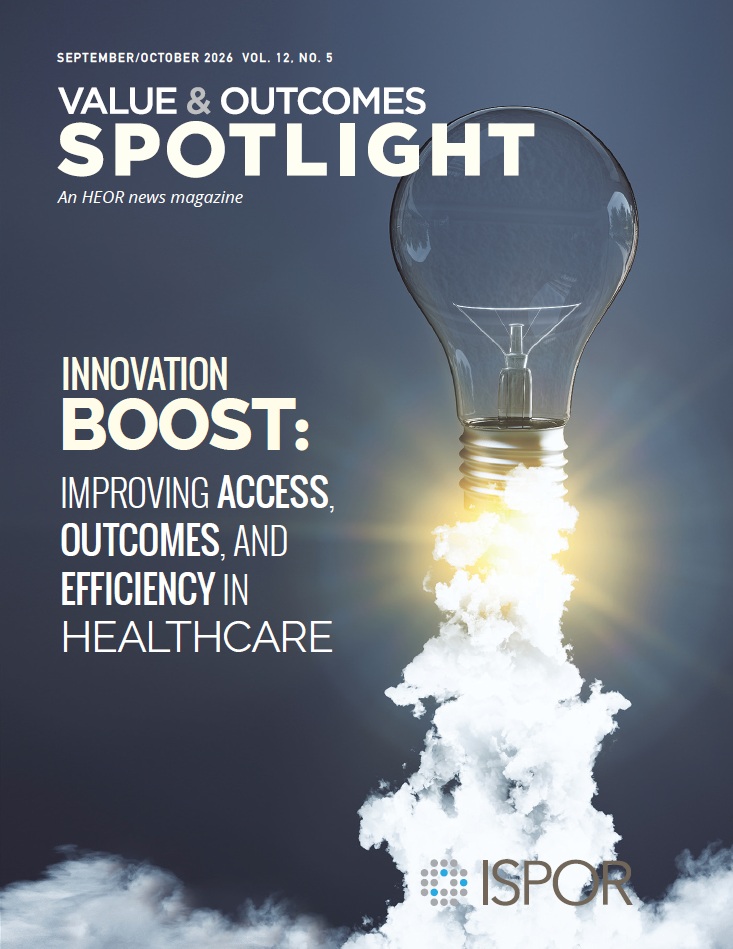
Revealing the True Value of Healthcare Innovation
Zeba M. Khan, RPh, PhD, Editor-in-Chief, Value & Outcomes Spotlight
 Innovation in healthcare is transforming the way we diagnose, treat, and prevent disease, driving better outcomes and improving quality of life. Advances in technology, from artificial intelligence (AI) to wearable devices, are enabling more personalized care and faster decision making. Meanwhile, new approaches to research, patient engagement, and care delivery are breaking down traditional barriers, making healthcare more efficient, accessible, and proactive than ever before.
The question for providers, payers, patients, manufacturers, and health economics and outcomes research (HEOR) professionals is no longer whether innovation is arriving, but how we recognize its full value.
Ultimately, healthcare innovation should serve a single, clear purpose. That purpose is not to deliver new gadgets or clever software, but to achieve better patient outcomes and more efficient health systems. The true measure of success in healthcare will never be the sophistication of a technology; it will be the quality of the care that technology delivers. That’s why it’s imperative for HEOR professionals to ensure we have the tools and the skills to document those successes.
Too often, a new drug, device, or digital tool is judged by its acquisition cost and its trial endpoints. Yet the improvements that benefit both health systems and patients—such as fewer admissions, shorter stays, and less clinician burden—rarely appear in a pivotal trial or on a single budget line. Capturing those system-level gains is where HEOR and real-world evidence (RWE) can make a difference.
It Starts With AI
The rampant proliferation of AI in healthcare exemplifies this challenge in action, because its promise is large and its evidence base is still taking shape. From imaging triage to ambient clinical documentation, AI tools are being deployed to speed diagnosis and return time to clinicians. A growing body of economic evaluations is mapping where AI creates value, and the infrastructure for judging that value is maturing as well. In the United Kingdom, the National Institute for Health and Care Excellence (NICE) has set a clear expectation that AI methods be used where they demonstrably add value and are transparently reported. ISPOR working groups have produced a roadmap for generative AI in health technology assessment, along with the ELEVATE-GenAI reporting checklist for large language models in HEOR. ICER and the Peterson Health Technology Institute have begun adapting value frameworks for digital health. Together, these standards and frameworks aim to provide a foundation for adopting AI with confidence.
Healthcare innovation should serve a single, clear purpose. That purpose is not to deliver new gadgets or clever software, but to achieve better patient outcomes and more efficient health systems.
Electronic health records (EHRs) make evidence gathering more achievable. When EHRs are integrated with other digital platforms, they capture utilization, outcomes, and workflow at scale. This data capture lets us evaluate innovations being used in routine practice rather than only in the controlled conditions of a trial. To ease the burden of EHR documentation, ambient AI scribes listen to patient-clinician conversations and draft structured notes for clinicians to review and finalize in the EHR. They have quickly become the most widely adopted generative AI tool in healthcare, with studies reporting roughly 20% to 40% reductions in documentation burden and burnout. Early evidence also shows modest gains in physician productivity without more claim denials, but the overall return on investment remains uncertain. HEOR and RWE can help health systems determine whether faster, more complete documentation delivers real efficiency and savings.
Value-Based Care
Value-based care offers another example of how RWE can help capture an innovation’s full value, as it requires health systems to pay for the outcomes that matter rather than the volume of services delivered. The Netherlands has long used bundled payments for chronic conditions such as diabetes, which have been associated with improved care coordination. Singapore’s Healthier SG initiative enrolls residents with a family physician to emphasize prevention and continuity. In the United States, integrated systems like Kaiser Permanente carry both insurance and delivery risk, giving them a strong incentive to keep people well, and Kaiser’s nonprofit Risant Health is now extending its value-based care expertise to community-based systems such as Geisinger.
As highlighted in our feature article, Brazil’s federally funded, municipally run Sistema Único de Saúde (SUS) delivers free preventive and primary care through local multidisciplinary teams, extending care beyond urban hospitals to underserved populations. It is credited with gains in infant mortality, maternal health, vaccine uptake, chronic-condition hospitalizations, and life expectancy, and new policy now makes primary care the hub for integrating services. In Chile, the Universidad de Valparaíso’s SISTAM program uses AI and other low-cost digital tools to help about 100 public primary-care centers reconnect with patients lost to follow-up. It flags areas with frequent missed appointments, sends personalized phone reminders, and prompts teams to address barriers such as transportation and distance.
Hospital-at-home is an innovation that is associated with cost savings, lower risk of hospital-acquired infections, faster recovery, and better outcomes.
In each setting, HEOR defines what “value” means—total cost of care, quality, or patient-reported outcomes—and uses RWE to track whether health systems’ performance on those measures improves in routine practice.
Strategic Shifts
Another type of innovation reshapes care delivery by changing where care is provided and who provides it. Hospital-at-home is an example that allows patients to receive acute-level care in their homes rather than in a hospital, leading to cost savings, lower risk of hospital-acquired infections, faster recovery, and better outcomes. A 2024 Cochrane Review found moderate-certainty evidence that hospital-at-home reduces costs, even as the Centers for Medicare and Medicaid Services report to Congress found inconclusive evidence of cost savings. A May 2026 JAMA Network Open study of nearly 16,000 Medicare patients reported striking mortality differences favoring those receiving hospital-at-home care.
Targeted outreach to high-need patients by community health workers has helped improve cost-effectiveness. Task shifting to nurses, pharmacists, and other professionals has improved blood pressure, HbA1c, and mental health outcomes. The next step is to use rigorous RWE and full cost accounting to test whether these early findings hold across broader populations and settings and to sharpen estimates of their true costs and benefits. Given that few economic evaluations to date have looked at task shifting, there is a clear opportunity for HEOR to fill this evidence gap.
The promise of innovation is undeniable: treatment that is faster, more predictive, and more personalized than ever before. Yet promise alone heals no one.
Whether an innovation succeeds also depends on who is evaluating it, because different health systems value innovation differently. A commercial insurer such as Blue Cross may focus on budget impact and member retention. The Veterans Administration, as an integrated payer and provider, can capture downstream savings. The National Health Service, through NICE, weighs cost per quality-adjusted life year against an explicit threshold. An innovation that demonstrably improves system efficiency—for example, by freeing bed days or clinician hours while also improving patient health outcomes—speaks to all 3 approaches and strengthens the case for reimbursement and adoption.
Obstacles Ahead
Of course, realizing healthcare innovation’s potential means confronting some real obstacles. These include fragmented data, uneven interoperability, short budget horizons that miss long-term returns, and evidence standards that have not kept pace with the technology. Addressing them requires investment in interoperable data infrastructure, agreement on system-level outcome measures, and evaluation plans built into implementation from day one rather than added afterward.
The question is no longer whether health systems can afford to invest in innovation, but whether they can afford not to. The promise is undeniable: treatment that is faster, more predictive, and more personalized than ever before. Yet promise alone heals no one.
By pairing forward-looking tools with deliberate process improvements and by keeping the front lines of care firmly in view, HEOR can help healthcare leaders build systems that are resilient, sustainable, and truly driven by value.
As always, I welcome input from our readers. Please feel free to email me at zeba.m.khan@hotmail.com.
Zeba M. Khan, RPh, PhD
Editor-in-Chief, Value & Outcomes Spotlight