
Updated, Policy-Responsive HEOR Guidelines for India Announced at ISPOR 2026
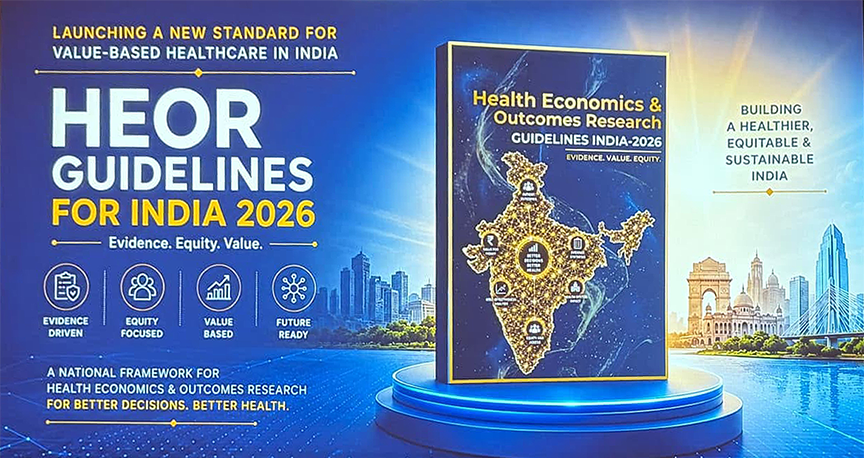 A defining moment for India’s healthcare innovation and evidence-informed policy ecosystem occurred at the 2026 ISPOR Annual Meeting in Philadelphia with the launch of the updated Health Economics and Outcomes Research (HEOR) Guidelines for India – 2026, formally announced by ISPOR CEO Rob Abbott.
India’s healthcare system stands at a defining crossroads, where scientific ambition, fiscal prudence, and equitable access must converge with unprecedented precision. As healthcare financing expands, disease burdens evolve, and policy decisions increasingly demand measurable value, the need for a robust, context-sensitive HEOR framework has never been more urgent.
Within this transformative national moment, the 2026 HEOR Guidelines for India are not merely an update to the 2016 Pharmacoeconomics & Outcomes Research Guidelines. The new guidelines represent a strategic recalibration of how India evaluates health technologies, allocates resources, and institutionalizes evidence-informed decision making.
Keeping Pace With Policy Shifts
The 2016 guidelines were foundational. They established India’s first structured framework for pharmacoeconomic evaluation and introduced methodological discipline into an emerging field. However, over the past decade, India’s healthcare architecture has evolved dramatically.
Today’s policy environment demands more than isolated cost-effectiveness analyses. It requires integrated frameworks capable of evaluating pharmaceuticals, diagnostics, devices, digital interventions, and service delivery models across increasingly complex healthcare realities.
The 2026 revision was therefore driven by a singular imperative: to modernize India’s HEOR standards in line with contemporary health system needs while preserving contextual relevance.
These updated guidelines address critical methodological gaps, including:
- expanded scope from pharmacoeconomics to full-spectrum HEOR
- greater emphasis on policy translation and implementation relevance
- standardized methodological rigor aligned with global best practices
- enhanced applicability for resource-constrained and heterogeneous systems
- stronger integration of outcomes research, affordability, and value-based healthcare principles
In essence, this revision reflects India’s transition from adopting economic evaluation to architecting it as a national policy instrument.
Closing Gaps for Informed Decisions
India’s healthcare ecosystem is uniquely complex, marked by epidemiological diversity, variable healthcare access, state-level heterogeneity, and competing resource priorities.
Historically, decision makers often faced 3 major challenges:
- Fragmented methodological standards: Different institutions and stakeholders used inconsistent approaches, limiting comparability and policy utility.
- Limited contextual adaptation: Global HEOR frameworks often lacked applicability to India’s socioeconomic realities, local cost structures, and implementation pathways.
- Translation gap between evidence and policy: Research frequently remained academic rather than actionable.
The 2026 guidelines directly address these challenges by creating a nationally harmonized framework that is scientifically rigorous, operationally practical, and policy-responsive. They reflect India’s progression from fragmented economic evaluation toward a mature, globally aligned HEOR ecosystem.
Leadership and Teamwork
This initiative exemplifies the power of collaborative scientific institution building.
The Kalam Institute of Health Technology (KIHT) served not merely as a coordinating body, but as the principal architect of the initiative, leveraging its position as a World Health Organization Collaborating Center for Health Innovation and a national health technology policy institute to convene an extraordinary coalition of domestic and international expertise.
This achievement was led by KIHT, under the strategic leadership of Jitendra Kumar Sharma, Executive Director, and the
operational stewardship of Kavita Kachroo, Scientist F and Chief Operating Officer, and a dedicated team of scientists.
Through structured consultations with ISPOR global leadership, methodological advisors from leading academic institutions, health technology assessment (HTA) experts, and ISPOR India regional chapters, the guideline development process was both nationally grounded and globally benchmarked.
This collaboration achieved something particularly rare: a framework that is internationally credible without being contextually detached.
ISPOR’s engagement strengthened methodological alignment with global standards, while India’s regional chapters ensured practical feasibility across diverse implementation landscapes. KIHT’s leadership unified these perspectives into a coherent national blueprint.
Guidelines’ Impact Beyond India
For low- and middle-income countries (LMICs), one of the greatest barriers to HEOR adoption is the absence of frameworks that reconcile scientific sophistication with system realities. India’s 2026 guidelines may serve as an important reference model for countries seeking to institutionalize value-based healthcare without relying on frameworks designed exclusively for high-income settings.
By embedding methodological rigor within pragmatic policy architecture, India offers a replicable paradigm: global standards, locally operationalized.
For India itself, these guidelines are poised to:
- strengthen HTA-informed policy decisions
- improve prioritization of health investments
- advance transparency in economic evaluation
- support sustainable healthcare financing
- build national HEOR capacity across academia, government, and industry
India is now positioned to advance from being primarily a consumer of global HEOR standards to also contributing to the evolution of those standards.
From Publication to Implementation
Formal publication of the 2026 HEOR guidelines is in progress. But publication is only the beginning. The true success of the 2026 HEOR guidelines will be defined by adoption, institutionalization, and capacity building. KIHT envisions this being facilitated by implementation science, training ecosystems, stakeholder integration, and methodological stewardship.
Key next steps include:
- national dissemination across policy makers, researchers, and industry
- capacity-building initiatives through ISPOR chapters and academic networks
- integration into HTA and evidence-generation pathways
- ongoing refinement based on emerging technologies and policy demands
This is not a static document—it is a living strategic framework designed to evolve alongside India’s healthcare transformation.
A National Milestone With Global Resonance
The 2026 HEOR guidelines signal more than methodological advancement; they reflect India’s growing confidence in shaping its own evidence architecture. At its core, this work underscores a powerful principle: Healthcare value must be measured not only by innovation, but by informed, equitable, and sustainable impact.
India has taken a decisive step toward institutionalizing that principle—creating a framework capable of informing national priorities today while inspiring broader global health systems tomorrow.