
Revolutionizing HEOR and Patient-Facing Digital Health: Targeted Tools for Defining, Conceptualizing, and Reporting the Evidence
Carl Asche, PhD, University of Utah, Salt Lake City, UT, USA; Zsombor Zrubka, MD, PhD, Óbuda University, Budapest, Hungary; Annette Champion, MBA, Healthcare Research Insights, Inc, Lake Forest, IL, USA; Rossella Di Bidino PhD, Fondazione Policlinico Universitario Agostino Gemelli IRCCS and The Graduate School of Health Economics and Management, Rome, Italy; Nachiket Gudi, MPH, Independent Researcher, Bangalore, India; Anita Burrell MA, MBA, Anita Burrell Consulting LLC, Flemington, NJ, USA; on behalf of the ISPOR Digital Health Special Interest Group.
Background
For many of us, the realm of patient-facing digital health interventions (DHIs) is a bewildering array of different technologies—including virtual reality, digital therapeutics, wearables, remote monitoring, and software as a service—that can be overwhelming to approach. This is also a complex area for health economics and outcomes research (HEOR) professionals seeking evidence to inform and guide healthcare-related decision making, whether in clinical, delivery system, financing, or development decision contexts. Determining how to systematically evaluate these interventions in all their different forms and report the results can be daunting. The Consolidated Health Economic Evaluation Reporting Standards (CHEERS) statement1 for comparative economic evaluations did not specifically address DHIs in its 2022 update, but several guidelines2,3 were developed to standardize the methodological and reporting quality of DHIs.
To support consistent definition and evaluation, the article noted, DHIs need their own structured frameworks rather than those used for evaluating drugs and devices.
While results from individual DHI studies are hardly generalizable, identifying comparable interventions for economic evaluations or pooled analysis presents a further challenge. Systematic reviews of patient-facing digital health interventions often end up with a range of modalities and applications that is too heterogenous to support meaningful recommendations—which can negatively affect the funding and dissemination of these cutting-edge tools.
In the March-April 2024 issue of Value & Outcomes Spotlight, the cover story on defining digital health for HEOR4 underscored the importance of conceptual clarity in this space and highlighted ongoing challenges related to terminology, classification, and comparability across digital health interventions. To support consistent definition and evaluation, the article noted, DHIs need their own structured frameworks rather than those used for evaluating drugs and devices.
In parallel with ongoing methodological advancements, efforts to standardize economic evaluation and reporting for DHIs continue to evolve rapidly. Notably, the increasing use of artificial intelligence (AI) and large language models (LLMs) to enable literature searches and inform the evidence base for economic research highlights the need for tools that meet rigorous standards and provide decision-relevant evidence for HEOR researchers.
Our goals were multifaceted:
(1) To develop a patient-facing DHI definition framework for HEOR purposes that
- Allows the identification of comparable DHIs with similar intended effects and
- Is specific and detailed enough to enable assessment of the appropriateness of patient-facing DHIs in specific decision contexts
(2) To compare the resulting DHI definition framework with other established DHI frameworks and guidelines to determine:
- The degree of overlap in definition items
- The additional value of the new framework and
- How they might be used together
(3) Design, test, and refine guidance on prompts that could be used for LLMs to improve the speed and quality of evidence synthesis, thereby bridging human experience and AI-assisted reasoning
(4) Develop tailored guidance for reporting the results of economic evaluations of DHIs, addressing their unique complexities through the development of a new CHEERS-DHI extension that incorporates elements of the DHI definition framework
Research Results
The ISPOR Digital Health Special Interest Group (SIG) team conducted a systematic scoping review of patient-facing DHI definitions occurring in systematic reviews of digital health and mapped these against established research frameworks such as PICOTS (population, intervention, comparator, outcomes, timing and setting),5 Shannon-Weaver Model of Communication6 (sender, message, encoder, channel/medium, decoder, received and information exchange/transmission pattern), and several others.
Following a Delphi Study of a geographically and professionally diverse group of SIG members, a minimum set was defined, and the final framework was given the acronym PICOTS-ComTeC, where “Com” stands for communication, “Te” for technology, and “C” for context (see Table). It was endorsed by the EQUATOR network and has been cited multiple times since being published in Value in Health.7
Table. The PICOTS-ComTeC Framework
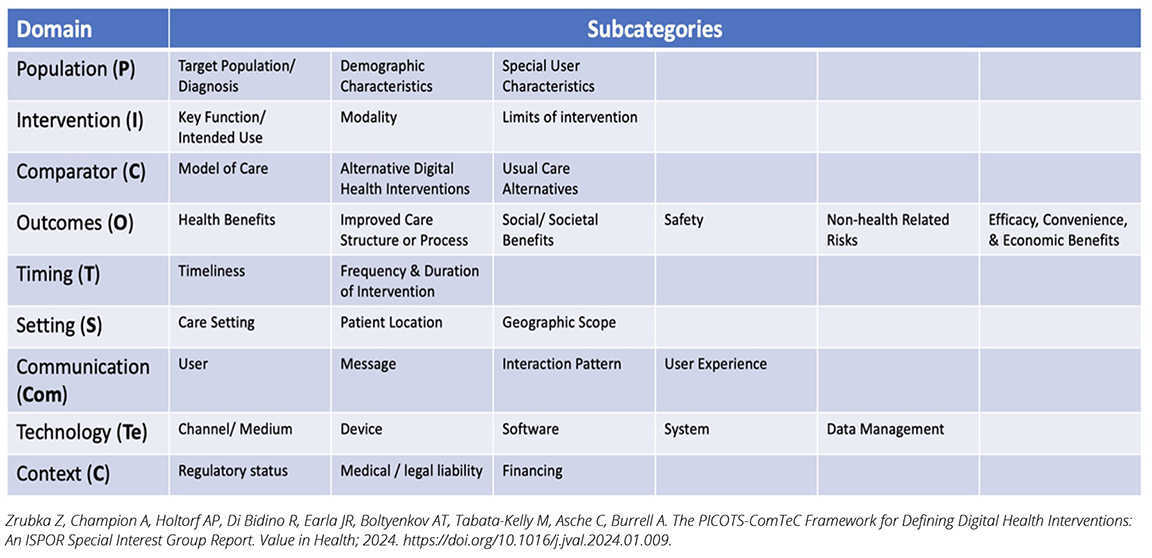
The full framework can be used in many contexts, such as writing study reports; framing clinical, financing, or development decision questions; formulating research questions for evidence syntheses; or applying for regulatory approval or reimbursement. PICOTS-ComTeC enhances decision making by helping users develop specific, detailed definitions for identifying comparable patient-facing DHIs (intended to deliver the same effect as the one being evaluated) and comparators that deliver a similar effect but differ in relevant determinants of value.
PICOTS-ComTeC not only structures the definition of DHIs but also provides a practical bridge to health technology assessment (HTA). By clarifying intervention characteristics, comparators, and contextual factors, the framework supports the development of more transparent and comparable evidence packages. This is particularly relevant in HTA settings, where heterogeneity in digital interventions has historically limited the interpretability and transferability of findings.
We compared PICOTS-ComTeC with 15 established DHI frameworks and guidelines, including 6 national HTA guidelines such as the German DiGA,8 3 DHI reporting guidelines (CONSORT-EHEALTH,2 iCHECK-DH,3 and mERA)9 and the World Health Organization classification scheme (CDISAH10). While a significant degree of commonality was found, PICOTS-ComTeC contributed items (domains or subcategories) not uniformly present in other frameworks. The DHI frameworks matched between 4 and 9 domains (mean 7.2). Even within CDISAH and DiGA (the frameworks that most closely matched PICOTS-ComTeC), while all 9 domains were present, approximately 20% of the subcategories were missing, and the 2 frameworks were missing different subcategories. With the sole purpose of defining DHIs, PICOTS-Com-TeC provides a convenient, comprehensive framework and a useful common ground for defining DHIs.11
To further support researchers in adopting PICOTS-ComTeC, the ISPOR Digital Health SIG is also designing, developing, testing, and refining a prompt that enables LLMs to identify and extract PICOTS-ComTeC items from scientific reports. Consistent use of a standard prompt for this task will improve the speed and quality of AI-assisted evidence synthesis pipelines, bridging human experience and digital efficiency.
Specific guidance is still needed for health economists seeking to publish the results of their economic evaluations of DHIs, given that existing guidelines don’t address all the topics in PICOTS-ComTec. CHEERS-DHI, a checklist specific to DHIs, is being developed based on the existing CHEERS1 health economic reporting standards to help authors, editors, and peer reviewers improve reporting.
Complementing this work, recent discourse, including our letter to the editor in Value in Health has emphasized the need for greater conceptual alignment between evidence-generation frameworks and reporting standards to ensure that DHI evaluations are both rigorous and decision-relevant.
Lessons Learned
A lack of clear terminology in digital health, compounded by its rapid advancement, hinders evidence-based decision making because heterogeneity across the technologies evaluated will limit high-quality synthesis. Furthermore, this could impede the diffusion and adoption of DHIs, which add value to healthcare settings. Despite existing checklists, standardizing evidence generation and assessment for DHIs remains difficult because of their personalized nature, complex technologies, and linkages to larger systems.
The convergence of frameworks such as PICOTS-ComTeC with reporting standards like CHEERS-DHI highlights an emerging ecosystem for DHI evaluation. While CHEERS-DHI focuses on how evidence should be reported, PICOTS-ComTeC is a flexible framework that addresses how interventions should be defined and conceptualized at the outset. Together, these efforts respond to a broader need—articulated in recent contributions to Value in Health—to reduce ambiguity in generating digital health evidence and to improve the usability of findings for HTA bodies, payers, and clinicians. The PICOTS-ComTeC framework, therefore, represents a foundational step toward more structured, decision-oriented evaluation of DHIs within HTA processes.
Acknowledgements
The authors wish to acknowledge the SIG leadership, including Katarzyna Kolasa, Brian Seal, Anke-Peggy Holtorf, Anton Pak, Doug Niven, Vladimir Zah, Jagadeswara Rao Earla, Marie Chivers, Josielli Comachio, and Artem Boltyenkov, as well as the ISPOR staff, Maddie Shipley, and Alyssa Long, for their support and input.
References
1. Husereau D, Drummond M, Augustovski F, et al. Consolidated Health Economic Evaluation Reporting Standards 2022 (CHEERS 2022) Statement: Updated Reporting Guidance for Health Economic Evaluations. Value Health. 2022;25(1):3-9. doi: 10.1016/j.jval.2021.11.135
2. Eysenbach G, Group C-E. CONSORT-EHEALTH: Improving and standardizing evaluation reports of Web-based and mobile health interventions. J Med Internet Res. 2011;13(4):e126. doi: 10.2196/jmir.1923
3. Perrin Franck C, Babington-Ashaye A, Dietrich D, et al. iCHECK-DH: Guidelines and checklist for the reporting on digital health implementations. J Med Internet Res. 2023;25:e46694. doi: 10.2196/46694
4. Truelove C. Defining digital health and getting clarity for HEOR. Value Outcomes Spotlight. 2024;10(2). https://www.ispor.org/publications/journals/value-outcomes-spotlight/vos-archives/issue/view/defining-digital-health---getting-clarity-for-heor/defining-digital-health--and-getting-clarity-for-heor Accessed April 24, 2026.
5. US Food and Drug Administration. Using the PICOTS framework to strengthen evidence gathered in clinical trials—guidance from the AHRQ’s Evidence-based Practice Centers Program. https://www.fda.gov/media/109448/download Published 2017. Accessed May 28, 2026
6. Shannon CE. A mathematical theory of communication. Bell Syst Tech J. 1948;27(3):381. doi:10.1002/j.1538-7305.1948.tb01338.x
7. Zrubka Z, Champion A, Holtorf A-P et al. The PICOTS-ComTeC Framework for Defining Digital Health Interventions: An ISPOR Special Interest Group Report. Value Health. 2024;27(4): 383-396. doi: 10.1016/j.jval.2024.01.009
8. The Federal Institute for Drugs and Medical Devices. The Fast-Track Process for Digital Health Applications (DiGA) according to Section 139e SGB v. A Guide for Manufacturers, Service Providers and Users (Bundesinstitut für Arzneimittel und Medizinprodukte B. https://www.bfarm.de/SharedDocs/Downloads/EN/MedicalDevices/DiGA_Guide.html Published July 8, 2020. Accessed May 28, 2026.
9. Agarwal S, LeFevre AE, Lee J, et al. Guidelines for reporting of health interventions using mobile phones: mobile health (mHealth) evidence reporting and assessment (mERA) checklist. BMJ. 2016;352:i1174. doi: 10.1136/bmj.i1174
10. World Health Organization. Classification of digital interventions, services and applications in health: A shared language to describe the uses of digital technology for health, 2nd ed. https://www.who.int/publications/i/item/9789240081949 Published October 2023. Accessed May 28, 2026.
11. Champion A, Burrell A, Holtorf AP, et al. Toward a common ground for defining digital health interventions, mapping digital health frameworks to PICOTS-ComTeC: An ISPOR Special Interest Group Report. Value Health. 2026;29(1):1-13. doi: 10.1016/j.jval.2025.07.022