
Optimize Health in Chronic Disease Populations by Putting Patient-Important Outcomes First
Nora Fayed PhD, Queen’s University, Kingston, Ontario, Canada; Angie Botto-van Bemden PhD, Musculoskeletal Research International, Miami, FL, USA; Sahar Alam, MPH, ISPOR, Lawrenceville, NJ, USA; Elizabeth Manias PhD, RN, RPh, Monash University, Melbourne, Australia; Radha Sharma, PhD, Connect HEOR, Edmonton, Alberta, Canada, on behalf of the ISPOR Patient-Centered Special Interest Group
 Chronic Disease Treatment Should Aim for Health Optimizatio
In the 20th century, the principal pathway for improving the health of societies was reduction of mortality and disease. While this approach resulted in major gains, societies are now increasingly challenged by chronic and noncommunicable diseases, which generate substantial and insufficiently addressed burdens of comorbidity and disability.1 Although estimates vary across jurisdictions, the prevalence of chronic conditions has risen to historically high levels, affecting approximately 20% of children younger than 18 years2 and more than half of adults older than 60 years,2 while their incidence continues to grow across low-, middle-, and high-income regions alike.2,3 Because chronic diseases are long-lasting and widely distributed, their consequences extend beyond patients to caregivers to health systems and societies as a whole. This means that, while it is still necessary for societies to aim for acute-care survival targets, such targets are no longer sufficient on their own.
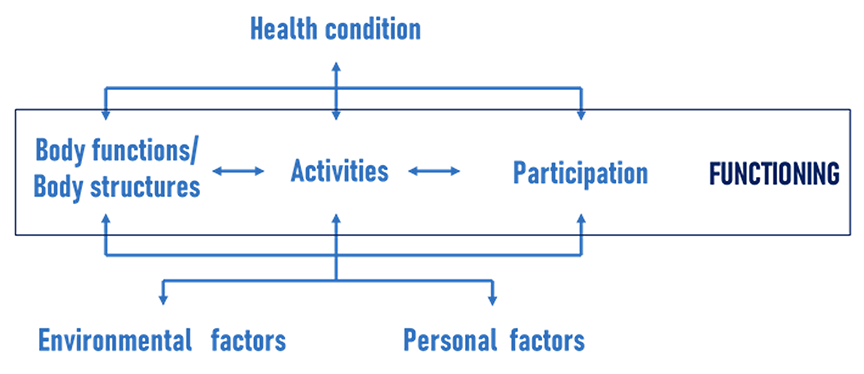
In the 21st century, health scientists must devote more efforts toward an under-recognized goal: to optimize individual health despite the persistence of chronic disease. When the threat of mortality is minimized, The International Classification of Functioning, Disability and Health (ICF) provides a way to reframe treatment targets around optimization for everyone.4 The ICF is more in keeping with the 1948 World Health Organization (WHO) Charter definition of broad health (“a state of complete physical, mental, and social well-being”4) than its preceding companion-classification of diagnoses, found in the International Classification of Diseases.5 Health in the ICF is conceptualized not by the absence of disease pathology, but by the presence of an individual’s functioning (Figure 1).
Functioning is the optimal health aim represented in the ICF classification (used to classify not categorical and functional outcomes). This classification maps onto outcomes of perceived health, caregiver burden, and social participation, which are emphasized in many health technology assessments. Functioning, in the WHO’s ICF language, is the result of a synergy between one’s body functions, (like moving limbs, breathing, or concentrating), daily activities, (like learning, eating, or walking), and participation in life roles (such as relationships, schooling, or work). In the ICF framework and classification, functioning is further supported (or hindered) by an individual’s environment (communities and society) and personal factors (like income, resilience, or education). Taken together, these components mean that an individual’s health is defined by what they can do, or need to do, in a situation, place, or time; not solely by whether a disease is absent or present.
Adoption of the ICF reframes therapeutic success (ie, good outcome) as the ability of individuals to achieve and sustain functioning, even when disease is present. Disability (ie, the opposite of functioning) is empirically observed in multiple chronic diseases, including heart disease, diabetes, arthritis, and multiple sclerosis. Disability occurs when patients achieve biomarker or symptom control, yet still have difficulty functioning due to mood, concentration, mobility, going to school or work, maintaining relationships, or taking care of their families.
Figure 1. The Framework of the World Health Organization’s International Classification of Functioning, Disability and Health (ICF)4
Although targeting biomarkers is important for transforming previously fatal diseases into chronic ones, once patients are living with chronic diseases such as diabetes, heart and stroke diseases, or even cancer remission, other outcomes also become important to target. A biomarker associated with marginal mortality gains is rarely a valid target for optimizing these patients’ health. Yet most new drug approvals introduce marginal mortality gains at high costs, which divert health system capacity away from the resources that make possible individual health progress,7 such as promising or evidence-based lifestyle, mental health, or rehabilitative interventions. Thus, solely targeting surrogate or biomarker endpoints excludes treatment innovation that advances optimal health outcomes.
As an alternative to a biomarker-defined good-outcome strategy, developers, interventionists, and clinicians can pursue outcomes that have been endorsed by patients as priorities, then identify and assess new treatments with those outcomes in mind. In other words, optimization of health deserves more scientific and treatment effort than it receives right now.
Policy Can Create Optimal Health by Using Patient-Important Outcomes
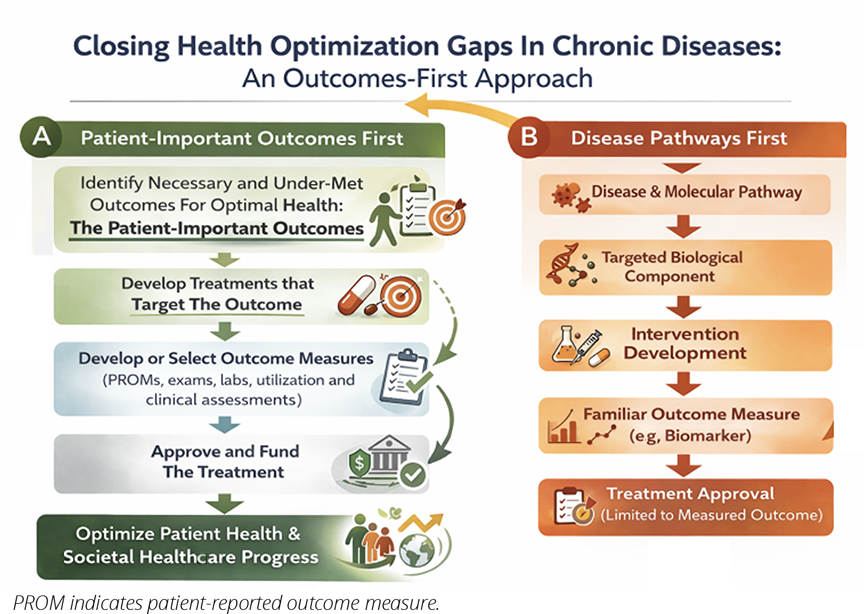
Patient-important outcomes (PIOs) provide a roadmap to attaining the optimization goal. When it comes to chronic disease, health optimization is possible through a focus on the necessary outcomes that remain unmet or under-met. The scientific and policy solutions that will push forward progress in health optimization for chronic disease patients universally require that treatment development and testing (eg, through trials) begin by targeting a PIO (Figure 2). This alternative is preferable to the status quo, in which treatment success is defined by outcomes like biomarkers or mortality.
Figure 2. PIO-First Versus Mechanism-First Treatment Approaches
We define a PIO as an outcome that is essential to health optimization but is being insufficiently addressed. While the definition of a PIO might have evolved over time, the way we define it means it is not equivalent to a patient-reported outcome measure (PROM). Although many PROMs can assess outcomes of importance to patients, not all PROMs measure the under-addressed outcomes patients require to achieve optimal health. For example, in patients with diabetes, outcomes such as vision, weight, mobility, fatigue, and diabetes-related distress are high-priority PIOs8; some of these are best measured using PROMs, while others are more appropriately measured with clinical tools, exams, tests, or functional assessments.8 Core outcome sets and standard sets across multiple chronic conditions represent a useful starting point for identifying specifically which PIOs should be measured for various chronic disease populations.
Among many core and standard outcome sets, the outcomes that are repeatedly prioritized as patient-important from the ICF health component of body functions include fatigue, appetite, motivation, emotions, and pain; from activities and participation, they include daily routines, walking, mobility, [schooling] and employment; and from environment, they include social support, formal healthcare supports and health access.9-11 Given their importance, these outcomes and other PIOs can—and should— be the endpoints of most clinical trials for new treatments.12 Typically, they are not.
Regulators, aware of the issue, have attempted solutions in the form of the US Food and Drug Administration’s (FDA’s) guidance for industry in the use of PROMs to support labeling claims and The European Medicines Agency (EMA) shortly thereafter.13 These policy initiatives were followed by an initial decline, followed by steady growth in new drug applications and approvals that included validated PROMs as primary or secondary endpoints.10 Despite this increased uptake, PROMs often remain grounded in investigator-defined conceptions of desirable outcome or positioned as secondary endpoints. The positioning of PROMs in trials suggests they are perceived as exploratory rather than as key targets for therapeutic development.14 Policy should aim to achieve optimal health through treatments that target PIOs, rather than encouraging the use of PROMs that don’t align with patient priorities.
Scientific funding agencies in the United States (eg, the Patient-Centered Outcomes Research Institute [PCORI]) and Canada (eg, Strategy for Patient-Oriented Research) also introduced major initiatives intended to make health research more patient-oriented, primarily through the promotion of patient engagement. Over time, these efforts contributed to the establishment of new research norms characterized by structured checklists, guidance frameworks, and accountability mechanisms, designed to promote rigorous patient involvement throughout the research process. These engagement strategies improved patient experiences within clinical trials for areas such as recruitment, representation, and retention;15 however, their role in developing treatment innovations that target PIOs remains uncertain. Thus, emerging standards for patient-oriented research must more intentionally and systematically redirect therapeutic targets toward PIOs, using patient engagement to achieve that objective, rather than patient engagement being a goal in and of itself.
Implications for Policy Makers
Regulatory and scientific funding policies will be unable to make progress on the health optimization problem simply by introducing process changes in the development-to-payment pipeline, or by using PROMs or patient engagement, without also incorporating clear mandates that treatments fill empirical gaps of patient-defined needs for good results. We recommend a bold but promising solution through the introduction of regulatory guidelines that specifically outline the importance of testing treatments that target empirically identified PIOs.
"An individual’s health is defined by what they can do—or need to do—in a situation, place, or time. It is not defined by whether a disease is absent or present."
For example, patient-focused drug development strategies from the FDA and EMA have articulated the need for patients to be “involved” at all stages of development and testing, without ever articulating that patient-oriented treatments can only be defined as such if they target unmet but necessary (ie, patient-important) outcomes.16 In particular, chronic disease categories that have succeeded in demonstrating marginal mortality gains with new treatments should be disincentivized from seeking additional approvals for treatments that ignore PIOs. Doing so might slow the speed of new development in the short-term, but in the long-term, will advance solutions toward much-needed health optimization innovations.
Funding organizations like PCORI or the National Institutes of Health can also improve the criteria for rigorous patient engagement in research, going beyond process-based patient consultation or collaboration to prioritizing the inclusion of patient-defined good-outcome measures. Doing so will ensure that new treatments are developed and tested, based not only on whether they are safe or clinically effective, but whether they facilitate optimal health for all. We recommend that funding be allocated to the [most rigorous] studies that ask the question, “Is this treatment making a difference to the outcomes chronic disease patients have empirically endorsed?” as a new requisite for excellence in patient-oriented research.
In short, moving forward with the 21st century aim of health optimization requires treatment strategies that support PIOs, not the other way around.
References:
1. Wright JG. Evaluating the outcome of treatment: Shouldn’t we be asking patients if they are better? J Clin Epidemiol. 2000;53(6):549-553. doi: 10.1016/S0895-4356(99)00225-5
2. Beaglehole R, Horton R. Chronic diseases: global action must match global evidence. Lancet. 2010;376(9753):1619-1621. doi: 10.1016/S0140-6736(10)61929-0
3. Waters H, Graf M. The costs of chronic disease in the US. The Milken Institute. https://milkeninstitute.org/sites/default/files/reports-pdf/ChronicDiseases-HighRes-FINAL.pdf Published August 28, 2018. Accessed May 26, 2026.
4. World Health Organization. Constitution of the World Health Organization. In: Basic Documents, forty-ninth edition. https://apps.who.int/gb/bd/pdf_files/Bd_49th-en.pdf Updated 2020. Accessed May 26, 2026.
5. World Health Organization. Manual of the International Statistical Classification of Diseases, Injuries, and Causes of Death. Sixth Revision. Geneva: World Health Organization; 1949.
6. Cieza A, Fayed N, Bickenbach J, Prodinger B. Refinements of the ICF Linking Rules to strengthen their potential for establishing comparability of health information. Disabil Rehabil. 2019;41(5):574-583. doi: 10.3109/09638288.2016.1145258
7. Naci H, Murphy P, Woods B, et al. Population-health impact of new drugs recommended by the National Institute for Health and Care Excellence in England during 2000–20: a retrospective analysis. Lancet. 2025;405(10472):50-60. doi: 10.1016/S0140-6736(24)02352-3
8. Nano J, Carinci F, Okunade O, Whittaker S, et al.; the Diabetes Working Group of the International Consortium for Health Outcomes Measurement (ICHOM). A standard set of person-centred outcomes for diabetes mellitus: results of an international and unified approach. Diabet Med. 2020;37(12):2009-2018. doi: 10.1111/dme.14286
9. Ramsey I, Eckert M, Hutchinson AD, Marker J, Corsini N. Core outcome sets in cancer and their approaches to identifying and selecting patient-reported outcome measures: a systematic review. J Patient Rep Outcomes. 2020;4(77). doi: 10.1186/s41687-020-00244-3
10. Lei R, Shen Q, Yang B, et al. Core outcome sets in child health: a systematic review. JAMA Pediatr. 2022;176(11):1131-1141. doi: 10.1001/jamapediatrics.2022.3181
11. Murad MH, Shah ND, Van Houten HK, et al. Individuals with diabetes preferred that future trials use patient-important outcomes and provide pragmatic inferences. J Clin Epidemiol. 2011;64(7):743-748. doi: 10.1016/j.jclinepi.2010.08.005
12. Fayed N, Guttmann A, Chiu A, et al. Family-provider consensus outcomes for children with medical complexity. Dev Med Child Neurol. 2019;61(9):1093-1100. doi: 10.1111/dmcn.14110
13. Gnanasakthy A, Barrett A, Evans E, D’Alessio D, Romano CD. A review of patient-reported outcomes labeling for oncology drugs approved by the FDA and the EMA (2012-2016). Value Health. 2019;22(2):203-209. doi: 10.1016/j.jval.2018.09.2842
14. Fayed N, de Camargo OK, Elahi I, et al. Patient-important activity and participation outcomes in clinical trials involving children with chronic conditions. Qual Life Res. 2014;23(3):751-757. doi: 10.1007/s11136-013-0483-9
15. Crocker JC, Ricci-Cabello I, Parker A, et al. Impact of patient and public involvement on enrolment and retention in clinical trials: systematic review and meta-analysis. BMJ. 2018;363:k4738. doi: 10.1136/bmj.k4738
16. Berg AT, Ludwig NN, Wojnaroski M, et al. FDA patient-focused drug development guidances: Considerations for trial readiness in rare developmental and epileptic encephalopathies. Neurology. 2024;102(1):e207958. doi: 10.1212/WNL.0000000000207958