Mind the Gap: Understanding the Global Imbalance in Spending on New Innovative Medicines
Richard Kane, MIPP*, Pharmaceutical Researchers and Manufacturers of America, Washington, DC, USA; Sarah McKeown, MSPH*, University of Oxford, Oxford, England, UK
* Richard Kane, MIPP, and Sarah McKeown, MSPH, are co-first authors of this article.
 The Cost of Investing in Global Innovation Is Not Shared Evenly
The development of new medicines should be celebrated as a triumph of science, but it is equally also a product of sustained global investment. Developing a novel therapy is risky,1 can take more than a decade,1,2 and can cost billions of dollars that are recovered only if a medicine successfully reaches patients.3 While the benefits of medical innovation can help patients worldwide, countries don’t evenly share in the cost of funding innovation.
Although biopharmaceutical research and development (R&D) is conducted in clinical trials and laboratories around the world, it is the expected sales of medicines that enable these endeavors to occur. Today’s spending on medicines pays for the investment in R&D needed to create them, while also setting expectations for the value of future innovations. Over the past decade, concerns have grown in the United States that it bears a disproportionate share of the costs of investing in biopharmaceutical R&D because it spends much more on new medicines relative to the size of its economy compared to other high-income countries.4,5 This analysis aims to estimate differences in spending on new medicines between the United States and other high-income countries as a share of their gross domestic product (GDP) and examines the extent to which each of these countries are not paying their fair share for biopharmaceutical innovation.
Measuring the Spending Gap
This analysis measures the gap in spending on new medicines between the United States and other high-income countries in the Organization for Economic Co-operation and Development (OECD). New medicines include new active substances first launched globally during the prior 10 years (2014-2023) and approved for use in the United States, Europe, or Japan. New medicines (up to 10 years old) are a logical focus for this analysis since sales during the first decade of a medicine’s product life cycle heavily influence early investment in R&D. The analysis measures spending “net” after accounting for the various pricing and cost-containment policies (eg, rebates, discounts, revenue clawbacks) that high-income countries impose and any rebates or discounts paid to private payers or pharmacy benefit managers, as occurs heavily in the United States. Net spending on new medicines best approximates what public and private payers spend on medicines, as well as the net revenues that biopharmaceutical manufacturers receive. [Note: Estimates of rebates, discounts, revenue clawbacks, and other paybacks are modeled using publicly available information on aggregate amounts and mechanisms from official government reports and statistics.]
Today’s spending on medicines pays for the investment in R&D needed to create them, while also setting expectations for the value of future innovations.
The analysis examines the extent to which each high-income country is not paying its fair share for biopharmaceutical innovation by comparing its share of economic resources with its share of spending on new medicines among high-income countries. If each high-income country contributes the same share of its GDP to new medicines, then each high-income country’s contribution to the cost of biopharmaceutical innovation will match its share of economic resources. To calculate combined spending on new medicines and GDP across high-income countries, the analysis converts both net spending on new medicines and GDP for each country into purchasing power parity (PPP) dollars. Using PPP conversion factors, as opposed to more volatile currency exchange rates, enables more meaningful cross-country comparisons that best account for differences in each country’s overall price levels.6
Results
The results show that the United States contributes 0.78% of its GDP to new medicines, a small amount relative to its economic size, but a far higher share of its GDP compared to other high-income countries. Japan and Germany, the second and third largest markets in the world for innovative medicines, contribute much smaller shares of their GDP to new medicines. Japan contributes only 0.40% of its GDP to new medicines, and Germany contributes only 0.36%. All other high-income countries in this study contribute a smaller share of their GDP to new medicines than the United States, including Australia 0.26%, Canada 0.32%, France 0.29%, Italy 0.46%, Korea 0.09%, Spain 0.53%, and the United Kingdom 0.28% (Figure 1).
Figure 1. Contribution to New Medicines First Launched Over the Last 10 Years as a Share of Gross Domestic Product, 2023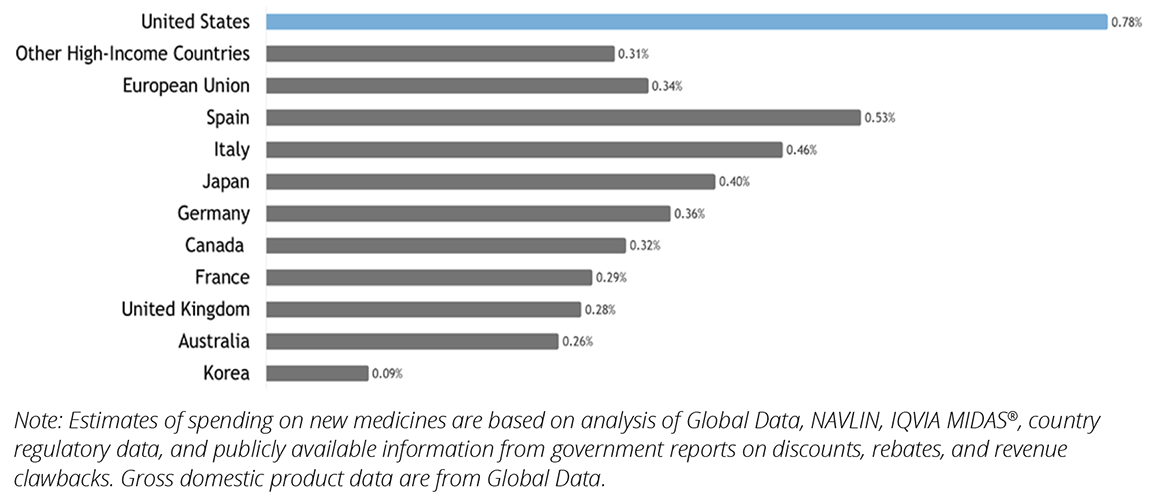
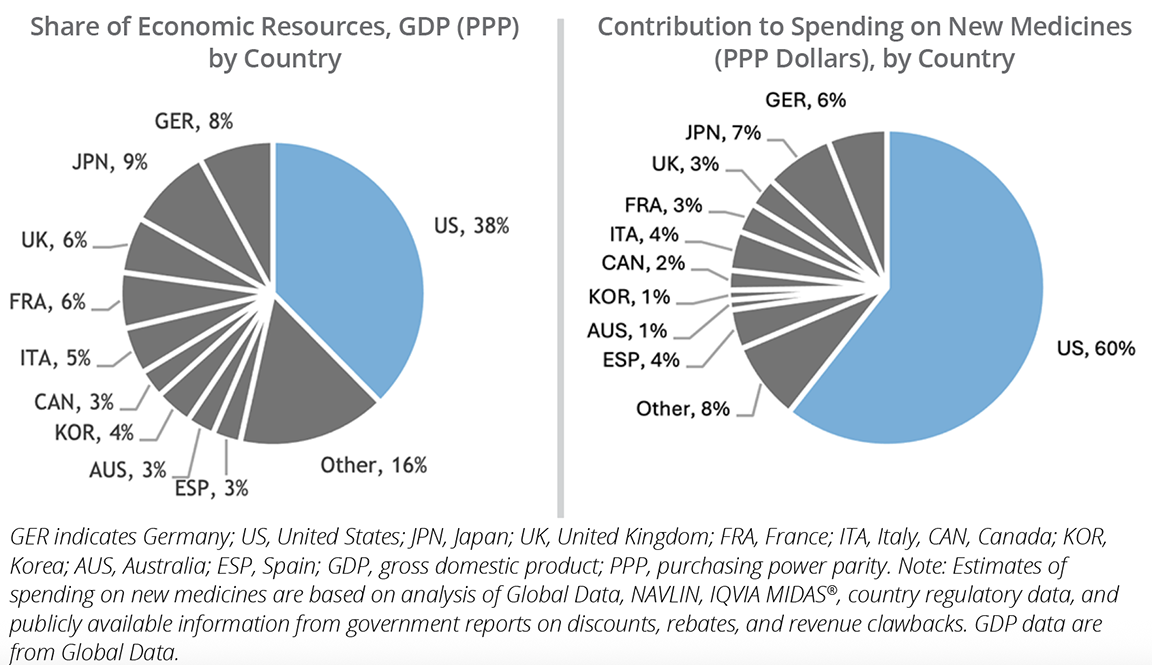
The results also show that the United States contributes 60% of the spending on new medicines by high-income countries, even though its share of economic resources among these high-income countries is only 38%. Other high-income countries contribute less to biopharmaceutical innovation than the size of their economic resources would suggest. For example, France and the United Kingdom each contribute only 3% of the spending on new medicines by high-income countries, even though each of them garners 6% of the economic resources (Figure 2).
Figure 2. Share of Economic Resources vs Contribution to Spending on New Medicines
The findings of this study are consistent with prior research suggesting that the United States bears a disproportionate share of global spending on pharmaceutical innovation relative to its economic size. Earlier analyses by the Council of Economic Advisers and Neumann et al argued that higher US pharmaceutical spending plays a central role in sustaining global biopharmaceutical research and development, and our analysis supports this conclusion by estimating that the United States accounts for 60% of spending on new medicines while representing only 38% of economic resources among high-income countries.4,5 The results are also consistent with previous studies showing that patients in Europe and other high-income countries experience delayed and more restricted access to innovative medicines because of government reimbursement decisions, health technology assessments, and budget impact analyses.7-10
What Drives the Spending Gap?
Worse patient access, not just low government-set prices, drives lower spending on new medicines as a share of GDP in Europe and other high-income countries. In the United States, new medicines approved as safe and effective are soon available for coverage and reimbursement by public health insurance. In other high-income countries, government regulatory agencies engage in further cost- and budget-based evaluations to determine whether already approved medicines should be covered by the public health insurance program and at what price.
Patients in Europe and other high-income countries experience delays in access to new medicines compared to patients in the United States due to their governments conducting cost- and budget-impact evaluations. For example, patients wait on average 25 months in France after a new medicine has been launched globally for access through public health insurance, and patients in the United Kingdom wait 30 months.8 In addition, decisions based on those cost- and budget-impact evaluations can reduce patients’ access to new medicines further through restrictions and negative coverage decisions. For example, less than half of new medicines are available through the public health insurance programs in France (40%) and the United Kingdom (46%), and patients face restricted access to the smaller share of medicines that are available.8 One study shows that in 2024, the uptake of new medicines publicly covered in the United Kingdom was 81% lower than in the United States, and more than 90% lower for new cancer medicines.9,10
Conclusion
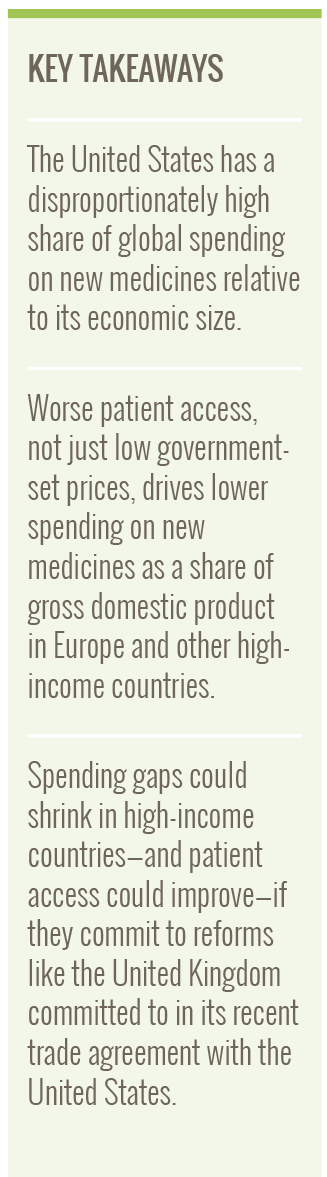
The United States accounts for a disproportionately high share of global spending on new medicines relative to its economic size. Worse patient access, not just low government-set prices, drives lower spending on new medicines as a share of GDP in Europe and other high-income countries.
Over the past decade, concerns have grown in the United States that it bears a disproportionate share of the costs of investing in biopharmaceutical R&D. The US government has recently initiated pilot demonstrations in Medicaid and drafted proposed pilot demonstrations for Medicare that set drug prices by referencing prices in other high-income countries.11-13 These policies could worsen access to new medicines in Europe and other high-income countries and thereby further widen the gap in spending with the United States.
However, patient access to new medicines could improve in high-income countries countries and spending gaps relative to GDP narrow if they adopt reforms similar to those agreed to by the United Kingdom in its recent pharmaceutical pricing agreement with the United States. In this agreement, the United Kingdom commits to increase spending on new medicines from 0.3% to 0.6% of GDP by the end of 2036, increase net prices by 25% “while maintaining broad patient access and ensuring rapid and equitable adoptions of those medicines,” and reduce revenue clawbacks to no more than 15%.14
Policy makers should consider how strict pricing and coverage rules can delay patient access to new medicines and reduce incentives for innovation. Greater international cost-sharing and faster access to treatments could benefit patients, support continued drug development, and create a fairer global system.
References
1. Sun D, Gao W, Hu H, Zhou S. Why 90% of clinical drug development fails and how to improve it? Acta Pharm Sin B. 2022;12(7):3049-3062. doi: 10.1016/j.apsb.2022.02.002
2. DiMasi JA, Grabowski HG, Hansen RW. Innovation in the pharmaceutical industry: new estimates of R&D costs. J Health Econ. 2016;47:20-33. doi: 10.1016/j.jhealeco.2016.01.012
3. EVERSANA. Launch sequencing and market prioritization in an evolving global market. https://www.eversana.com/wp-content/uploads/2021/12/WP_Launch-Sequencing-and-Market-Prioritization_EVERSANA.-1.pdf Published December 21, 2021. Accessed May 11, 2026.
4. Council of Economic Advisers. Funding the global benefits to biopharmaceutical innovation. https://www.govinfo.gov/content/pkg/GOVPUB-PREX6-PURL-gpo133193/pdf/GOVPUB-PREX6-PURL-gpo133193.pdf Published February 2020. Accessed May 11, 2026.
5. Neumann U, Martin S, Chandra A. Research and development (R&D) investment by the biopharmaceutical industry: a global ecosystem update [ISPOR abstract HPR63 presentation document]. ISPOR. https://www.ispor.org/heor-resources/presentations-database/presentation/intl2024-3896/137860 Published May 5, 2024. Accessed May 11, 2026.
6. International Monetary Fund. Implied PPP conversion rate. IMF DataMapper. https://www.imf.org/external/datamapper/PPPEX@WEO/OEMDC/ADVEC/WEOWORLD Updated April 2026. Accessed May 11, 2026.
7. PhRMA comments on foreign nations freeloading on American-financed innovation. https://phrma.org/resources/phrma-comments-on-foreign-nations-freeloading-on-american-financed-innovation Published June 27, 2025. Accessed May 11, 2025.
8. Pharmaceutical Research and Manufacturers of America. Access to new medicines in the United States vs. other high-income countries. https://cdn.aglty.io/phrma/Attachments/NewItems/PhRMA_OnePager_AccessToNewMedicinesReport_8.5x11_v3.2_Print%20(2)_20260512113247.pdf. Published May 2026. Accessed May 30, 2026.
9. McKeown S, Kane R. Measuring impact of HTA on patient access to new medicines in NHS England: a comparison of public health insurance funding restrictions and patient uptake for new medicines across England, France, Germany, and the United States [ISPOR Europe abstract HPR142]. Value Health. 2024;27(12 suppl):S303. doi: 10.1016/j.jval.2024.10.1568
10. Pharmaceutical Research and Manufacturers of America. Analysis of access restrictions to new medicines in the United Kingdom. https://phrma.org/blog/new-analysis-of-patient-access-restrictions-in-the-united-kingdom Published November 21, 2023. Accessed May 11, 2026.
11. Centers for Medicare & Medicaid Services. CMS proposes new mandatory GLOBE model. https://www.cms.gov/newsroom/press-releases/cms-proposes-new-mandatory-globe-model. Published December 21, 2025. Accessed May 11, 2026.
12. Centers for Medicare & Medicaid Services. CMS proposes new mandatory GUARD model. https://www.cms.gov/newsroom/press-releases/cms-proposes-new-mandatory-globe-model. Published December 21, 2025. Accessed May 11, 2026.
13. Centers for Medicare & Medicaid Services. GENEROUS (GENErating cost Reductions fOr U.S. Medicaid) Model. https://www.cms.gov/priorities/innovation/innovation-models/generous Published December 21, 2025. Accessed May 30, 2026.
14. Office of the United States Trade Representative. Arrangement between the government of the United States of America and the government of the United Kingdom on pharmaceutical pricing. https://ustr.gov/sites/default/files/files/Press/Releases/2026/U.S.-UK%20Pharma%20Pricing%20Arrangement%20-%204.2.2026.pdf. Published April 2, 2026. Accessed May 11, 2026.