
Elephant in the Room: How Social and Traditional Media Analytics Help Uncover Actionable, Patient-Reported Gaps in Lymphoma Care
Jakub Novák, PhD, ROCHE s.r.o., Prague, Czechia; Kateřina Nováková Havránková, MSc, independent analyst; Veronika Bačová, MSc, Jan Popluhár, MSc, Martin Pour, MSc, ROCHE s.r.o., Prague, Czechia
 Silent (R)evolution
For decades, health technology assessment (HTA) and health economics and outcomes research (HEOR) have been on an evolutionary journey. Their origins are rooted in the era of evidence-based medicine, where the randomized controlled trial (RCT) was—and often remains—the gold standard for clinical and economic data. HTA bodies traditionally relied on this structured data to determine efficacy and cost-effectiveness.1
However, decision makers soon recognized that what works in the highly controlled, narrow population of an RCT does not always translate to the complex, heterogeneous reality of clinical practice. This led to a significant shift toward embracing real-world evidence (RWE) from claims, registries, and electronic health records to understand long-term effectiveness and safety in broader populations.2 Alongside this shift, another emerged: the realization that a deeper understanding of the patient journey—the complete experience of a patient, from symptoms through treatment and daily management—was also a critical contributor to health outcomes. It became clear that value was not just about clinical endpoints but also about the holistic patient experience.3,4
This focus on the patient journey fueled the push for patient centricity, with HTA bodies and organizations like ISPOR formalizing the integration of structured patient-reported measures.5 Yet, even these data have limitations, often failing to capture the full picture of a patient’s psychosocial burdens, which can influence outcomes.6-9
This brings us to the present challenge. A vast source of unsolicited RWE remains largely untapped: raw, authentic, and (relatively) unbiased patient voices from social media and public forums.
On the (Patient) Journey
These unsolicited data are generated every day as patients and informal caregivers discuss their health experiences, fears, and unmet needs on social media and in public, online discussion forums. To build a 360-degree view of the patient journey, we designed a dual-pronged methodology to analyze public communications over a 24-month period (October 2022 to October 2024), focused on hematologic malignancies.10
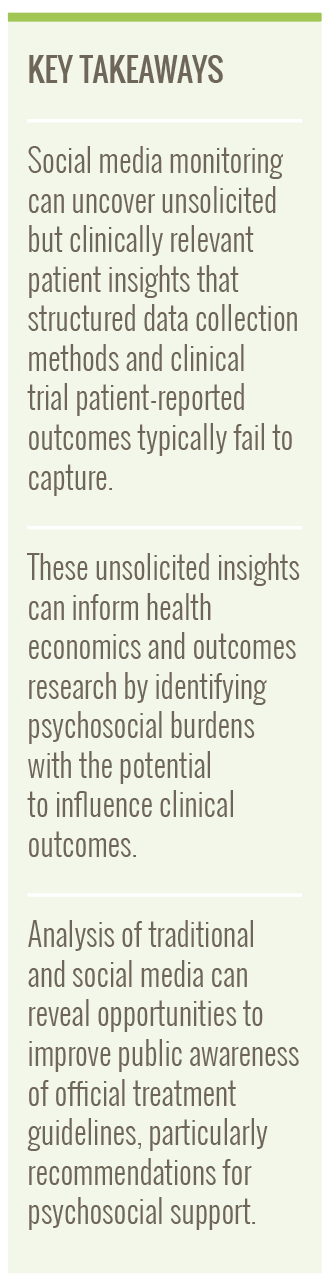
A vast source of unsolicited real-world evidence remains largely untapped: raw, authentic, and relatively unbiased patient voices from social media and public forums.
The formal public narrative was captured by traditional media analysis, resulting in 531 unique mentions related to “lymphoma” across the Czech press, online news, television, and radio using the Newton Media archive. The unstructured patient-reported voice was captured using a social media listening tool from Newton Media to monitor related keywords on platforms, including Facebook, X (formerly Twitter), Instagram, YouTube, TikTok, and Reddit, as well as Czech discussion forums and user discussions on news portals.
This combined methodology allows us to map the true patient experience, integrating the top-down information disseminated by media and healthcare experts and the bottom-up, real-world concerns reported by patients and caregivers.
What makes malignant hematologies particularly relevant for this approach is the high level of disease-related psychosocial distress experienced by patients with lymphoma and its largely “invisible” nature. Not seeing any obvious symptoms, others might not appreciate a lymphoma patient’s chronic health condition, and this misperception might lead the patient to feel isolated and lacking social validation of their suffering.11 This invisibility stands in stark contrast to the lived reality of the disease: prolonged treatment regimens involving multiagent chemotherapy, immunotherapy, or stem cell transplantation impose cycles of response and relapse that generate persistent fear of recurrence,12-14 while cancer-related fatigue—driven by both disease biology and myelosuppressive treatments—is associated with impaired quality of life.15,16
By applying this dual-pronged analytical methodology to patients with lymphoma in Czechia, we uncovered a significant “elephant in the room”: a profound, clinically relevant gap between an established need for psychosocial support17,18 and a patient population unaware of its availability. The patients’ perspective provided insights into the immense psychosocial and financial toll of the disease. Fear was identified as a negative modifier of quality of life, evolving from fear of diagnosis to fear of relapse. Patients also reported significant financial toxicity and treatment-related fatigue. Overall, this approach proved to be an effective tool to identify unmet needs that traditional data collection methods may miss.
The Lived Patient Experience
The SML analysis provided an unfiltered view into the patient experience, revealing the true drivers of their quality of life and economic burden. Patient discussions were not limited to the classic B-symptoms (bodily symptoms beyond localized lymph nodes) such as fever, night sweats, and unexplained weight loss. Many also reported that severe, unexplained fatigue was a primary limiting factor. Alcohol-related pain in lymph nodes was another example of a symptom that led some patients toward their diagnosis. However, some patients’ comments noted no visible symptoms, in which case the disease was discovered by chance.
By analyzing both social media and traditional media, we uncovered a profound, clinically relevant gap between an established need for psychosocial support and a lymphoma patient population unaware of its availability.
This is the kind of granular, real-world data that structured clinical trials might fail to capture using electronic patient-reported outcomes. Similarly, the analysis of traditional media found that symptoms are most often mentioned in the context of personal stories.
The Unseen QoL and Economic Burden
On social media, patients expressed specific fears and worries about managing treatment, particularly if they were elderly and lived alone or were parents of young children. These experiences were also reflected in the traditional media, which noted that patients are often isolated during treatment and highly dependent on support from family and friends for daily needs like care, food, and transportation. While patients find psychological comfort in peer support groups and hope in treatment progress, there were few mentions in traditional media regarding professional psychological support or where to find it, and those few mentions tend to come from low-reach sources like community newspapers.
And despite Czech treatment guidelines recommending psychological support as part of early palliative care to improve quality of life and treatment compliance,19 this fact is not reaching patients. We found only limited mentions of this support in any public-facing media, and patient forums were filled with individuals who said they had been seeking this support but were unable to find it. Patient organizations that could fill this role were generally missing from those conversations.
The Value of SML for HEOR
The failure to address the psychosocial needs of patients with lymphoma is a failure in care delivery that has a demonstrable impact on survival and, by extension, on health outcomes and related costs.20,21
This study demonstrates that social media listening, especially when combined with traditional media analysis, represents a useful HEOR tool for gathering patient-reported data and insights that might be further analyzed for their potential to inform healthcare and health policies. It allows researchers to move beyond the confines of structured data to identify real-world, emergent patient concerns—such as lack of access to psychosocial support—that can improve quality of life and potentially clinical outcomes.
This approach allowed us to identify critical gaps in the lived patient experience. Therefore, social media listening should be embraced as a vital tool to help guide policy, improve awareness, and build a more responsive and effective patient support ecosystem.
References
1. Banta D. The development of health technology assessment. Health Policy. 2003;63(2):121-132. doi: 10.1016/s0168-8510(02)00059-3
2. Berger ML, Sax H, Willke FJ, et al. Good practices for real-world data studies of treatment and/or comparative effectiveness: Recommendations from the Joint ISPOR-ISPE Special Task Force on Real-World Evidence in Health Care Decision Making. Value Health. 2017;20(8):1003-1008. doi: 10.1016/j.jval.2017.08.3019
3. Gualandi R, Masella C, Piredda M, Ercoli M, Tartaglini D. What does the patient have to say? Valuing the patient experience to improve the patient journey. BMC Health Serv Res. 2021 Apr 15;21(1):347. doi: 10.1186/s12913-021-06341-3.
4. Schroeder K., Bertelsen N, Scott J, et al. Building from patient experiences to deliver patient-focused healthcare systems in collaboration with patients: A call to action. Ther Innov Regul Sci. 2022;56(5):848-858. doi: 10.1007/s43441-022-00432-x
5. Drummond M, Torbica A, Tarricone R. Should health technology assessment be more patient centric? If so, how? Eur J Health Econ. 2020;21:1117-1120. doi: 10.1007/s10198-020-01182-z.
6. Bokemeyer F, Gali K, Kiefer P, et al. Alcohol consumption in cancer patients receiving psycho-oncologic care analysis of socio-demographic, health-related and cancer-related factors. J Cancer Surviv. 2026;20:581-594. doi: 10.1007/s11764-024-01673-5.
7. Hasegawa T, Okuyama T, Uchida M, et al. Depressive symptoms during the first month of chemotherapy and survival in patients with hematological malignancies: A prospective cohort study. Psycho-Oncology. 2019;28(8):1687-1694. doi: 10.1002/pon.5143
8. Kuczmarski TM, Tramontano AC, Mozessohn L, et al. Mental health disorders and survival among older patients with diffuse large B-cell lymphoma in the USA: a population-based study. The Lancet Haematology, 2023;10(7):e530-e538. doi: 10.1016/S2352-3026(23)00094-7
9. Tao R, Chen Y, Kim S, et al. Mental health disorders are more common in patients with Hodgkin lymphoma and may negatively impact overall survival. Cancer. 2022;128(19):3564-3572. doi: 10.1002/cncr.34359
10. Novák J, Smutny J, Bacova V, Popluhar J, Pour M. Elephant in the room: Gap between the awareness and need for psycho-social support for Czech lymphoma patients as captured through the analyzes of social and traditional media. [ISPOR Abstract PCR121]. Value Health. 2025;28(6):S332-S333. doi: 10.1016/j.jval.2025.04.1441
11. Swash B, Hulbert-Williams N, Bramwell R. ‘Haematological cancers, they’re a funny bunch’: A qualitative study of non-Hodgkin’s lymphoma patient experiences of unmet supportive care needs. J Health Psychol. 2018;23(11):1464-1475. doi: 10.1177/1359105316660179
12. Lymphoma: What people don’t see. MyLymphomaTeam. https://www.mylymphomateam.com/resources/lymphoma-what-people-dont-see-infographic Last updated November 7, 2019. Accessed May 21, 2026
13. Schneider B. Nearly half of MyLymphomaTeam members say they feel isolated and alone. MyLymphomaTeam. https://www.mylymphomateam.com/resources/nearly-half-of-mylymphomateam-members-say-they-feel-isolated-and-alone Published November 22, 2021. Accessed May 21, 2026
14. Lymphoma Coalition. Psychological Impact of Lymphoma. https://lymphomacoalition.org/wp-content/uploads/Psychological-Impact-of-Lymphoma-2023-FINAL-A4-Digital-1.pdf Published 2023. Accessed May 21, 2026.
15. Tan KP, Talaulikar D, Scholz B. Factors of emotional distress in lymphoma: A systematic review. Cancer Med. 2023;12:14646-14662. doi: 10.1002/cam4.6069.
16. Kiserud CE, Lockmer S, Baerug I, et al. Health-related quality of life and chronic fatigue in long-term survivors of indolent lymphoma—a comparison with normative data. Leukemia & Lymphoma. 2023;64(2):349-355. doi: 10.1080/10428194.2022.2142050
17. Perez GK, Walsh EA, Quain K, Abramson JS, Park ER. A virtual resiliency program for lymphoma survivors: Helping survivors cope with post-treatment challenges. Psychology & Health. 2021;36(11):1352-1367. doi: 10.1080/08870446.2020.1849699
18. Wang Y, Chen T, Niu H. Psychosocial burden and coping strategies among lymphoma patients: A nurse-led hematology care approach. Front Psychol. 2026;17:1783426. doi: 10.3389/fpsyg.2026.1783426
19. Belada D, Trněný M, Cooperative Lymphoma Group. Diagnostic and therapeutic procedures in patients with malignant lymphomas – XV edition [in Czech]. https://www.lymphoma.cz/_uploads/attachments/Lecebna_doporuceni_2025_-interaktivni_obsah_-_final_1.pdf Published April 2025. Accessed May 21, 2026.
20. Santiago-Jiménez G, Hernández-Company A, Ramírez-Jaramillo JG, et al. (2026). Impact of psychiatric disorders on treatment adherence and overall survival in patients with Hodgkin lymphoma: a retrospective cohort study. Cancer Causes Control. 2026;37(2):31. doi: 10.1007/s10552-025-02119-8
21. Kim SJ, Kang D, Kim IR, et al. Impact of fear of cancer recurrence on survival among lymphoma patients. Psycho-Oncology. 2020;29(2): 364-372. doi: 10.1002/pon.5265