


Health is a right in law.
Yet for billions, it is not yet a reality.1
Why Was the ISPOR Institute Created?
Where the Gap Shows Up
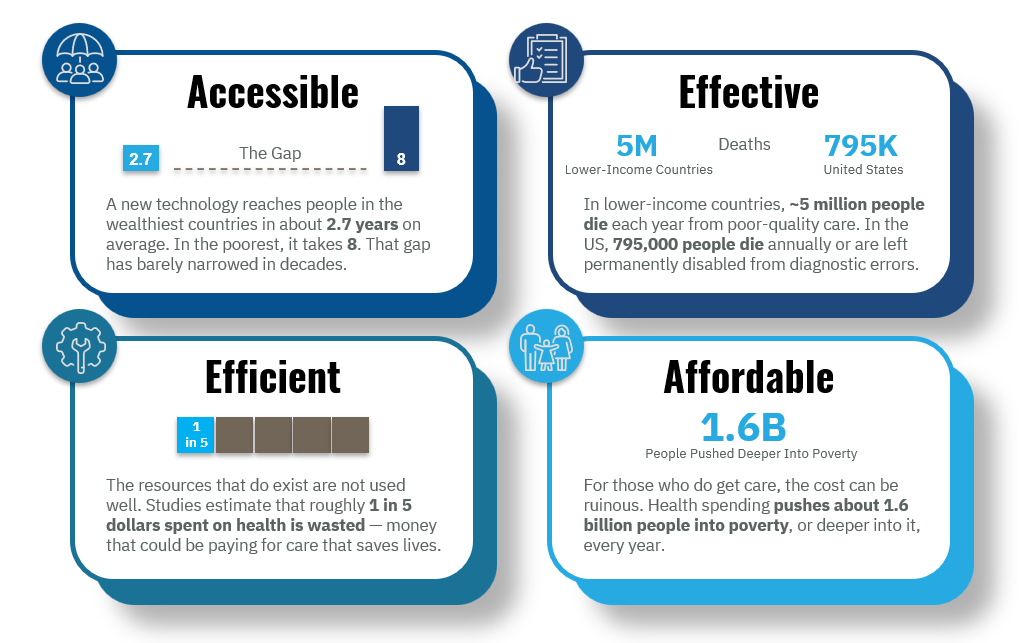
The distance between what governments have promised and what people actually receive shows up in 4 ways.
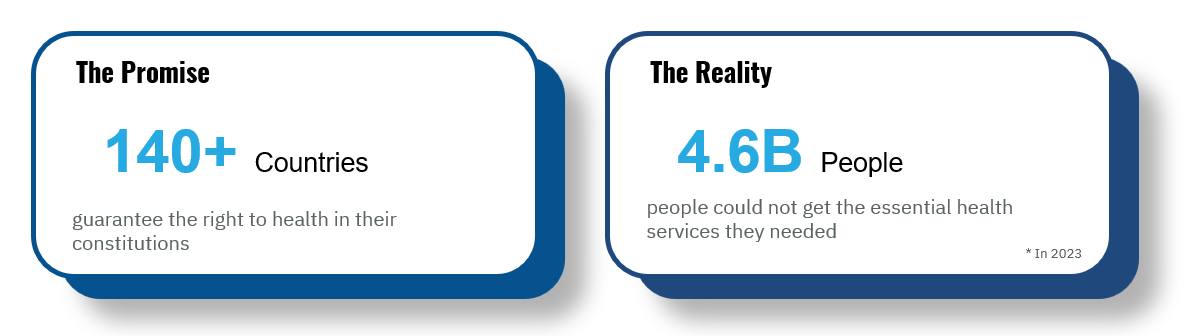
More than 140 countries guarantee the right to health in their constitutions.[1] Yet in 2023, about 4.6 billion people — more than half the world's population — still could not get the essential health services they needed.[2]
The distance between what governments have promised and what people actually receive shows up in 4 ways that are depicted in the graphic above.
These gaps are not only a failure of knowledge. Health systems around the world are under increasing pressure from funding cuts, service disruptions, technology innovations, growing complexity, and rising costs. At the same time, leaders in health are being asked to make increasingly higher-stakes decisions with limited resources under rapidly changing conditions. These pressures are exactly why the ISPOR Institute for Healthcare Transformation was created: to help health systems turn evidence into decisions that can succeed in the real world.
Healthcare systems do not improve simply because better evidence exists. Real transformation requires intentional collaboration and a clear goal to effect change. Many decisions impacting health fail not because the evidence is weak, but because implementation challenges were never fully considered. The ISPOR Institute focuses on helping stakeholders in health work through the structural, financial, political, and operational barriers that often prevent good decisions from leading to meaningful impact.
We believe that by connecting evidence-producers and decision makers earlier, we increase the chances that they will identify the information that’s needed to make better healthcare decisions and be in a stronger position to implement those decisions successfully. Better decisions impacting health happen when researchers, payers, policy makers, clinicians, industry, patients, and communities come together to identify challenges and share perspectives.
Graphic References: Accessible [3]; Effective [4] [5]; Efficient [6]; Affordable [2].
What Types of Issues Does the ISPOR Institute Work On?
The ISPOR Institute’s priorities focus on urgent decision making challenges facing health systems: improving equitable access to treatments and technologies; ensuring responsible integration of AI; grounding health decisions in real-world results; and setting patient-centered priorities in the face of spending constraints. In practice, these priorities often come together, as health systems make decisions that combine questions of access, evidence, affordability, implementation, and trust.
For example:
- Making equity usable in health technology assessment (HTA) and healthcare decision making. Equity expectations are rising, but practical approaches remain unclear and unevenly applied. The ISPOR Institute can help clarify the equity concern at issue and test approaches that make equity more explicit, predictable, and usable in real decisions.
- Aligning living HTA, public financial management, and real-world evidence. Health systems often assess value, set budgets, and track outcomes through disconnected processes. The ISPOR Institute can help define the shared data, governance, and feedback systems needed to connect spending, delivery, and outcomes over time.
- Building a better way to value prevention. Preventive technologies often create long-term health and economic value that current priority-setting approaches do not fully capture. The ISPOR Institute can help develop and test approaches that reflect the value of prevention across time, budgets, and populations.
- Making global evidence usable in local decisions. Evidence generated in one setting may not fully reflect local populations, disease patterns, health-system capacity, or delivery conditions elsewhere. The ISPOR Institute can help design governed approaches for adapting existing evidence so decision makers can use it more confidently and appropriately in their own contexts.
Learn more about the ISPOR Institute for Healthcare Transformation:
Reach out to the ISPOR Institute to learn more and discuss how partners play a role in transforming healthcare:
References
[1] Yamin, Alicia Ely, Filho, Luciano Bottini & Malca, Camila Gianella (2024). Analysing governments' progress on the right to health. Bulletin of the World Health Organization, 102(5), 307 - 313. World Health Organization. https://doi.org/10.2471/BLT.23.290184
[2] World Bank, World Health Organization. (2025). Tracking Universal Health Coverage: 2025 Global Monitoring Report. Geneva: World Health Organization and the International Bank for Reconstruction and Development / The World Bank.
[3] Low- And Middle-Income Countries Experienced Delays Accessing New Essential Medicines, 1982–2024, Olivier J. Wouters and Jouni Kuha, Health Affairs 2024 43:10, 1410-1419 10.1377/hlthaff.2024.00089
[4] Kruk M, Gage A, Arsenault C et al. High-quality health systems in the Sustainable Development Goals era: time for a revolution, The Lancet Global Health, 2018; 6, e1196-e1252
[5] Newman-Toker DE, Nassery N, Schaffer AC, et al, Burden of serious harms from diagnostic error in the USA, BMJ Quality & Safety 2024;33:109-120.
[6] OECD (2017), Tackling Wasteful Spending on Health, OECD Publishing, Paris, https://doi.org/10.1787/9789264266414-en