Treating Multiple Sclerosis Early and Aggressively in Mexico: What the Numbers Say
Karina Carrillo, MSc, National Institute of Neurology and Neurosurgery, Mexico City, Mexico; Víctor Gasca, MD, Mexican Social Security Institute, Mexico City, Mexico; Margarita Fuentes, MBA; Iliana González, MD, Merck S.A. de C.V., State México, Mexico; Pedro Oliva, MD, MSc; Nadia López, MSc, Mexico City, Mexico
 Four Realities of MS Treatment in Mexico
Imagine being diagnosed with multiple sclerosis (MS) in Mexico. Depending on where you live and which healthcare system you have access to, the treatment you receive or don’t receive could be vastly different from the patient in the next city. MS is a chronic immune-mediated disease that attacks the nervous system, and its most common form, relapsing-remitting MS (RRMS), causes episodic flare-ups that progressively accumulate neurological damage. Left uncontrolled, it can lead to severe, permanent disability.
Disease-modifying therapies (DMTs) represent the most significant therapeutic innovation in MS of the past 3 decades. Unlike symptomatic treatments, DMTs act on the underlying immune mechanisms of the disease, reducing the frequency of relapses and slowing the accumulation of disability. Moderate-efficacy agents include injectable interferons, glatiramer acetate, and oral options like teriflunomide and dimethyl fumarate; high-efficacy therapies include natalizumab, ocrelizumab, alemtuzumab, and cladribine tablets. The distinction matters: In clinical trials, high-efficacy DMTs reduce annualized relapse rates by 50–70% relative to moderate-efficacy agents, and observational data suggest they are associated with substantially lower long-term disability accrual.
Today in Mexico, 4 treatment realities coexist: some patients receive no DMTs at all; others get moderate-efficacy agents; some follow an escalation path starting with moderate-efficacy drugs and switching to high-efficacy ones only when the disease breaks through; and a growing number are now starting high-efficacy therapy early, right from diagnosis. This heterogeneity is driven not by clinical preference but by structural barriers: delayed diagnoses, unequal access across public and private systems, and limited availability of innovative therapies in the public sector.
The central question our research sets out to answer is a practical one: over 15 years, which approach delivers better outcomes for patients and for the health system’s budget?
Disease modifying therapies represent the most significant therapeutic innovation in multiple sclerosis of the past 3 decades.
What We Did
We built a Markov model (a simulation tool widely used in health economics) to follow a cohort of adult patients with active RRMS over a 15-year horizon. The model tracked patients moving between 4 disability states, defined by the Expanded Disability Status Scale (EDSS):
- Mild disability (EDSS <4, patients ambulatory and largely independent)
- Moderate disability (EDSS 4–6, patients with limited walking ability or requiring some assistance)
- Severe disability (EDSS ≥6, patients needing a wheelchair or bedridden, highly dependent on caregivers)
- Death
Transition probabilities between these states were drawn from published clinical literature, calibrated to reflect how each treatment strategy actually slows disease progression.
We modeled all 4 strategies head-to-head. Costs were assigned to each disability state and included everything relevant to a real patient’s burden: drug acquisition (with wastage factored in), hospitalizations, relapse management, neurology consultations, rehabilitation, out-of-pocket expenses, caregiver time, assistive devices, absenteeism, presenteeism, and early disability pensions. All costs were expressed in US dollars, applying a standard 5% annual discount rate. All cost inputs are original model estimates derived from Mexican institutional sources and national labor data; systematic reviews by Samjoo et al and Schauf et al informed the selection of cost categories included in the model.
What We Found
The results tell a clear story and one that should matter to clinicians, payers, and policy makers alike.
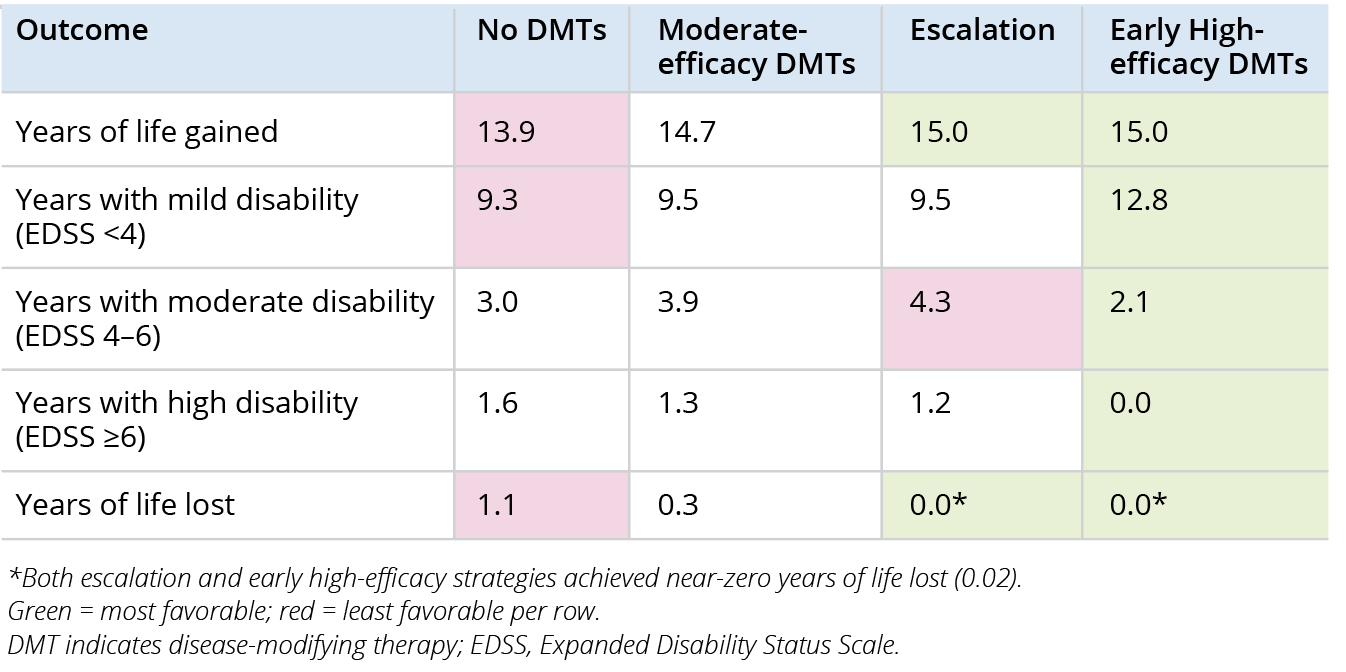
Clinically, early high-efficacy treatment changes the trajectory of the disease. As shown in Table 1, patients on early high-efficacy DMTs spent 12.8 of their 15 modeled years in the mild disability state, compared with just 9.3–9.5 years in all other strategies. Just as striking: under early high-efficacy treatment, patients accumulated zero years in the severe disability state, compared with 1.2–1.6 years under the other approaches. In practical terms, that means delaying years of dependence on caregivers and wheelchairs, along with lost productivity.
Table 1. Clinical Outcomes by Treatment Strategy (15-year horizon)
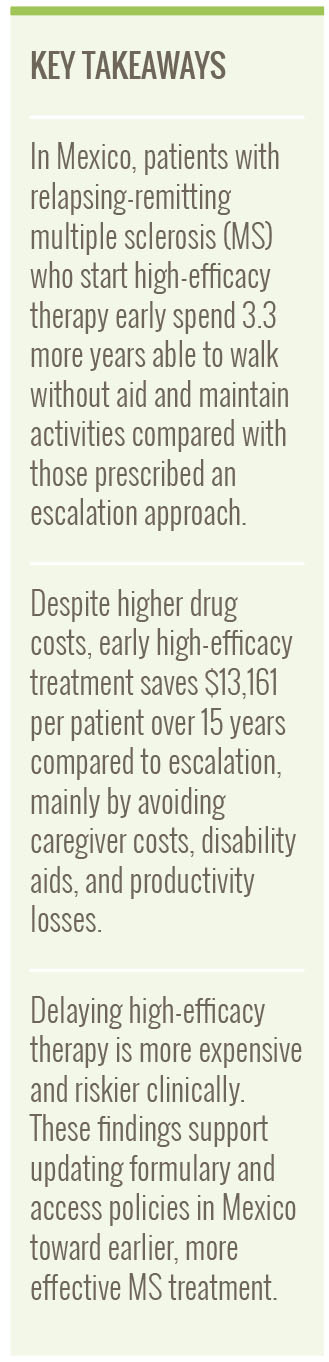
Economically, paying more upfront for better drugs costs less overall. This is the counterintuitive finding that deserves the most attention (Table 2). Early high-efficacy DMTs carry the highest direct drug costs ($155,186 over 15 years), yet their total discounted cost is $172,931, which is $13,161 less than the escalation strategy ($186,092). Why? Because early disease control dramatically reduces what gets spent on caregivers, home support, disability devices, and lost wages. Nonmedical and indirect costs under early high-efficacy treatment are 57% lower than under no-DMT scenarios. Those savings more than offset the higher drug bill.
Table 2. Total Discounted 15-year Costs per Patient by Treatment Strategy (USD)
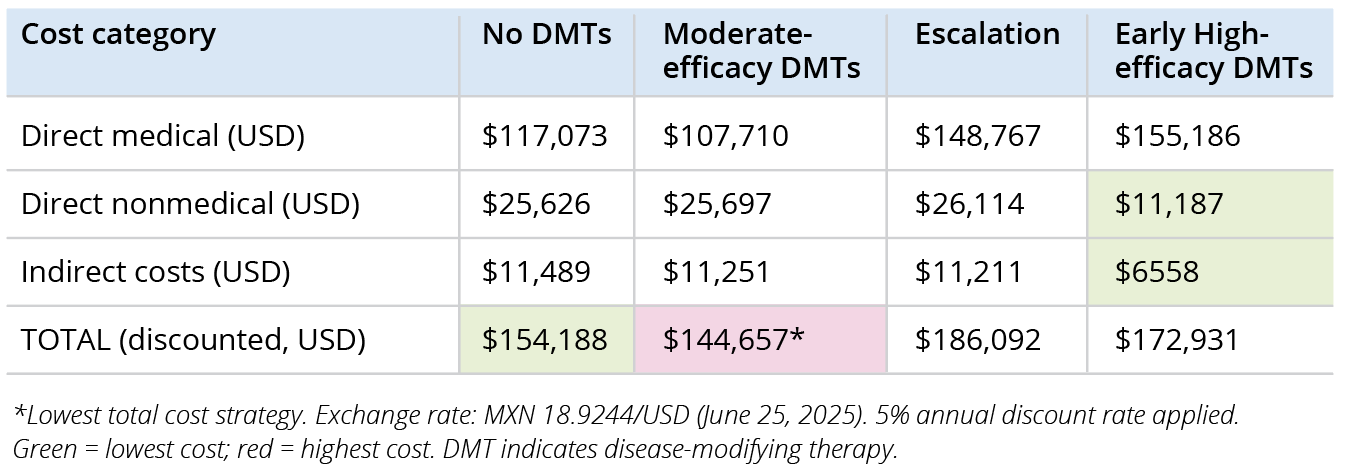
The escalation strategy, by contrast, combines the drug costs of 2 sequential therapy lines with the disability costs accumulated while waiting for a treatment switch, making it both more expensive and less clinically efficient than early high-efficacy DMT initiation.
Lessons Learned
What worked
- Adopting a societal cost perspective was a key methodological choice and one that changed the conclusions. From a narrow healthcare budget perspective, early high-efficacy treatment appears to be the most expensive option due to higher drug costs. It is only when caregiver burden, productivity losses, and disability aids are included that the full picture emerges: early high-efficacy treatment becomes the more cost-efficient option compared to escalation. Decision makers who operate under a strict healthcare budget perspective may still weigh these trade-offs differently depending on their mandate.
- Modeling all 4 coexisting strategies rather than just comparing 2 gave decision makers a realistic picture of the Mexican landscape. It surfaced the counterproductive economics of the escalation paradigm in a way a simpler comparison would not.
- Applying EDSS-based health states made clinical and economic outcomes directly linkable: Each year spent in the severe disability state has a calculable cost in caregiving, devices, and lost productivity.
Limitations
- Not including quality-adjusted life years (QALYs) limits the study’s formal cost-effectiveness claims. A future version should incorporate utility weights so that the results can feed directly into health technology assessment (HTA) decisions, which typically require an incremental cost-effectiveness ratio.
- Transition probabilities came from published literature, not Mexican real-world data. Local registry data, when available, would make this model significantly more credible to national regulators.
- The 15-year horizon may still understate the full benefit. MS is a lifelong disease; extending the simulation to 20–25 years is likely to widen the cost advantage of early high-efficacy treatment as disability divergence compounds over time.
Implications for stakeholders
- Payers and HTA bodies: Consider incorporating indirect and nonmedical costs into assessment frameworks, as a budget-only perspective may underestimate the full societal burden of MS disability beyond drug costs.
- Formulary committees in public institutions (IMSS, ISSSTE, IMSS Bienestar): This analysis provides cost and outcomes data that can inform access decisions. The findings suggest that restricting high-efficacy agents to patients who have already failed moderate-efficacy therapy may generate higher downstream disability-related costs; this evidence can be one input in formulary deliberations.
- Clinical guideline developers: The escalation paradigm is not just clinically suboptimal. This analysis shows it is also economically inefficient in the Mexican healthcare context. Guidelines should reflect that evidence.
Why This Matters Beyond Mexico
The story here is not unique to Mexico. In many middle-income countries, treatment access for MS is shaped by the same structural constraints: inadequate diagnosis infrastructure, fragmented payer systems, and risk aversion toward high-cost drugs. The lesson from this analysis is transferable: When you account for the full downstream costs of uncontrolled disability, early intensive treatment often costs less, not more than sequential escalation.
The HEOR community has a role to play in making that argument visible to the right audiences. Models like this one are decision tools. Their value lies not just in the numbers they generate, but in placing those numbers in front of the people who set formularies, write guidelines, and allocate health budgets and helping them see that spending on better treatment today is, in many cases, an investment that pays for itself.
Funding & Disclosures: This study was sponsored by Merck Biopharma Distribution S.A. de C.V., Mexico, an affiliate of Merck KGaA, Darmstadt, Germany (CrossRef Funder ID: 10.13039/100009945). Margarita Fuentes and Iliana González are employees of Merck Biopharma Distribution S.A. de C.V., Mexico, an affiliate of Merck KGaA, Darmstadt, Germany. All other authors declare no additional conflicts beyond the sponsorship relationship. The work was presented as poster EE130 at ISPOR Europe 2025, Glasgow, UK, November 9–12, 2025.