Smartphone-Based Screening Could Change the Economics of Obstructive Sleep Apnea Care
Marcel Braun, PhD, MBA, University of Duisburg-Essen, Essen, Germany
 A Silent Epidemic Hidden in Plain Sight
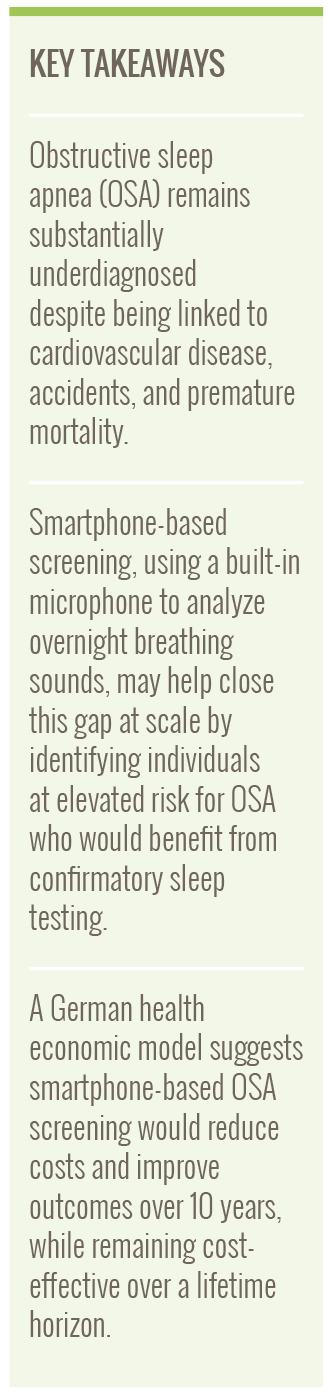
Obstructive sleep apnea (OSA) is one of the most common chronic disorders that health systems still struggle to detect efficiently. Although prevalence estimates suggest that up to 50% of adults may be affected in some countries, a large proportion of moderate-to-severe cases remain undiagnosed for years. This diagnostic gap matters because untreated OSA is not simply a sleep disorder. It is associated with increased risks of cardiovascular disease, stroke, road traffic accidents, reduced workplace productivity, and premature mortality.
The downstream burden extends far beyond sleep clinics and affects employers, insurers, and healthcare systems broadly, and furthermore, the condition is associated with substantial economic impact through healthcare utilization, accidents, and productivity losses. A 2023 systematic review of 31 studies reported annual cost estimates ranging from €1,669 to €5,186 per patient and found that OSA-related costs can increase years before diagnosis.
Yet the conventional diagnostic pathway is difficult to scale. Traditional instrumental sleep assessments require specialist infrastructure, trained personnel, and waiting lists that often delay diagnosis and treatment initiation. The first-line treatment for OSA is positive airway pressure (PAP) therapy, which aims to maintain airway patency during sleep via a face mask and has been associated with reduced risk of all-cause mortality and cardiovascular mortality in patients with OSA. Because PAP requires regular use to prevent airway obstructions, the extent to which modeled benefits are realized in practice depends on successful initiation as well as sustained and consistent use.
This raises an important question for stakeholders: What if diagnosis could be shifted earlier and made substantially more accessible? Digital health technologies, particularly smartphone-based tools, may offer an answer.
Why Smartphone-Based Screening Matters
Smartphone-based applications that record nocturnal breathing sounds through the phone’s built-in microphone and analyze acoustic patterns to estimate the risk of OSA represent an emerging approach to accessible, inexpensive screening in which app-based identification of an elevated risk triggers a referral for confirmatory sleep testing. The smartphone technology should not be considered a replacement for gold-standard diagnostics, but it can change who enters the diagnostic pipeline in the first place. In our study, presented at ISPOR Europe 2025, we evaluated the cost-effectiveness of a smartphone-based screening application for identifying individuals at risk for moderate-to-severe OSA.
The concept is straightforward:
- Large populations can be screened at low cost and low friction.
- High-risk individuals can then be referred for confirmatory testing.
- Earlier diagnosis may enable earlier treatment initiation.
- Earlier treatment could reduce downstream complications and costs.
This “triage-first” approach resembles digital transformation already occurring in other disease areas, such as atrial fibrillation screening, where scalable front-end screening tools help prioritize limited specialist resources. Importantly, the economic value is not generated by the app alone. It emerges from changing the timing of diagnosis and intervention.
What if diagnosis could be shifted earlier and made substantially more accessible? Digital health technologies, particularly smartphone-based tools, may offer an answer.
What We Modeled
We developed a Markov model from the perspective of German statutory health insurance (SHI) comparing smartphone-based screening versus no systematic screening.
The model simulated a cohort entering at age 50 years and followed it over a 10-year horizon (approximately to age 60 years) and over a lifetime horizon. The model incorporated:
- screening uptake
- confirmatory sleep investigation and treatment initiation
- long-term treatment adherence
- cardiovascular complications, road traffic accidents, mortality
- quality-adjusted life-years (QALYs)
- healthcare costs and the incremental cost-effectiveness ratio (ICER) calculated as the difference in costs divided by the difference in QALYs between screening and no screening
The model also reflected an important real-world challenge: diagnosis alone is insufficient. Clinical benefits depend on patients successfully progressing through the pathway from screening to confirmatory testing to sustained treatment adherence.
The Modeled Economic Signal Was Strong
Over a 10-year horizon, smartphone-based screening generated more QALYs at lower cost than no screening, and was hence economically dominant in both male and female populations. In practical terms, this means the strategy both improved outcomes and reduced costs.
Over the 10-year horizon, compared with no screening, the model projected:
- approximately 18% lower healthcare costs
- 20% higher QALYs
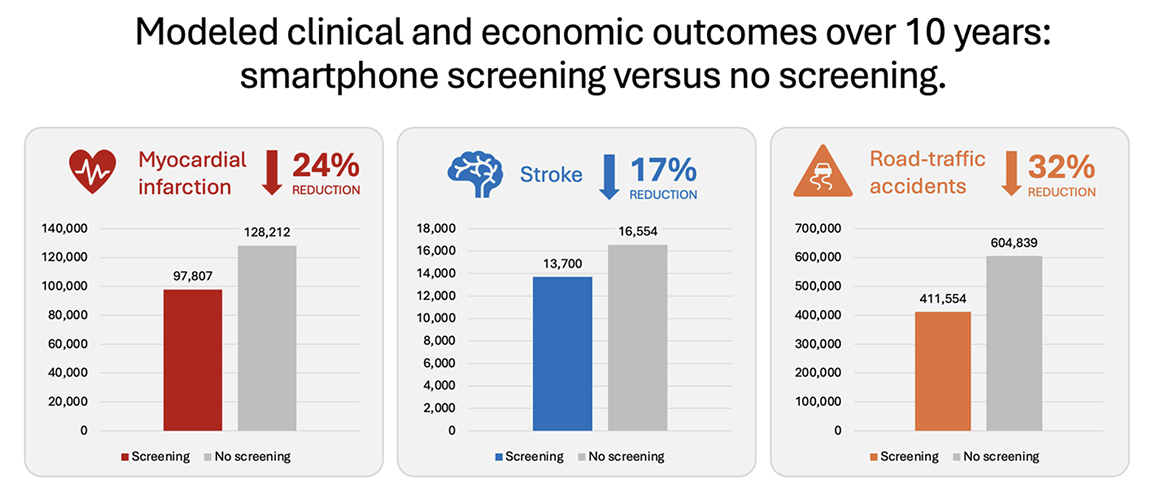
- fewer clinical events (Figure 1) and
- lower mortality
Over the lifetime horizon, the model projected higher total costs with screening because longer modeled survival generated additional years of healthcare use. Nevertheless, the resulting lifetime ICERs remained below the illustrative cost-effectiveness benchmark of 50,000 EUR applied in the analysis.
Figure 1. Earlier detection and treatment of OSA through smartphone-based screening can prevent serious health events while reducing burden on the healthcare system (population-based modeling with ~5.6 m. women and men aged 50 years and time-horizon of 10 years).
Survival and Outcomes
One of the more interesting findings from the analysis was how strongly survival influenced long-term outcome interpretation. Over a lifetime horizon, individuals in the screening arm lived substantially longer, resulting in more cumulative years at risk for age-related health events (Figure 2).
Figure 2. Longer lifetime changes the interpretation of lifetime event counts in economic assessment of preventive screening technologies. Over a lifetime horizon, longer modeled survival generates additional person-time at risk and changes the age distribution of the surviving population. Absolute event counts and crude rates that are not age-standardized should therefore be interpreted alongside survival and QALY outcomes.
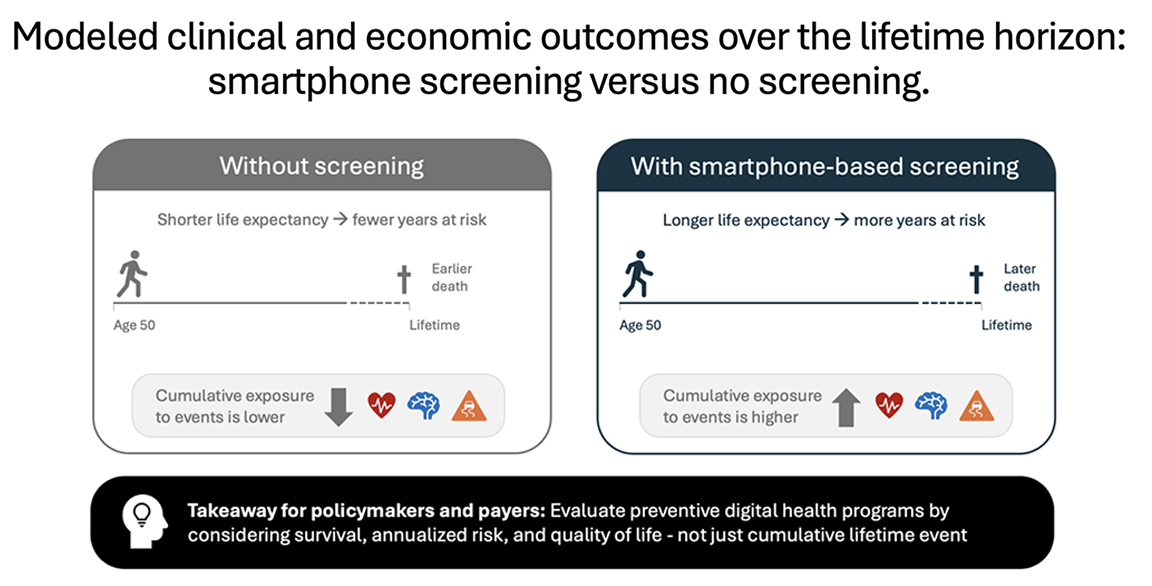
This highlights an important principle in preventive health economics: effective interventions can sometimes generate higher cumulative lifetime numbers of events simply because patients survive longer. This leads to more events occurring because more life-years are gained, and not because outcomes worsen.
In our model, when outcomes were interpreted relative to survival time, screening was consistently associated with lower annualized risk exposure, particularly for road traffic accidents.
The broader message is that preventive digital health interventions should be evaluated not only by cumulative event counts, but also by their effects on survival, quality of life, and time at risk. For policy makers and payers, this distinction becomes increasingly relevant as digital screening programs are evaluated over long time horizons and across large populations.
A New Bottleneck
Digital screening technologies are advancing rapidly. This means that, in many situations, organizational challenges may be greater than technological ones. Our analysis suggests that the economic value of smartphone-based OSA screening depends heavily on implementation factors, such as screening uptake, confirmatory diagnostic capacity, treatment initiation, and long-term therapy adherence.
This means digital screening tools only create value if the corresponding downstream pathway can handle increased volume. A scalable front-end screening strategy could overwhelm sleep laboratories if diagnostic capacity is not expanded simultaneously. Likewise, poor treatment adherence could erode much of the projected long-term benefit.
This has important implications for payers and health systems considering digital OSA programs. Reimbursement discussions should not focus exclusively on the digital tool itself, but on the performance of the entire care pathway.
Lessons Learned
This work also highlights broader lessons for HEOR evaluations of digital health technologies.
Digital interventions should not be assessed solely as standalone products. Their value often depends on pathway redesign and operational integration. The economics of preventive digital interventions may also depend on the
time horizon selected. Short-term analyses may show cost savings, whereas lifetime analyses often capture the economic consequences of improved survival.
Implementation assumptions matter. In our model, parameters such as treatment adherence and disease prevalence had greater impact on results than the screening cost itself (Figure 3). It may look paradoxical that reduced mortality is the strongest driver of economic value while also raising lifetime costs. Net monetary benefit reconciles the 2 findings by weighing the monetized value of health gained against the additional spending. Preventing premature death adds many QALYs, and at conventional willingness-to-pay thresholds, the value of those years far outweighs the extra age-related care that typically accompanies a longer life.
Figure 3. Top drivers of Net Monetary Benefit: One-way sensitivity analysis showing how the economic value of smartphone-based OSA screening responds when each key model parameter is varied across its plausible range.
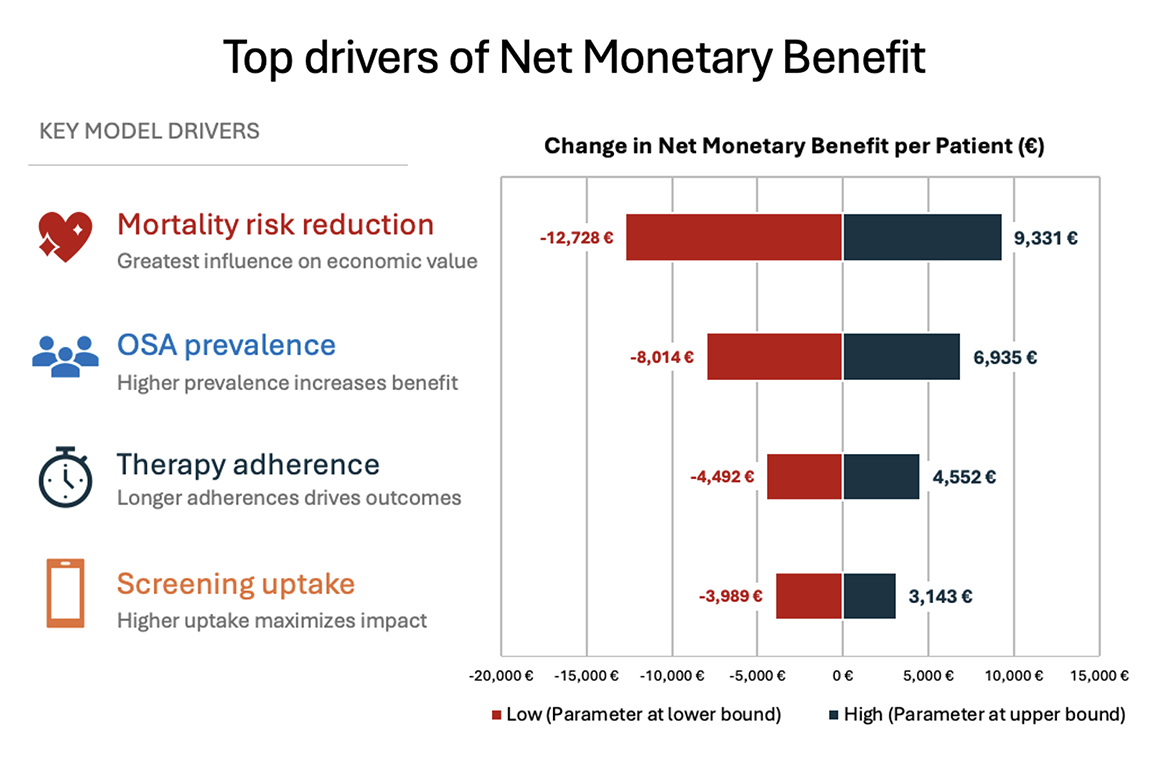
Mortality reduction lifts both costs and health, but the health gain is by far the larger movement.
Published economic evaluations of digital health interventions are heterogeneous in their methods and analytical perspectives, which limits comparison across interventions. Our model necessarily simplifies real-world processes, such as spontaneous diagnosis, switching of treatment modalities, or digital literacy barriers.
Next Steps for Decision Makers
For healthcare systems facing growing demand and capacity constraints, smartphone-based OSA screening may represent an opportunity to modernize access to care. But implementation should proceed pragmatically.
Three priorities appear especially important:
- Integrate screening into structured pathways: without confirmatory testing of patients identified as at-risk, followed by treatment of those who are confirmed, screening is unlikely to deliver meaningful value.
- Measure real-world adherence to treatment and retention: long-term effectiveness in chronic conditions—which affects the value of screening—depends heavily on sustained treatment use.
- Evaluate equity and digital access: smartphone-based pathways must not widen disparities among older adults or digitally underserved populations.
The broader implication extends beyond sleep medicine. OSA may become an important example of how health systems can evaluate and operationalize scalable digital screening technologies more generally.
AI disclosure: The author used an AI-based language tool to improve the English-language phrasing and readability of this article. The tool was not used to generate content, conduct analysis, or interpret results. The author reviewed and edited all text and is solely responsible for the accuracy and integrity of the work.