Innovating Evidence for Medical Device and Diagnostic Technologies: Connecting Data, Patients, and Decisions
Arturo Cabra, MSc, GE HealthCare, Miami, FL, USA; Belinda A. Mohr, PhD, Medtronic, Phoenix, AZ, USA
Three Breaks in the Medical Technology Evidence Chain
ISPOR 2026 in Philadelphia put the medical devices and diagnostics (MD&D) community on full display: 3 scientific presentations, a dedicated MD&D Special Interest Group (SIG) meeting, a research podium, and a short course; one of those sessions was delivered jointly with the Digital Health SIG. Together, these sessions showcased the field’s growing methodological rigor and cross-stakeholder collaboration but also surfaced a shared throughline: good medical technology isn’t enough without the evidence infrastructure to connect data, patients, and decisions.
This article looks at 3 such breaks:
- Making device and diagnostic data traceable across care settings,
- Building the infrastructure for patients to co-design the digital endpoints and biomarkers meant to represent them, and
- Making evidence decision-relevant for the payers, regulators, and health technology assessment (HTA) bodies who act on it.
The article—grounded in real examples pulled directly from the ISPOR 2026 sessions—asks whether the digital infrastructure now emerging across MD&D can close these breaks, generating evidence that is continuous, patient-anchored, and decision-relevant in ways that weren’t possible before. Viewed together, the sessions also point the field toward the concept of an integrated life-cycle evidence plan that keeps evidence traceable, meaningful, and actionable from product use through decision making.
Break 1: Traceable Evidence to Preserve Product Identity
The problem begins long before any analysis is run: although identification standards exist, device- and diagnostic-specific identifiers do not reliably survive the trip from point of care into the data sources used for real-world evidence. The evidence problem is not a lack of data, but loss of product identity. A stent may be scanned in the cath lab or a diagnostic assay may be recorded precisely in the lab, yet by the time those encounters reach electronic health record (EHR) extractions, claims files, and registries, the details that matter—brand, model, version, platform—have often vanished.
This erosion of identity creates a quiet but consequential distortion. When a device’s model or a diagnostic’s platform collapses into a generic procedure or test code, the resulting evidence can obscure meaningful differences. Comparative effectiveness studies lose granularity. Postmarket surveillance becomes too coarse to be useful. Risks related to diagnostic real-world evidence (RWE) become nonactionable because the specificity needed to interpret results is buried in narrative notes or lost in translation between systems.
Identity breaks down in predictable ways across the systems that handle device and diagnostic data. Supply-chain tools may preserve unique device identifier (UDI) and lot numbers, EHR notes may preserve context, claims systems may preserve utilization, and laboratory information systems may preserve result values—but each preserves only a fragment. No single system carries the full identity forward. The result is a data trail that begins with precision and ends with generalities, leaving decision makers with evidence that lacks the specificity needed for informed decisions.
Capturing identity at the source, maintaining robust master data, linking systems at the point of exposure, and abstracting residual narrative with modern language models all help rebuild what the data pipeline erodes. Several pragmatic solutions are already emerging, including linking device registration and device-generated data to downstream outcomes sources such as claims and EHRs, linking clinical trial and registry data to outcomes datasets for longitudinal follow-up, and using chargemaster data to identify specific products in comparative safety analyses. Still, even the most sophisticated linkage and extraction strategies do not eliminate the need for validation, governance, and evidence that is demonstrably fit for purpose.
In the end, the challenge is evident but hard to solve; RWE is only as trustworthy as the product identity it carries forward. If product-level identity is lost along the way, the resulting evidence may be too aggregated to distinguish meaningful differences across technologies.
Example in context: The US Food and Drug Administration’s Systemic Harmonization and Interoperability Enhancement for Laboratory Data (SHIELD) pilot showed how quickly diagnostic identity drifts once tests enter real clinical systems. That pilot found that only 59% of Logical Observation Identifiers Names and Codes (LOINC codes) recommended by diagnostic test manufacturers matched the LOINC codes used in medical center laboratories for the same tests. Naming and coding practices used by local laboratory information systems led to mismatches in the remaining 41%. Without harmonized identity, diagnostic RWE cannot reliably compare tests or interpret results across sites.
A stent may be scanned in the cath lab or a diagnostic assay may be recorded precisely in the lab, yet by the time those encounters reach electronic health record extractions, claims files, and registries, the details that matter—brand, model, version, platform—have often vanished.
Break 2: Meaningful Evidence – Start With What Matters to Patients
Patients live their lives between clinic visits—not inside them—and the signals that matter most to them often happen in those in-between spaces. As digital tools move into everyday use, from wearables to home sensors to passive monitoring, they promise to capture what patients experience in real time rather than at the next appointment. That promise is powerful, but it raises questions that most programs skip: who decides what is worth measuring, and how will those data connect to the broader clinical record?
The problem is not a lack of digital capability. It is the absence of patient input early enough to shape the endpoint itself, combined with infrastructure’s limited ability to link patient-generated data to EHRs, claims, and other systems across care settings.
Without linkage infrastructure, even well-designed measures may remain isolated signals rather than evidence that can inform decision makers. Instruments migrated from paper to a digital format can lose the meaning they were designed to capture, even when the conversion is technically sound.
Without patient input, digital endpoints risk measuring what is technically feasible rather than what is meaningful to the people living with the condition. Skipping patient input can add burden, reduce adherence, and leave technically sound measures disconnected from clinical workflows and reimbursement decisions. Digital endpoints and biomarkers therefore need to be meaningful to patients and credible to the clinicians, regulators, and payers who will act on them.
Conceptual validity—defining what matters to patients before selecting a sensor or algorithm—must be the first step. Without it, the technology may advance while the endpoint drifts from lived experience.
A digital endpoint built with patients from the start is also the one built to answer the questions patients, clinicians, payers, and regulators are already asking—the same audience Break 3 turns to next.
Break 3: Actionable Evidence, Designed for the Decision
Good evidence and good decisions do not always go hand-in-hand. Even when product identity is preserved upstream (Break 1) and patient-centered endpoints are built in collaboration with patients and backed by infrastructure to connect digital data to the broader care journey (Break 2), the evidence can still fail to influence the people who ultimately decide. Across medical devices and diagnostics, decision-readiness depends on 3 distinct elements: relevance and format, timing, and methodological credibility. Technologies often fall short on more than one of these elements.
When identity, relevance, and usability stay connected from the moment a product is used to the moment a decision is made, real-world evidence becomes what it was always meant to be: a tool that improves care, rather than just describing it.
Procurement makes this tension easiest to see. Interviews across 6 European countries—part of an ongoing MD&D SIG project that includes a manuscript currently in preparation—showed that HTA and procurement are not integrated. Where they do connect, it is usually informal—for example, a procurement team reading an HTA report after the fact rather than shaping the decision together.
Two problems sit inside that disconnect. One is format: in interviews, procurement teams asked for shorter, more actionable outputs built around what a purchasing decision actually needs: budget impact, eligible population, implementation requirements, organizational effects, and timing aligned to the tender calendar. The other is criteria: Procurement teams weigh supply resilience, clinician preference, sustainability, and contract terms alongside affordability. Evidence built for HTA can be perfectly adequate for HTA’s purpose and still arrive at procurement unusable, simply because it answers different questions.
Timing creates its own kind of failure. Evidence can be perfectly accurate and still arrive too late to matter, especially when economic questions are addressed only after pivotal data are locked in. Early economic modeling is more useful as an iterative part of development, helping teams clarify value drivers, test scenarios, and reduce commercial risk long before major decisions become difficult to reverse. This is the case not just for earlier modeling, but also for modeling that evolves as the technology evolves. When that process is delayed, the evidence eventually generated may be exactly right, but its usefulness will be limited if it lands after the investment, design, and strategic decisions it could have shaped are already fixed in place.
Example in context: The Device Economic Evaluation Methodological Quality (DEEM-Q) checklist, developed through a Delphi process with 40 health economists, illustrates what decision-ready evidence can look like. It provides a consensus framework for assessing the methodological quality and reporting of device economic studies—addressing the credibility component of decision readiness.
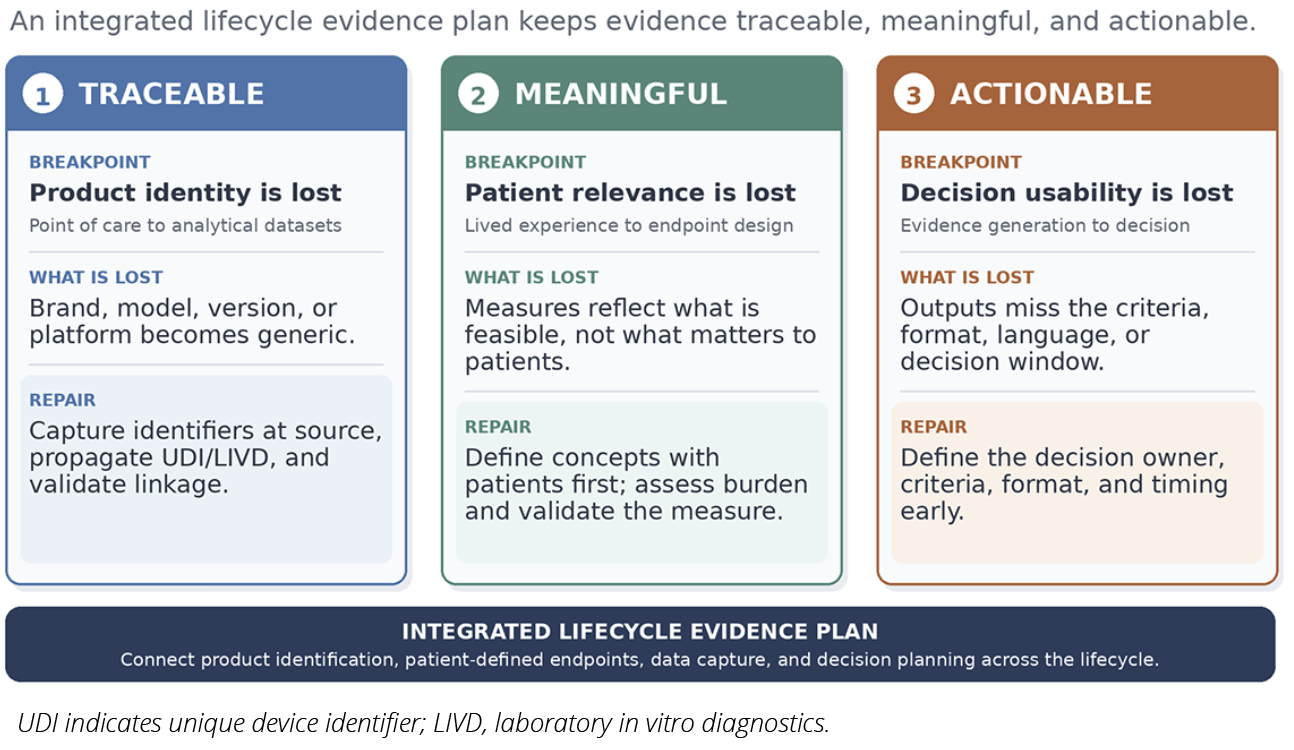
Figure. Three breaks in the medical technology evidence chain
Reconnecting the Evidence Chain
Across identity, patients, and decisions, the pattern is the same: evidence breaks when continuity breaks. Product identity erodes as data move through systems. Patient relevance fades when endpoints are built around what can be measured rather than what should be understood. Decision maker usability collapses when evidence arrives in formats, timelines, or languages that do not match the decision that must be made. These breaks are the result of fragmented processes.
One potential path forward is an integrated evidence-generation plan, an approach used more often in pharma that could be adapted to medical devices and diagnostics. Rather than treating evidence development as a series of disconnected activities, it aligns product identification, data capture, endpoint development, and evidence planning across the technology life cycle. For medical devices and diagnostics, that means preserving product identity at the point of care, linking digital and clinical data across settings, engaging patients early to define meaningful endpoints, and generating evidence iteratively in formats decision makers can use.
When identity, relevance, and usability stay connected from the moment a product is used to the moment a decision is made, RWE becomes what it was always meant to be: a tool that improves care, rather than just describing it.