Artificial Intelligence in HEOR: From Potential to Practice in Standards, Oversight, and Real‑World Implementation
Kathy Lang, PhD; Ross Maclean, MD; Precision AQ, New York, NY, USA
Introduction
Health economics and outcomes research (HEOR) has long served as a cornerstone for evidence‑based decision making—guiding policy, reimbursement, and clinical practice through rigorous evaluations of patient outcomes, healthcare costs, comparative effectiveness, disease burden, cost‑effectiveness, and budget impact. Traditionally, HEOR has relied on structured methodologies—including systematic literature reviews, network meta‑analyses, economic modeling, and observational research—to assess the value of medical interventions. Today, artificial intelligence (AI), machine learning (ML), and large language models (LLMs) are reshaping the HEOR workflow across literature review, data extraction, simulation, and reporting.
The potential for AI in HEOR is clear. Less clear is what that potential looks like in terms of responsible adoption of AI and the conditions that must be met for the technology to be trusted. Trust is essential, given that HEOR directly informs reimbursement, pricing, and access decisions that affect millions of patients and billions of healthcare dollars.
Successful adoption of AI in HEOR will depend on internal and external governance, transparency, accountability, and organizational readiness, as opposed to technological capability alone, to establish trust among health technology assessment (HTA) agencies and other decision makers.
What Constitutes Credible AI-Enabled HEOR
AI tools are being tested to automate and augment core tasks across HEOR, including the analysis of evidence bases, identification of gaps in care, and sizing of unmet need.
- Targeted and systematic literature reviews can be expedited via natural language processing (NLP) and interactive searches.
- LLMs can apply predefined inclusion/exclusion criteria, extract key data points, and produce concise summaries.
- In health economic evaluations, AI can be used to support cost‑effectiveness and budget‑impact models by driving country adaptations and parameter documentation.
- ML can be used in real-world evidence (RWE) studies to process large claims and electronic health record datasets and evaluate patient treatment patterns, healthcare resource utilization and costs, and predictors of outcomes.
- NLP can be used to extract outcomes from trials and publications to populate models.
- GenAI can be used to automate sensitivity analyses, synthetic patient scenarios, and model adaptation and documentation, subject to fit‑for‑purpose validation and expert review.
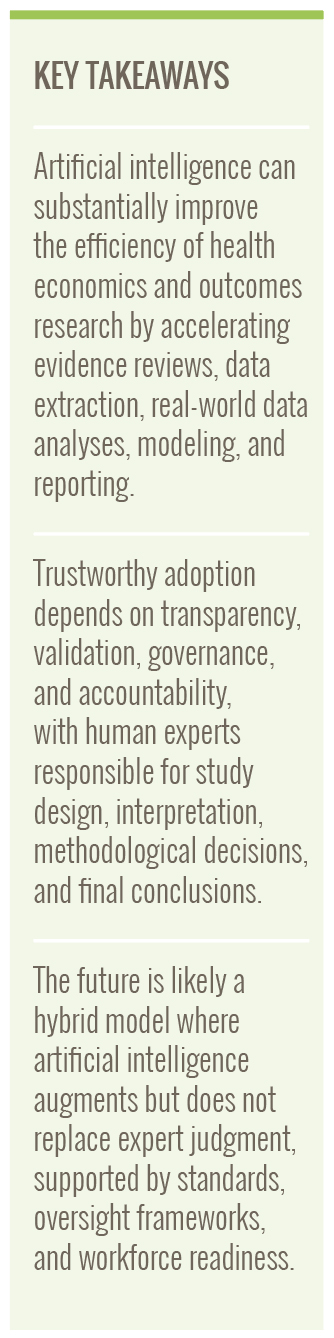
While these enhancements can enable substantial time savings, in a field that relies on and prioritizes expert peer review, they must be used in a way that is transparent and verifiable if they are to be trusted and accepted. This is particularly important given the challenges associated with their use. Currently, AI cannot apply scientific judgment or anticipatory strategic thinking in drawing conclusions and making recommendations, and it cannot make methodologic judgments required in building models or interpreting evidence. It also cannot foresee and account for evolving patient, provider, payer, and HTA preferences and priorities. Furthermore, AI can infuse bias if the data on which it is trained are incomplete or nonrepresentative. As a result, unchecked use of AI creates the risk of introducing factual inaccuracies, hidden biases, inconsistent reasoning, and erroneous conclusions that undermine the credibility of generated evidence.
The likely trajectory is a hybrid intelligence model with workflows that intentionally combine the computational power of AI with expert human judgment and guidance to ensure reproducibility and validity. Trained human experts must remain the drivers and decision makers to ensure that AI augments decision making and doesn’t replace it.
Trained human experts must remain the drivers and decision makers to ensure that AI augments decision making and doesn’t replace it.
Published guidance for AI use in HEOR consistently references the need for transparency, validation, accountability, and auditability, all of which necessitate human expert oversight. Early HTA position statements from the National Institute for Health and Care Excellence in the United Kingdom and Canada’s Drug Agency, as well as Joint Clinical Assessment dossier preparation guidance from the European Union’s member state HTA Coordination Group, stress the need for human oversight, explicit justification of AI use, and full disclosure of methods and data—positioning AI to augment, not replace, expert judgment in HTA. Standards such as CHEERS-2022 and CHEERS‑AI and evolving LLM reporting guidance (eg, ELEVATE‑GenAI) also define consistent expectations for transparency, accuracy, and reproducibility, including specifying what to disclose when LLMs contribute to synthesis, drafting, or coding.
The ISPOR Generative AI Working Group offers a shared taxonomy (eg, retrieval‑augmented generation, prompt engineering, domain fine‑tuning) to improve accuracy, traceability, and reproducibility across systematic literature reviews, RWE, and modeling. The International Committee of Medical Journal Editors have outlined similar priorities related to transparency, accountability, disclosure, and responsibility in using AI for the drafting of peer-reviewed publications.
Together, these frameworks establish a shared floor of accountability that makes AI-assisted HEOR legible to HTA agencies, journals, and payers alike.
The Role of Human Accountability in Driving Credibility
As drivers of AI activity, human experts must remain responsible and accountable for all aspects of an HEOR workflow; it is not sufficient for a human to be simply “in the loop”. The emerging distinction between human-in-the-loop, where experts approve each AI output at defined checkpoints, and human-over-the-loop, where experts set parameters and review final outputs, has direct implications for how accountability is assigned in HTA submissions. Table 1 illustrates how this accountability should be distributed across core HEOR activities.
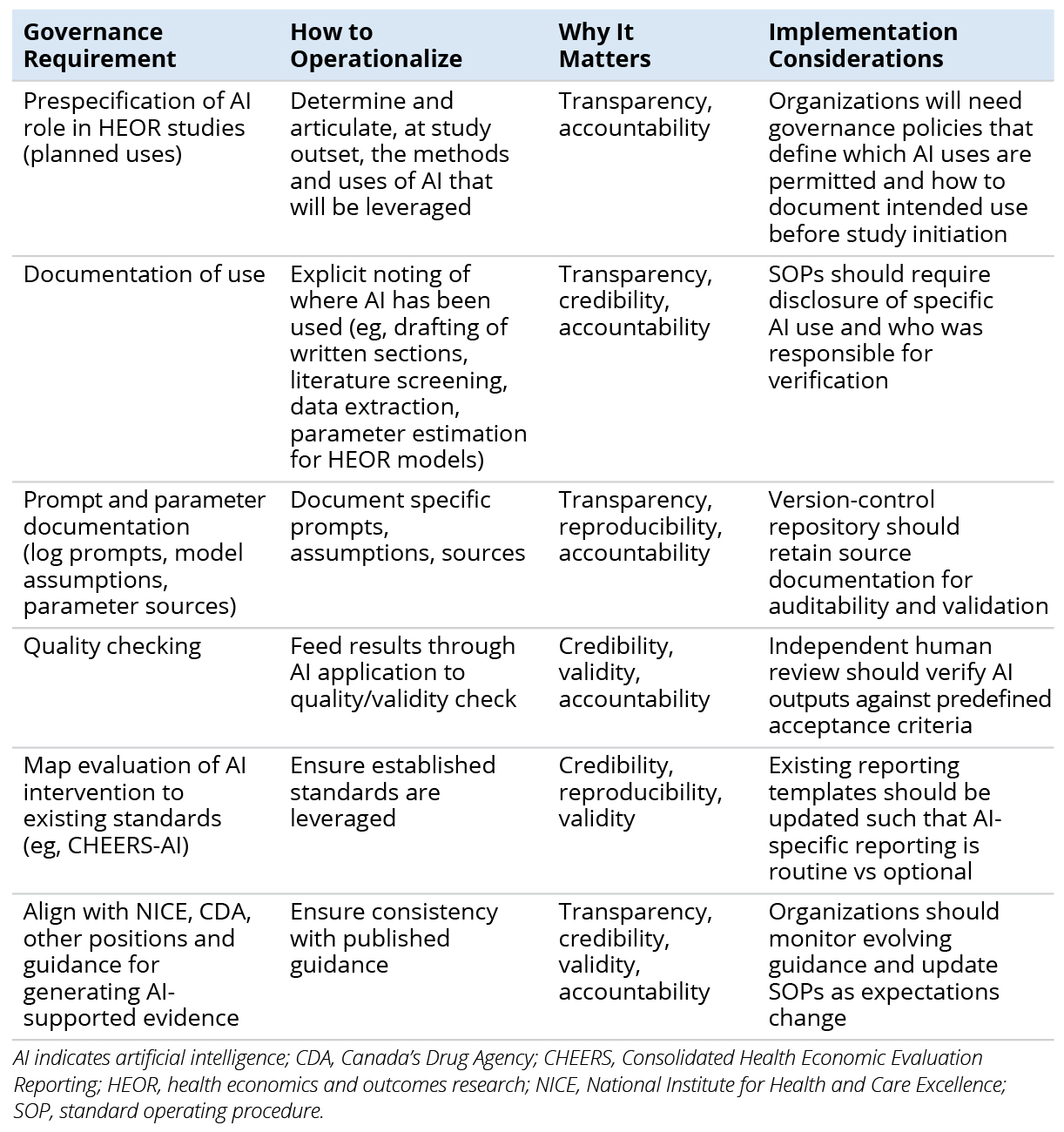
Operationalizing credible AI use in HEOR requires governance policies that evolve alongside the technology. Table 2 outlines key controls, their rationale, and implementation considerations for HEOR.
Table 1.
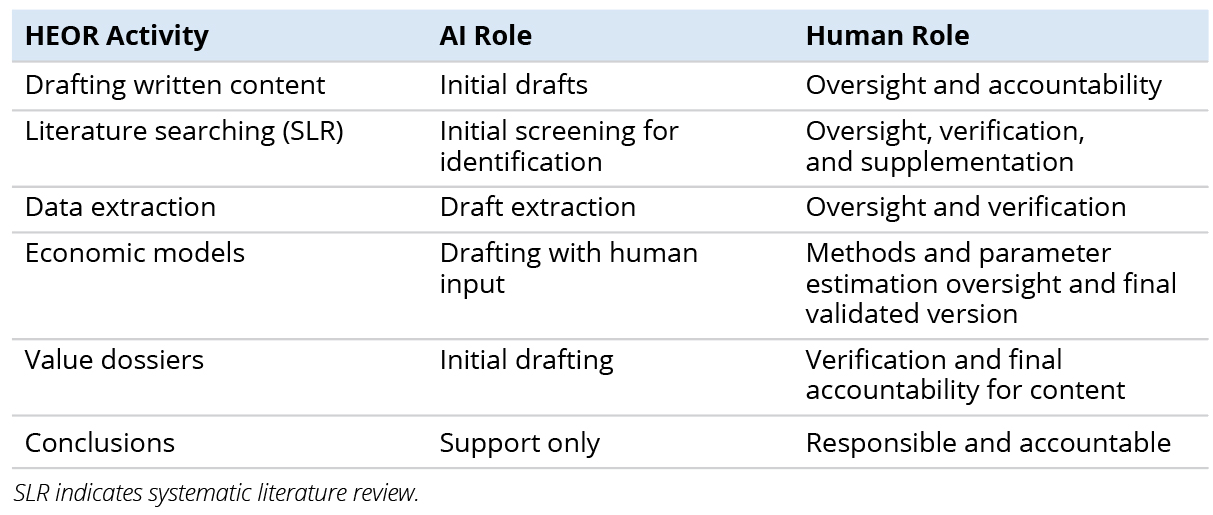
Table 2.
Workforce and Organizational Readiness
To prepare for the future, HEOR professionals at all career stages will need training alongside emerging AI competencies to maintain methodologic standards in an AI-augmented environment. Core AI competencies for HEOR professionals include:
- Rigorous prompt/query design for conducting and validating research
- Methodologic validation of AI-generated outputs
- Identification of potential bias or inaccurate conclusions
- Documentation skills and awareness of internal and external AI governance rules and requirements
To guide responsible use of AI, organizations will need to build out governance policies, validation procedures for all AI applications, version control systems, audit trails, and staff training programs. Given the rapid pace of AI advancement, these processes and procedures should be designed to be living documents that are regularly reviewed and updated by human experts as AI technologies evolve.
Conclusion
AI is not a replacement for human expertise, although it is a powerful partner. Teams that understand where AI adds value and where human judgment must prevail will lead. With appropriate standards and oversight, AI-assisted HEOR can deliver more efficient and credible evidence to support health technology decisions.
The defining challenge for the next decade of HEOR will not be whether AI can generate evidence. It will be whether organizations can establish appropriate governance, accountability, and rigor sufficient for HTA, payers, clinicians, and patients to trust AI-assisted evidence.
Disclosures:
Authors Lang and Maclean are employees of Precision AQ, a consultancy offering AI-assisted HEOR services where appropriate.
ChatGPT (OpenAI) was used to assist with drafting selected sections of this paper, improving language and organization, and editing for clarity and conciseness. The conceptual framework, interpretation of the evidence, opinions expressed, and final content were developed and critically reviewed by the authors. The authors verified all factual statements, references, and citations and accept full responsibility for the accuracy, originality, and integrity of the paper.