Real-World Evidence in Europe: Closing the Gap Between Ambition and Execution
Emma van Eijndhoven, MSc, MA; Chia-Yu Yang, MHS; Ambarish Ambegaonkar, PhD, APPERTURE LLC, Marlboro, NJ, USA
Elevated Expectations in Europe
Real-world evidence (RWE) shows how treatments perform beyond controlled clinical trials and is increasingly expected to play a role in how drugs are evaluated in Europe. This shift is being reinforced through concrete policy changes.
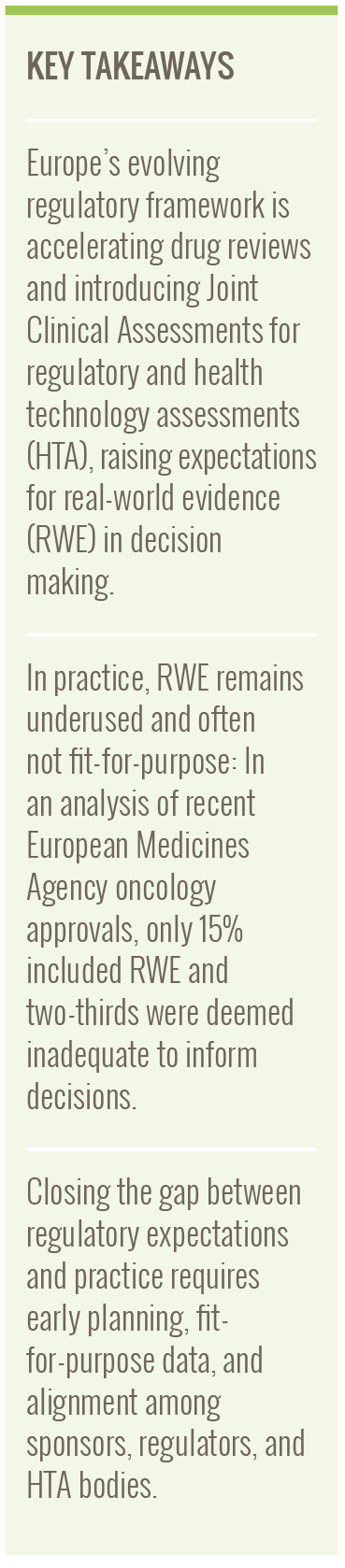
The European Union Health Technology Assessment Regulation (EU HTAR) introduced Joint Clinical Assessments (JCA), in which HTA bodies from participating European countries jointly evaluate how a new treatment compares to existing options before making country-level decisions on access and reimbursement. Initially scoped for oncology and advanced therapy medicinal products, JCA will expand to cover most new medicines. While sponsors have traditionally adapted evidence for individual countries, JCA reduces the ability to tailor evidence post hoc and instead requires a single evidence base that is relevant across multiple healthcare systems at the time of assessment. In parallel, new EU pharmaceutical legislation aims to shorten regulatory assessment timelines, requiring decision-ready evidence at the time of submission and leaving less opportunity for postsubmission evidence generation.
To support evidence generation at scale, the Data Analysis and Real-World Interrogation Network (DARWIN EU), a federated network of data sources coordinated by the European Medicines Agency (EMA), connects hospitals, registries, and other real-world data sources across Europe. Through this network, regulators can request analyses of real-world data to contextualize sponsor-provided evidence. As a result, RWE submitted by sponsors is subject to greater scrutiny, increasing expectations that it will be robust, transparent, and decision relevant.
Expectations for real-world evidence in Europe are increasing faster than the availability of clear, operational frameworks to support sponsors in meeting those expectations.
Yet despite these advances, no internationally harmonized framework for RWE currently exists. Regulators, including the EMA, have issued guidance on the use of RWE; however, these recommendations remain fragmented and are not always sufficiently detailed to ensure consistent implementation across countries. As a result, expectations for RWE are increasing faster than the availability of clear, operational frameworks to support sponsors in meeting those expectations. Recognizing the need for international harmonization beyond Europe, the International Council for Harmonisation (ICH), which brings together regulators and industry from Europe, the United States, Japan, and other regions, has initiated efforts to align terminology, data standards, and methodological expectations for RWE across regions, but these efforts are still evolving.
These developments mark a shift in how RWE is expected to support decision making in Europe. In practice, however, RWE often falls short of these expectations due to limitations in data quality, study design, and analytical approaches, raising questions about its fitness for purpose in regulatory and HTA decision making.
Reality Check and a Silver Lining
Despite growing expectations, RWE is still not consistently used and often lacks the quality needed to inform decisions. In our review of oncology drugs receiving initial marketing authorization by the EMA between January 2023 and August 2025, only 6 of 40 (15%) included RWE. In all 6 cases, RWE was submitted as supportive rather than primary efficacy evidence. Use of RWE varied across submissions, from descriptive benchmarking analyses to formal external control arms (ie, using real-world patients as a comparison group). However, in two-thirds of the submissions, the RWE was considered inadequate due to limitations related to data or study design. In contrast, 2 case examples illustrate successful applications of RWE: benchmarking in rare diseases (Welireg [belzutifan]) and contextualizing trial outcomes in later-line refractory multiple myeloma (Elrexfio [elranatamab]).
Real-world evidence is frequently planned late in product development, limiting the ability to define appropriate comparators, prespecify analyses, and align with regulatory expectations.
This pattern of infrequent RWE inclusion is consistent with the broader literature. A study of EMA approvals across all therapeutic areas from 2020 to 2023 found that fewer than 1 in 10 incorporated RWE in regulatory submissions. Where RWE was included, assessment reports often lacked key details on data sources or study design or used terminology inconsistently. In addition, assessment reports rarely clarified whether or how these data influenced the final decision, limiting interpretability.
Similar findings have been reported outside Europe, where a systematic review of US Food and Drug Administration (FDA) approvals for orphan-designated, non-oncology rare disease therapies (2017-2022) found that only 20 of 151 applications (13%) included RWE to support efficacy outcomes. In more than half of these submissions (11/20; 55%), the FDA raised concerns regarding the use of RWE, citing issues related to study design, population comparability, and missing information. Together, these findings help explain why RWE continues to fall short of decision-making expectations.
Why Hasn’t RWE Reached Its Potential?
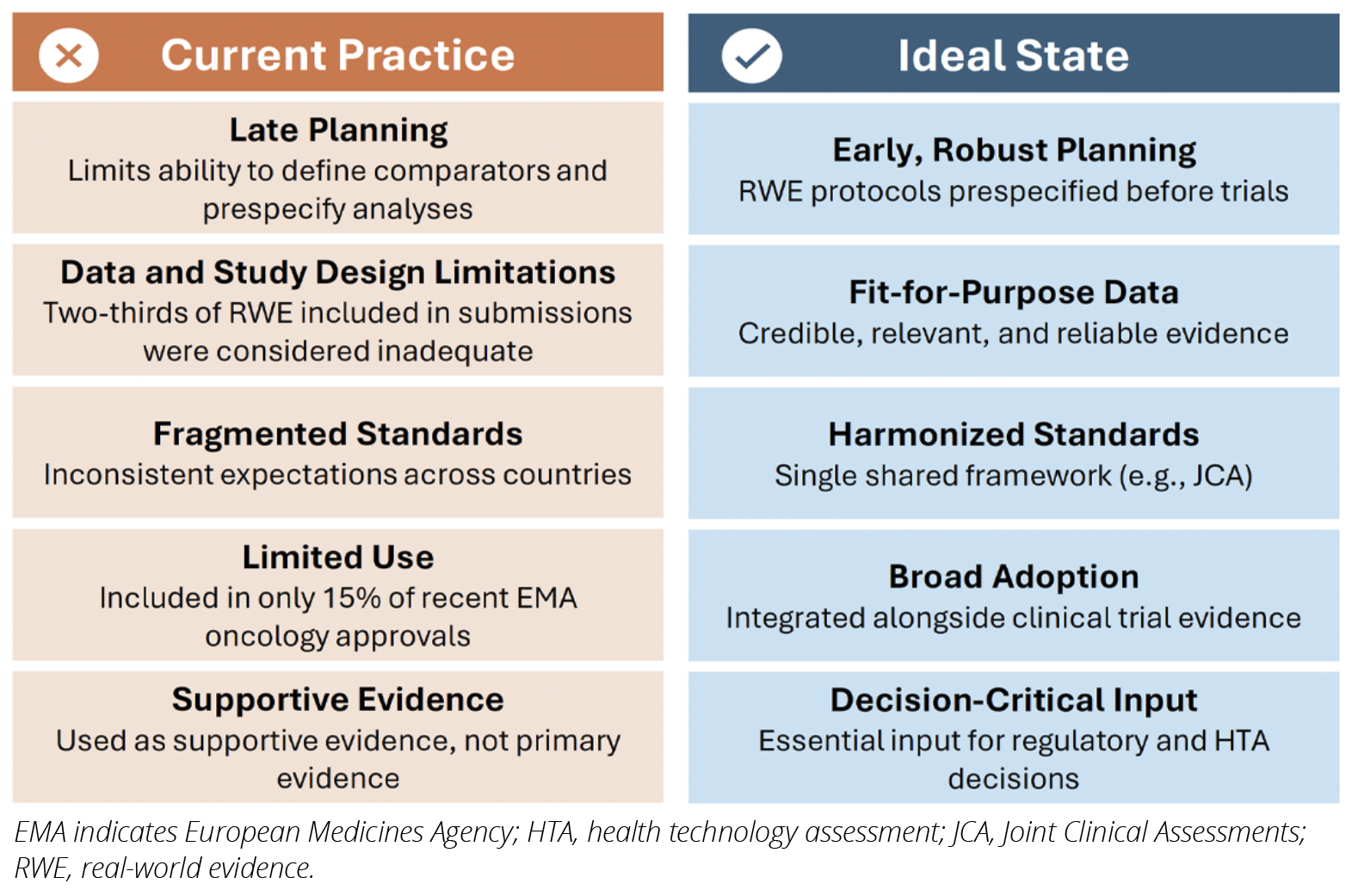
Figure 1 illustrates the gap between what regulators expect from RWE and current practice.
Many real-world data sources are not inherently fit-for-purpose. Key variables may be missing, recorded inconsistently, or measured differently across healthcare settings. In our review, two-thirds of the RWE used in submissions were considered inadequate. Tepkinly (epcoritamab) illustrates this challenge: A retrospective observational study using electronic health records was submitted as supportive evidence to characterize treatment outcomes, but regulators noted several limitations—including inconsistent response assessment, incomplete records, and variability across sites—that affected the interpretation of these data.
Study design and analytical approaches are often insufficiently robust. RWE is frequently planned late in development, limiting the ability to define appropriate comparators, prespecify analyses, and align with regulatory expectations. In our review, historical benchmarks and indirect comparisons were frequently associated with methodological limitations. For Ezmekly (mirdametinib), the external control analyses were defined in a statistical analysis plan addendum after the data cut-off date, meaning key analytic choices may have been influenced by observed data rather than prespecified statistical and clinical rationale (eg, endpoint definition, covariate selection, and weighting or matching approaches), potentially introducing bias.
Expectations for RWE remain inconsistent across countries. Although the JCA process under HTAR is designed to minimize these inconsistencies by providing a single, shared clinical evaluation across Member States, the same evidence may be interpreted differently by decision makers, creating uncertainty for sponsors and limiting the influence of RWE in joint and national assessments. Together, these challenges reinforce the gap between rising expectations for RWE and its current ability to inform decision making.
Figure 1. Gap Between Ideal State and Current Practice of RWE in Europe
RWE’s Greatest Promise
Yet there are settings where RWE is delivering meaningful value. For rare diseases with small populations, RWE can provide essential context for interpreting trial outcomes. For Welireg (belzutifan), natural history data in von Hippel–Lindau disease provided context for interpreting response rates in a small, single-arm trial, supporting the primary endpoint in the absence of a randomized comparator. More broadly, in our review, therapies with an orphan designation were more likely to include RWE than the overall cohort, suggesting that both sponsors and regulators are turning to RWE when trial-based evidence is most limited.
With expectations now embedded in regulatory and health technology assessment processes, the key question is no longer whether real-world evidence should be used, but whether it is being generated in a way that meets decision-making standards.
In single-arm trials without a comparator, RWE can help contextualize effectiveness and safety, particularly in underrepresented or clinically complex patient populations where randomized evidence is difficult to generate. For Elrexfio (elranatamab), external real-world cohorts were used alongside trial data to contextualize effectiveness in heavily pretreated multiple myeloma patients. This highlights where RWE is most impactful: addressing evidence gaps that randomized trials cannot. In practice, this helps ensure that treatment decisions reflect how therapies perform in real-world clinical settings, not just in trials.
From Data Availability to Decision-Grade Evidence
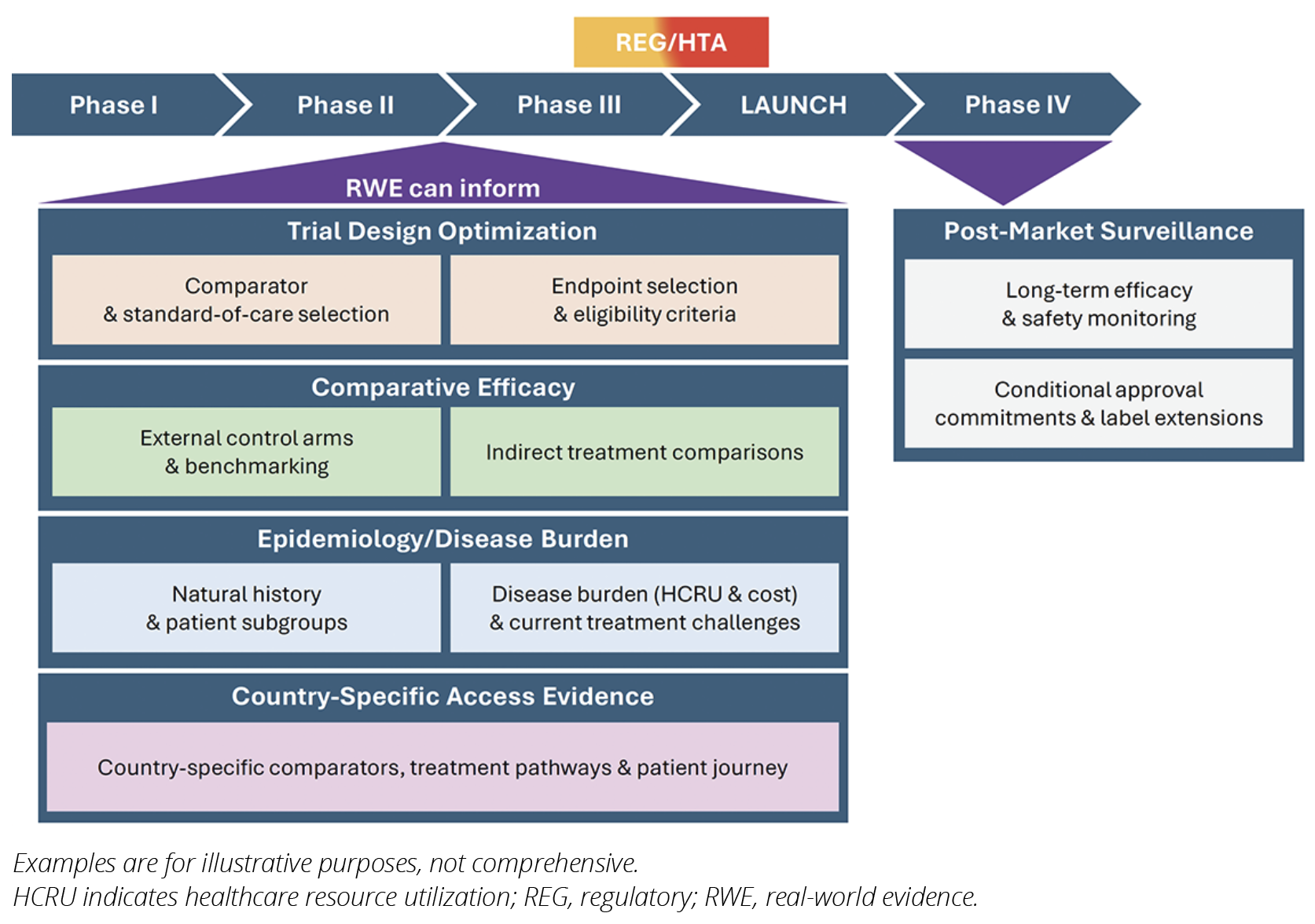
With expectations now embedded in European regulatory and HTA processes, the key question is no longer whether RWE should be used, but whether it is being generated in a way that meets decision-making standards. As summarized in Figure 2, RWE contributes across the product life cycle, from informing trial design and establishing disease context, through generating comparative evidence and supporting regulatory and HTA submissions, to post-market surveillance and post-approval commitments. Beyond regulatory decisions, decision-grade RWE is increasingly informing health economic evaluations, helping HTA bodies assess the comparative value of treatments in local healthcare contexts where trial-based evidence alone may be insufficient.
Figure 2. Examples of How RWE Can Contribute Across the Product Life Cycle
Closing the gap between expectations and practice requires action on 3 fronts.
- Evidence planning must shift earlier. Evidence generation strategies must be defined at the outset of development, with RWE considered alongside clinical trials rather than retrospectively. Early alignment with regulators and HTA bodies is critical to ensure that data sources, comparators, and analytical approaches are appropriate and decision relevant. The JCA process further underscores that RWE strategies for a single evidence base across multiple Member States must be defined well before submission.
- Data quality and methodological rigor must be treated as non-negotiable. Limitations in data completeness, consistency, and variable capture must be addressed proactively. The examples of Welireg and Elrexfio highlight that even when RWE adds useful context, it is typically positioned as supportive unless study designs, comparators, and analytical methods are clearly prespecified and transparent.
- European decision makers must work toward more consistent expectations for what constitutes fit-for-purpose RWE. Without this, sponsors will continue to face uncertainty, and RWE will remain underutilized in joint and national assessments. Initiatives such as HTAR, JCA, and ICH provide an important foundation, while our findings underscore the need for clearer guidance on generating and evaluating RWE across countries.