Has Real-World Evidence Reached Its Potential?

Bethany Levick, PhD; Shea O’Connell, PhD, OPEN Health, London, United Kingdom
Formation and Formalization of RWE
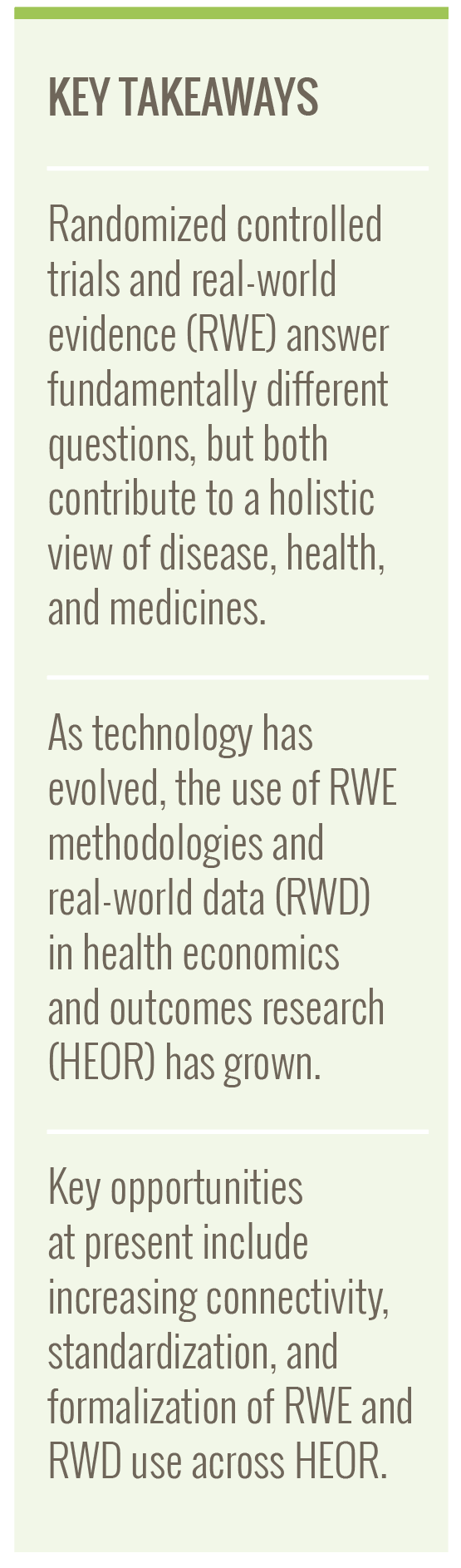
Observational studies and evidence in the real world are established pillars of research that are fundamental in epidemiology and public health. Within medical research, the gold standard for research has long been randomized controlled trials (RCTs), and unfavorable comparisons have frequently been made regarding the relative strength, value, or relevance of observational evidence. Recently, however, observational research, including real-world evidence (RWE), has received increased recognition within research and from regulatory and payer bodies. This growing acceptance reflects the reality that RCTs and RWE are addressing fundamentally different questions, while both are contributing to a holistic view of disease, health, and medicines.
To support this development, RWE frameworks setting out approaches and standards for the use of RWE in product evidence submissions have been published by several payer and approval bodies, including the US Food and Drug Administration (FDA), European Medicines Association (EMA), National Institute for Health and Care Excellence (NICE), Haute Autorité de Santé (HAS), and Canadian Drug Administration (CDA). Accordingly, the use of RWE in health technology assessment (HTA) submissions has increased over time; the FDA recently detailed more than 70 device submissions that used RWE between 2020-2025. Importantly, RWE also has featured in successful drug submissions, including several submissions to NICE for oncology therapies.
As acceptance and recognition of RWE has increased, so has its methodological formalization and development. While the principal aim of observational research—to describe health and disease as experienced by people every day, often at scale—has remained consistent, wider growth in computing power, speed, and efficiency has improved our ability to store and analyze ever larger amounts of data and to operate increasingly complex statistical methods for handling uncertainty, expanding the capabilities of observational research.
Randomized controlled trials and real-world evidence are addressing fundamentally different questions, while both are contributing to a holistic view of disease, health, and medicines.
Even with the strictest data collection, validation, and analytics processes, the “messiness” of human life and experiences brings a particular and unavoidable humanity to real-world data (RWD) and RWE. Many in the field have been drawn to the “messiness” of RWD as a scientific challenge. The methods developed to account for and harness this character have been key to the evolution of RWE. For example, propensity scores and weighting methods allow for estimates from unbalanced populations to be brought into closer balance; causal frameworks allow for explicit handling of confounding relationships (including those involving genetic variants); and target trial emulation (TTE) allows for the exploration of a specific “what if?”.
Current Developments in RWE
With RWE now accepted as part of regulatory grade evidence, it seems an opportune time to ask: Is there further to go? If so, where next?
While RWE is past its infancy, it has yet to reach its potential. As with any data-driven field, advancements in RWE methodologies will continue to develop along with the continual change of computing technology, associated data storage, and processing power. Increasingly complex methods being developed and adopted today will likely be standard practice within a decade. For example, machine learning model-based approaches have a wide range of potential applications, including feature identification and analysis, but arguably are yet to be an established “core” method in RWE.
The ability to store and handle larger datasets allows for summarizing of patients’ healthcare experiences across a range of settings and providers in a single analysis. Challenges arise when RWE for secondary data studies is drawn from data systems that were not designed for use in research, but rather to support the delivery of informed, quality patient care (such as electronic health record [EHR] or administrative data). Such data are often care-context specific and may not be connected across the full range of care settings with which a patient interacts. In these circumstances, data tokenization and record linkage can provide insight into each patient’s whole healthcare journey, joining these segmented datasets into a more complete picture. Studies conducted using this type of linked data are better informed about patients’ general health state and ongoing care needs. Unfortunately, at the moment, linked datasets are sporadic in coverage and quality across contexts and countries.
Another developing change in research practice involves the interaction between RWE and RCT evidence. In an explicit deviation from any perceived competition as evidence, RWE/D can be leveraged to augment and strengthen RCTs. Within a trial, RWD can be used in 2 key ways: to augment RCT data, such as through passive follow-up of participants via EHR systems, and as an external control arm (ECA). At a recent ISPOR Europe issue panel, the use of RWD sources for ECAs was explored, with a particular focus on the acceptance of such evidence by regulatory authorities. The discussion from this panel concluded that, for the moment at least, ECA studies have to reach a high bar to be acceptable, and that prospective primary data collection (ideally planned alongside the associated trial) represents the best opportunity for successful use of this approach.
Data tokenization and record linkage can provide insight into each patient’s whole healthcare journey.
Machine learning and natural language processing (NLP) have been used to enhance and curate RWD sources, including the extraction of data from EHR documents to improve dataset completeness, and for hypothesis generation and predictive analysis using advanced methods. In the future, artificial intelligence, large language models, and other technologies offer the potential to collect, store, and analyze data in new ways that help maximize the potential value of RWE/D.
Opportunities for RWE
The clear theme for the development of RWE is opportunities for increased connectivity: in prespecified development of RWE with onward use for other health economics and outcomes research (HEOR) methodologies, and within RWE itself through increasing connection of RWD sources.
Preplanned connection of RWE to other HEOR methodologies enables robust and well-informed evidence. Particularly in the postlaunch environment, many modes of health economic modeling now frame estimates and assessments in terms of real-world care. This requires real-world estimates.
A collaborative cross-functional approach, connecting efforts and expertise from RWE and economic modeling specialists, can be employed to efficiently generate cohesive bodies of real-world and economic evidence that are fit for each specific purpose from design. An RWE study can be designed with model parameterization in mind, generating evidence on the target population and outcomes while simultaneously providing designed-for-use parameter estimates for a parallel model. In evidence generation that is cross-functional from first principles, RWE can make an exclusive but vital contribution and bring a new viewpoint or contextualization that adds value to evidence across HEOR.
Within RWE, increasing connectivity between RWD sources could help overcome issues of sample size (especially affecting rare diseases) and increase the generalizability of results. The European Health Data Space (EHDS) regulation came into force in 2025, setting the framework for pan-European Union health data sharing and a timeline for the first datasets (patient summaries and prescribing) to be included by 2029. This marked a major step forward for data interoperability and introduced the potential for true cross-border working across Europe in RWE. In addition, following the establishment of the EU Health Technology Assessment Regulation framework in 2021, the first Joint Clinical Assessments (JCAs) were submitted. This international alignment in assessments provides clear motivation for internationally aligned evidence.
In evidence generation that is cross-functional from first principles, real-world evidence can bring a new viewpoint or contextualization that adds value across health economics and outcomes research.
Data standards such as the Observational Medical Outcomes Partnership (OMOP) Common Data Model, Fast Healthcare Interoperability Resources (FHIR), and openEHR are intended to address the challenges of interoperability. However, despite the great potential offered by tools such as OMOP, FHIR, and openEHR, challenges remain—including complete and clinically appropriate data mapping and broad agreement on extract-transform-load approaches—for their integration at scale.
The JCA and EHDS regulations set the stage for a drive toward increasing data standardization and connected working over the next few years. What remains to be seen is how fast changes will happen and exactly what this alignment will look like. The potential for innovation in RWE methods and research is substantial and could include a landscape shift toward a future in which cross-country studies with built-in alignment and standardization are the norm.
Conclusion
RWE contributes a unique and unreplicable view into the day-to-day reality of people’s health, experience of living with disease, treatment patterns, and associated outcomes. There are groups of patients who likely will never contribute to RCT evidence, due to lack of access, health-related issues, or demographic-based exclusions. The power of RWE lies in its potential to capture and quantify this reality—with all its heterogeneity, missingness, and that’s-an-unusual-treatment-pathways—and, specifically, to include patients who will not ever contribute to RCT evidence.
The growth and change in RWE over the last decade have been expansive. From its beginnings in observational research, RWE has developed into a completely new field. The formalization and standardization of newer methods (such as TTE and ECA), and the increasing acceptance of these methods for use with RWE, illustrate the potential for further change and growth. The opportunities for RWE in data standardization and connection, and by-design integration with other HEOR methodologies, could be revolutionary.
RWE has certainly not reached its ultimate potential. A coalescence of technology-enabled data handling and analysis ability, buy-in from regulators and HTA bodies, and motivation in the form of policy change is set to drive RWE toward widespread innovation and optimization.