Experts from China, Taiwan Discuss HEOR-Driven Decisions in Student Network Webinar
Vishwanauth Persaud, MPH, PharmD Candidate, Touro College of Pharmacy, New York, NY, USA

Advancing Evidence-Based Healthcare Decisions
As healthcare systems worldwide continue to navigate rising costs, expanding therapeutic innovation, and increasing demands for value-based care, health economics and outcomes research (HEOR) has become an essential component of healthcare decision making. To explore these evolving challenges, the ISPOR Student Network hosted the webinar From Evidence to Access: Applying HEOR and Economic Evaluation in Healthcare Decision-Making, bringing together experts from China and Taiwan to discuss how HEOR informs reimbursement, pricing, and health policy across diverse healthcare systems.
The webinar highlighted how region-centric economic evidence, clinical outcomes, and real-world data are increasingly being integrated into decision making in China and Taiwan to improve patient access while ensuring the long-term sustainability of healthcare systems.
Shitong Xie, PhD, professor in the School of Pharmaceutical Science and Technology at Tianjin University in China, explained that his team has been developing population-specific instruments, like the CHROME-G and CQ-11D, because existing tools such as the EQ-5D and SF-6D don’t capture the outcome dimensions that matter most locally. As he put it, the goal is that “these specific instruments can capture more precise and more related dimensions... and hopefully have a better result of the economic valuation to better inform the coverage decision making in China.”
Huang-tz (Anita) Ou, PhD, professor at National Cheng Kung University in Tainan, Taiwan, shared during the webinar that Taiwan’s conditional listing mechanism for new therapies requires real-world data and adverse event tracking during a temporary reimbursement period. These real-world results have shown that “these classes of drugs really work well for majority of the cancer population,” although 2 indications were ultimately removed from the coverage list after the evidence showed otherwise, underscoring how real-world data directly shapes reimbursement decisions.
Key Insights From Global Perspectives
One of the most valuable aspects of the discussion was the opportunity to compare how different countries apply similar HEOR principles within their own healthcare environments. Although each healthcare system has unique priorities and reimbursement structures, the speakers demonstrated that evidence-based decision making remains central to improving access to innovative therapies.
The presentations explored China’s National Reimbursement Drug List process and Taiwan’s established health technology assessment (HTA) framework to support universal health coverage initiatives. These examples illustrated how local policy, available resources, and healthcare infrastructure influence the implementation of HEOR while maintaining a shared commitment to delivering value-driven care.
Bridging Research and Real-World Application
One of the strongest messages from the webinar was that HEOR extends well beyond academic research. While concepts such as cost-effectiveness analysis, budget impact analysis, and real-world evidence are frequently introduced in educational settings, the speakers demonstrated how these tools directly influence reimbursement negotiations, pricing strategies, formulary development, and national healthcare policy.
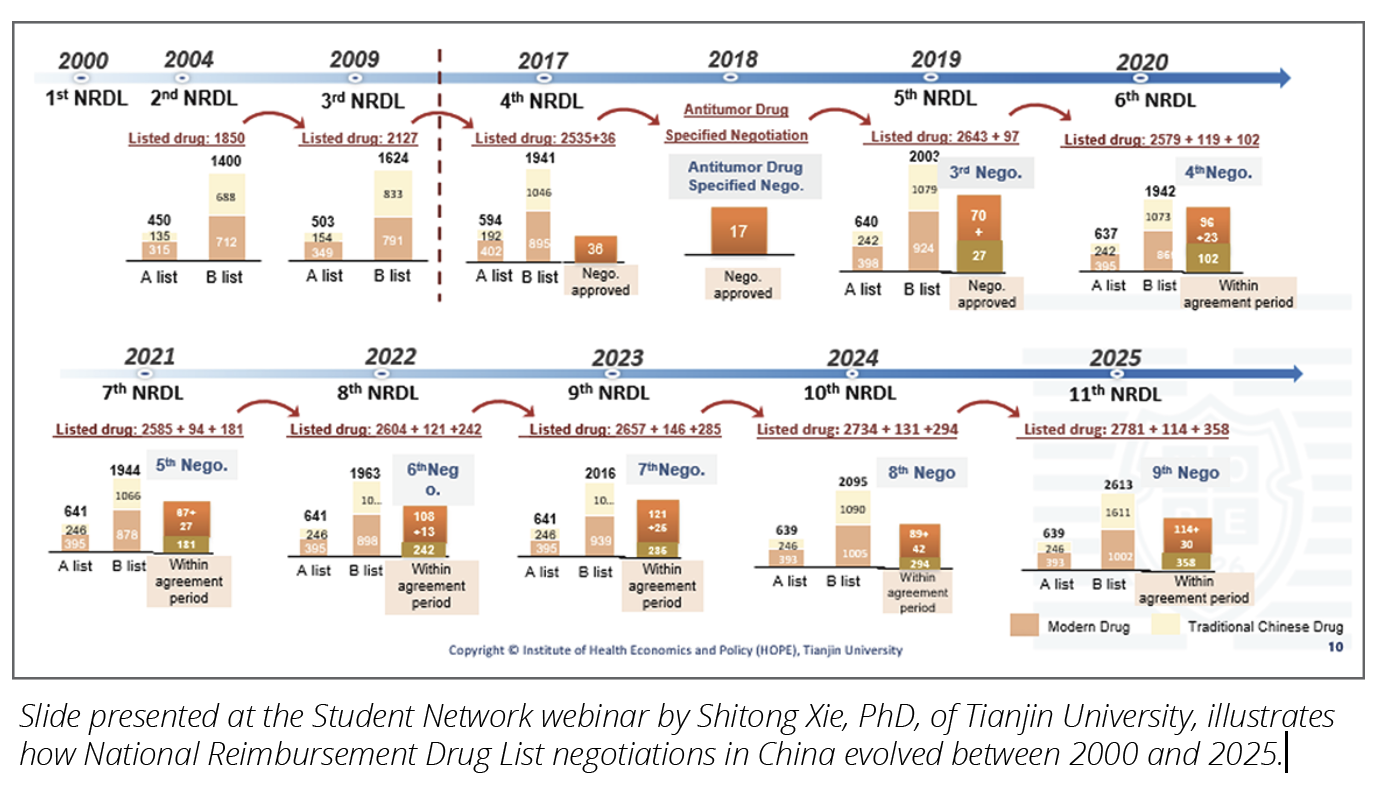
For example, Xie shared how pharmacoeconomic evaluation is used in China to help set prices for innovative drugs entering the National Reimbursement Drug List (NRDL) negotiations between the government and pharmaceutical companies (Figure). He noted the goal is for population-specific outcome instruments to “capture more precise and more related dimensions” so they can “better inform the coverage decision making.”
Figure. History Overview of NRDL in China
Ou described how, in Taiwan, real-world data drove a reassessment of a sodium-glucose cotransporter 2 (SGLT2) inhibitor originally reimbursed for diabetes. Three years after its initial listing, real-world evidence showed the drug offered better cardiovascular and kidney protection compared with a DPP4 inhibitor—evidence that, she said, “truly supports the policy changing.” The findings informed the decision by Taiwan’s National Health Insurance to extend reimbursement to patients with chronic heart failure and chronic kidney disease.
As the moderator, I found this particularly impactful because it reinforced the connection between evidence generation and its practical application. Understanding how research informs real-world decisions provides valuable context for students interested in market access, health policy, and value assessment, while emphasizing the multidisciplinary nature of healthcare decision making.
Inspiring Future HEOR Professionals
I hope webinar attendees gained greater appreciation for the growing role of HEOR in shaping modern healthcare systems. Students and early career professionals in pharmacy and related fields often have limited exposure to careers in market access, health technology assessment, and reimbursement strategy. Hearing directly from internationally recognized experts provided meaningful insight into these career paths while demonstrating the broad impact that HEOR professionals can have on patient care and healthcare policy.
The webinar also highlighted the importance of international collaboration. Although healthcare systems differ substantially across countries, many of the underlying challenges, including balancing affordability, innovation, and equitable access, are shared globally. Learning from these diverse perspectives encourages broader thinking and fosters a deeper understanding of how evidence can be translated into better healthcare decisions.
The Role of the ISPOR Student Network
Educational programming like this reflects the ISPOR Student Network’s commitment to preparing the next generation of HEOR professionals. By connecting students with global experts and creating opportunities for meaningful discussion, these events help bridge the gap between classroom learning and professional practice.
As healthcare continues to evolve, developing the ability to translate evidence into informed policy and reimbursement decisions will become increasingly important. Webinars such as this not only strengthen students’ understanding of HEOR but also inspire future leaders to contribute to evidence-based healthcare systems that improve patient outcomes worldwide.