Bridging Evidence Gaps for Rare Disease Decision Making: The Role of Real-World Evidence
Divya Pushkarna, BTech; Ramandeep Kaur, PhD; Jean-Paul Collet, MD, PhD; Mir Sohail Fazeli, MD, PhD, Evidinno Research Outcomes Inc., Vancouver, British Columbia, Canada; Massoud Toussi, MD, PhD, United BioSource Corporation, Wayne, PA, USA
Rare diseases present distinct challenges for health technology assessment (HTA). Small patient populations, heterogeneous clinical presentations, and limited treatment options constrain the generation of robust evidence to support benefit-risk and value assessment for new therapies. In many rare disease settings, randomized controlled trials (RCTs), the traditional gold standard for evaluating clinical benefit, are impractical due to feasibility and ethical constraints, limitations in endpoint development, and logistical barriers. As a result, HTA bodies often face considerable uncertainty when assessing benefit-risk and economic value of novel rare disease treatments.
In this context, real-world evidence (RWE) is increasingly gaining prominence as a complementary source of information for rare-disease HTA decision making. Derived from sources such as patient registries, electronic health records, insurance claims, and observational studies, RWE provides insights beyond those captured in clinical trials. In rare disease settings, RWE is commonly used to characterize disease natural history, establish benchmark trajectories for outcomes without treatment, and provide external comparator data to supplement single-arm clinical trials. Collectively, these uses help contextualize observed treatment effects and may reduce uncertainty by addressing knowledge gaps where conventional clinical evidence may come up short.
Recent implementation of the European Union Health Technology Assessment Regulation (EU HTAR) has further increased attention on evidence requirements for rare disease therapies. A coordination group of delegates from all Member States now oversees Joint Clinical Assessments (JCAs) of new pharmaceutical products, each of which is tasked with generating a single evidence-based report to inform pricing and reimbursement decisions across those Member States—a mandate that creates pressure to address evidence gaps consistently across jurisdictions. The JCA rollout began in 2025 with submissions for oncology and advanced therapy medicinal products; the call for orphan medicine submissions is scheduled for 2028. Although the role of RWE within JCAs is still evolving, real-world data (RWD) are increasingly recognized as a potential source of evidence for addressing uncertainties related to comparative effectiveness, treatment patterns, and external control generation in rare diseases.
Beyond evidence scarcity, HTA is shaped by the unique parameters of precision medicine, with therapies targeting molecularly or genetically defined subgroups. This is most evident in rare oncology and genetic disorders, where populations are highly stratified and pathways evolve rapidly. Surrogate endpoints and shifting comparators complicate oncology assessments, while durability and long-term safety challenge genetic therapies, increasing the need for flexible approaches in which RWE informs reimbursement under uncertainty.
Real-world evidence is increasingly gaining prominence as a complementary source of information for decision making during rare disease health technology assessment.
Against this backdrop, we examined the role of RWE in HTA evaluations for rare disease therapies across the EU4 (France, Germany, Italy, and Spain) and the United Kingdom. A targeted literature review of HTA appraisals and peer-reviewed publications from 2014 to 2025 was conducted involving therapies with European Medicines Agency (EMA) orphan drug designation that incorporated RWE in submissions. Information on sources and types of real-world data (RWD) such as patient registries, observational studies, and electronic health records was extracted and qualitatively assessed. Cross-country comparisons examined how RWE informed benefit-risk assessments, cost-effectiveness, and budget impact, and identified patterns related to the influence on price and reimbursement decisions.
RWE and HTA for Rare Diseases
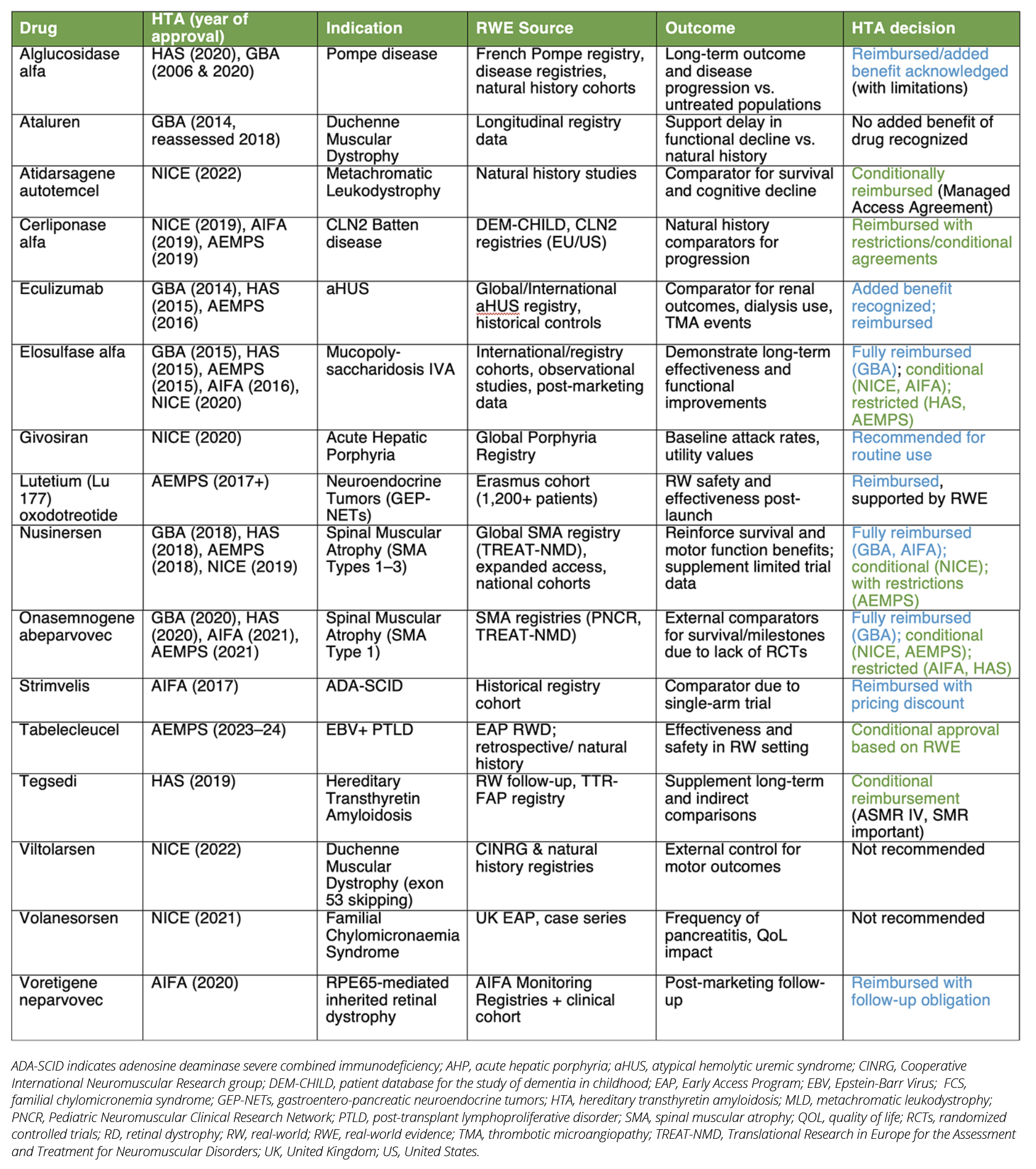
Across the EU4 and the United Kingdom, the review identified 16 rare disease therapies that incorporated RWE within HTA submissions to support pricing and reimbursement decisions. Thirty-two submissions for these therapies were evaluated by 5 major HTA agencies: National Institute for Health and Care Excellence (NICE) in the United Kingdom (n=8), Haute Autorité de santé (HAS) in France (n=6), Federal Joint Committee (G-BA)/ Institute for Quality and Efficiency in Health Care (IQWiG) in Germany (n=6), Agenzia Italiana del Farmaco (AIFA) in Italy (n=5), and Agencia Española de Medicamentos y Productos Sanitarios (AEMPS) in Spain (n=7) (Table 1).
Neurological disorders represented the most common therapeutic area, followed by oncology, immunology and metabolic disorders (Figure 1A). Gene therapies comprised the largest treatment category, followed by enzyme replacement therapies and antisense oligonucleotides (Figure 1B).
Figure 1. Clinical (A) and therapeutic (B) categories seen across included rare disease HTA submissions
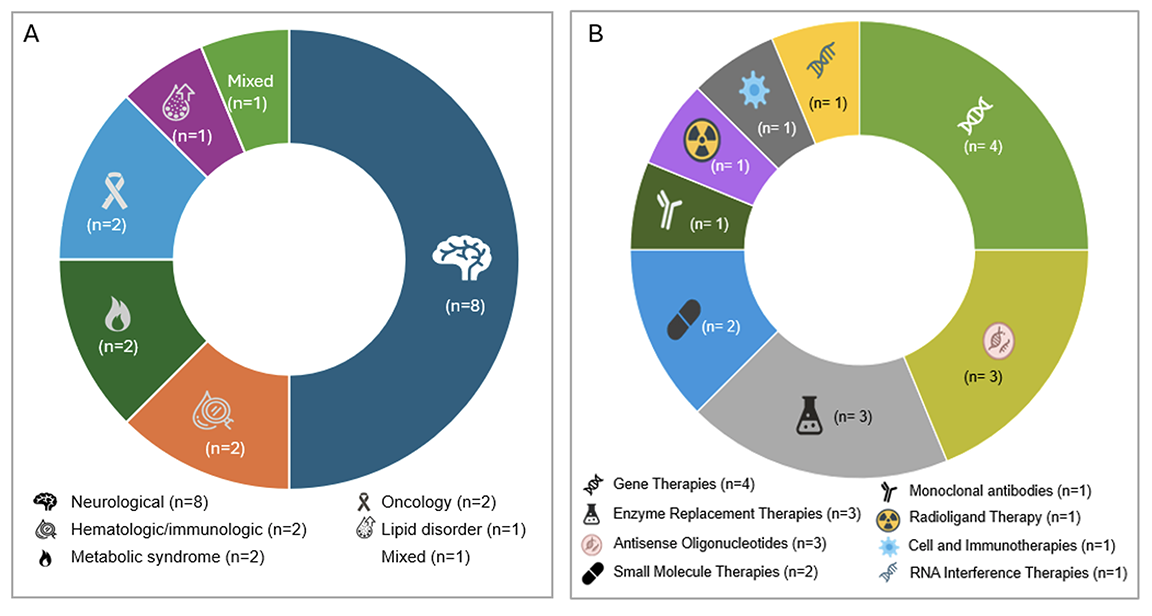
Variation in RWE use across therapeutic areas may reflect the maturity of existing data infrastructures rather than HTA preferences. Neurological, genetic, and metabolic disorders often benefit from long-standing international registries that provide established data sources for generating RWE, whereas other therapeutic areas have less developed ecosystems. This distinction is important when interpreting why certain rare disease therapies appear more heavily supported by RWE.
While this review focused on the EU4 and United Kingdom, the findings may have broader relevance across Europe. Although reimbursement processes for rare disease therapies differ across countries, many smaller European and Nordic markets face similar challenges related to limited clinical evidence, small patient populations, and uncertainty regarding long-term outcomes.
How RWE Is Being Used for Rare Diseases
Across the 16 therapies identified in this review, different RWE sources were used to address distinct evidentiary objectives (Table 1). Data from patient registries, the most common source (n=10), were used to characterize disease progression and long-term outcomes. Natural history or historical comparator studies (n=6) primarily supported untreated benchmarks and external controls for single-arm trials, while observational/postmarketing studies (n=5) assessed real-world safety, durability, and effectiveness.
Table 1. Overview of drug therapies approved for reimbursement utilizing RWE across EU4 + UK
RWE contributed to HTA evaluations in 4 main ways, each addressing a specific evidence gap commonly seen in rare-disease drug development:
- External comparators for single-arm trials. The most prevalent application of RWE was the creation of external comparator arms, particularly where pivotal evidence came from single-arm trials, a frequent scenario in ultra-rare conditions. For 9 of 16 analyzed therapies, RWE provided comparator data to contextualize treatment benefits when randomized trials were infeasible, drawing on natural-history datasets, and disease registries. Examples included onasemnogene abeparvovec for spinal muscular atrophy (SMA), atidarsagene autotemcel for metachromatic leukodystrophy, cerliponase alfa for CLN2 disease, eculizumab for atypical hemolytic uremic syndrome, and strimvelis for adenosine deaminase severe combined immunodeficiency.
- Safety and postmarketing outcomes. In several submissions (lutetium [Lu 177] oxodotreotide, voretigene neparvovec, tabelecleucel, and elosulfase alfa), observational and registry data characterized safety, tolerability, and treatment durability under real-world conditions, complementing small or short-duration clinical programs and informing the net clinical benefit at decision time.
- Evidence of long-term effectiveness. RWE extended the evidence horizon beyond trial follow-up in several cases, demonstrating sustained clinical benefit, especially for enzyme-replacement therapies and gene therapies, where durability is central to value assessment. These data included real-world functional trajectories, progression rates, and survival observed in routine practice. Examples included elosulfase alfa for mucopolysaccharidosis type IVA, nusinersen for SMA, alglucosidase alfa for Pompe disease, tegsedi for hereditary transthyretin amyloidosis, and atidarsagene autotemcel for metachromatic leukodystrophy.
- Economic and utility inputs. In 2 cases (givosiran and volanesorsen), RWE fed directly into economic models, providing measures of health-related quality of life (HRQoL), utilities, resource-use patterns, or other model parameters to reduce uncertainty in cost-effectiveness estimates where trial-based HRQoL or utilization data were sparse or nongeneralizable.
Differences in Agency Acceptance
Our findings suggest that acceptance of RWE in HTA submissions varies by agency. Within the therapeutic assessments included in this review, NICE (United Kingdom) and AEMPS (Spain) demonstrated relatively greater openness to RWE, particularly when natural history data or external comparator analyses were used to contextualize outcomes from single-arm clinical trials. AIFA (Italy) frequently considered RWE from registry-based monitoring systems and, in some cases, outcomes-based agreements, reflecting the agency’s strong reliance on structured RWD collection. HAS (France) tends to consider RWE primarily during postlaunch reassessments or as supplementary evidence in broader reimbursement decisions. In contrast, G-BA/IQWiG (Germany) applies more stringent evidentiary standards, generally accepting RWE only in ultra-rare disease settings or when no alternative evidence sources are available. This finding aligns with previous research reporting considerable variation in the acceptance, weighting, and interpretation of RWE across European HTA agencies, even when assessing the same therapy.
In many markets, RWE is not a one-off submission element but part of a life-cycle evidence plan: Coverage is granted alongside managed access and registry-linked obligations, with time-bound reassessments to resolve residual uncertainty (eg, NICE Managed Access Agreements and AIFA monitoring registries for advanced therapies). This embeds ongoing effectiveness, durability, and safety tracking into routine care and links evidence delivery to continued reimbursement.
The most prevalent application of real-world evidence was the creation of external comparator arms, particularly where pivotal evidence came from single-arm trials.
Influence on Reimbursement Outcomes
Overall, 6 of 16 therapies that incorporated RWE in their HTA appraisals received full/positive reimbursement outcomes. For another 4 of 16 therapies, conditional reimbursement or restricted access was granted to manage residual uncertainty. Additionally, 3 of 16 therapies had mixed reimbursements across different HTA agencies.
The remaining 3 of 16 therapies did not achieve positive or conditional outcomes, underscoring that RWE complements but does not replace robust clinical evidence. Notably, onasemnogene abeparvovec and elosulfase alfa achieved reimbursement across all 5 markets, with RWE included in evidence packages. While RWE was included in all assessed submissions, its specific contribution to the final reimbursement decision could not be consistently determined from the available HTA documentation.
Looking Ahead: Toward Greater Harmonization
The increasing reliance on RWE across European HTA submissions aligns with broader policy developments, most notably the implementation of the EU-JCA process. That process is still evolving, but JCA has the potential to align the expectations of Member States around evidence generation, including how and when RWD may be used to address uncertainty in rare-disease evaluations.
For manufacturers, the implications are clear. As advanced rare-disease therapies increasingly undergo assessment by HTA bodies with limited clinical data, successful reimbursement strategies require a proactive approach to evidence generation throughout the product life cycle. Manufacturers should develop an integrated strategy with patient registries, natural-history studies, and postlaunch evidence generation infrastructure to ensure that the right data are available to meet diverse HTA requirements, ultimately supporting timely and sustainable patient access.
For HTA bodies and policy makers, the challenge lies in maintaining methodological rigor while recognizing the practical realities of rare disease research, where randomized evidence is often infeasible and natural history may be the only viable comparator. Differences in national processes will persist, but ongoing collaboration through JCA dialogue and national initiatives to define good-practice RWE methods may improve alignment over time.
As innovation accelerates, particularly in gene and cell therapies and precision-medicine oncology, where treatments target biomarker-defined subgroups that make randomized trials challenging, RWE is poised to play an even more central role in demonstrating clinical value, supporting economic evaluations, and reducing decision uncertainty. While RWD rarely replace traditional clinical evidence, they have the potential to add value for HTA committees navigating the complex, evolving landscape of rare disease treatment assessment.