Beyond Posters and Publications: Defining the Value of Real-World Evidence Scientific Content
Nan Qiao, PhD, MPH, MSc, MBBS, Philadelphia, PA, USA
Introduction
The US Food and Drug Administration (FDA) defines real-world evidence (RWE) as the clinical evidence about the usage and potential benefits or risks of a medical product derived from analysis of real-world data routinely collected from sources such as electronic health records (EHRs), medical claims, registries, and digital health technologies.
RWE adds important value by showing how treatments perform in routine practice, capturing effectiveness, safety, patient experience, and economic impact across broader and more diverse populations than randomized clinical trials (RCTs) alone, although careful attention to data quality and bias is essential when analyzing RWE.
Scientific content has long been created to support the nonpromotional scientific exchange and engagement activities of medical affairs teams in pharmaceutical and biotechnology companies.
Pharmaceutical and biotechnology companies have increasingly generated RWE to complement RCTs in communicating with healthcare professionals (HCPs) and key decision makers (KDMs) to inform decision making. This type of exchange and engagement often is facilitated by RWE scientific content.
Scientific content has long been created to support the nonpromotional scientific exchange activities of medical affairs teams in pharmaceutical and biotechnology companies, yet no formal definition exists. In general, it may be understood as nonpromotional material containing scientific information derived from congress presentations and publications. Historically, such content has focused on clinical trial findings, sometimes supplemented with epidemiological and disease information for context. More recently, scientific content focused on RWE and other health economics and outcomes research (HEOR) has become increasingly prominent.
As with scientific content in general, there is currently no official definition of RWE scientific content, nor are there dedicated guidelines governing its development. In practice, its development often relies on guidance for scientific exchange in defined scenarios, such as FDA guidance on scientific information for HCPs about unapproved uses of approved medical products and FDA draft guidance on responding to unsolicited requests for off-label information, while also following relevant principles from guidance on promotional materials, such as FDA guidance and recently updated draft guidance on communications with payers and formulary committees and the PhRMA Code on Interactions With Health Care Professionals.
Although RWE is frequently generated by HEOR professionals, scientific content development has historically centered on clinical trials and has therefore been led by individuals with pharmacy or clinical backgrounds. HEOR-trained professionals have not yet established a strong presence in this field, and many, including those working as researchers in pharmaceutical and biotechnology companies, may still be unfamiliar with the subject.
This article introduces RWE scientific content and discusses its importance, best practices, and relevance to HEOR practice. It aims to provide HEOR researchers with a basic understanding of RWE scientific content to facilitate more effective collaboration with scientific content experts and introducing scientific content development as a potential career path.
What Is RWE Scientific Content?
For the purposes of this article, RWE scientific content is defined as purpose-built, truthful, balanced, nonmisleading, and nonpromotional scientific materials based on 1 or more RWE sources, intended for use by pharmaceutical or biotechnology medical affairs teams in scientific exchange with HCPs and KDMs. Like broader scientific content, RWE scientific content can be either reactive (addressing stakeholders’ questions) or proactive (anticipating and discussing questions before they are raised). Scientific content can come in multiple formats, such as slide decks, question-and-answer documents, evidence summaries, and interactive or dynamic content.
The importance of RWE scientific content includes its practical value alongside existing RWE posters and publications and its role in scientific exchange.
Practical Value Beyond Posters and Publications
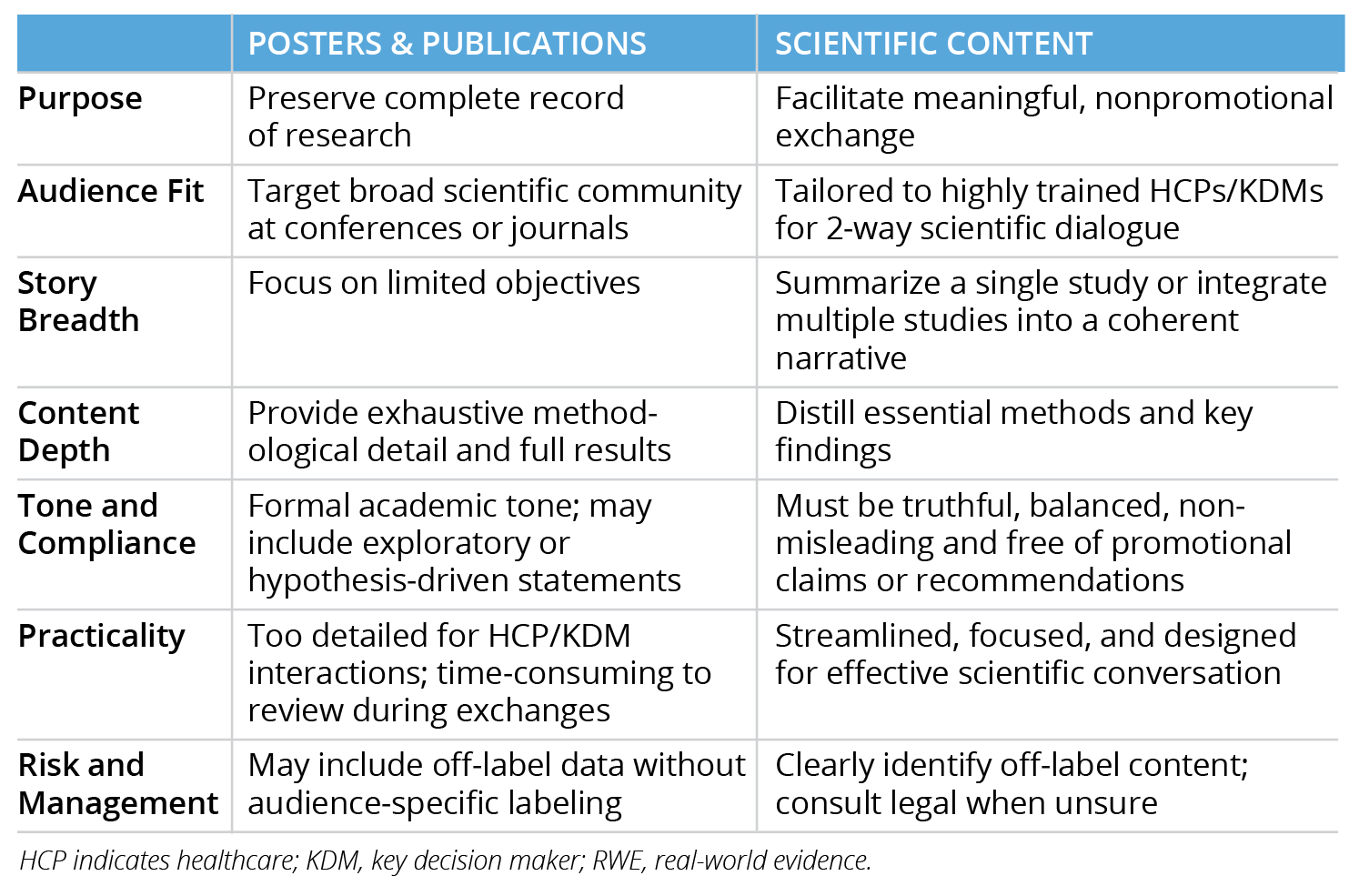
Posters and publications serve to help preserve the complete scientific record. They present comprehensive methods and full results, enabling other scientists to critically evaluate and reproduce the work. They are suited to conference settings and journal audiences seeking a detailed review of a study. By contrast, scientific content is developed to facilitate meaningful, nonpromotional exchange. It distills essential methods and highlights key findings that clinicians and payers need to inform practical decision making. It can also bring together findings from multiple related posters or publications as a single, coherent narrative, enabling the audience to rapidly understand the broader evidence base.
Posters and publications may include exploratory language appropriate for research discourse; however, scientific content must remain strictly truthful, balanced, and non‑misleading. Any content referencing off‑label use must be clearly labeled. Proactive content, as well as content related to comparisons with competitor products often requires legal review before dissemination.
These differences are summarized in Table 1.
Table 1. Comparing RWE Scientific Content with Posters and Publications
Enabling Scientific Exchange and Engagement
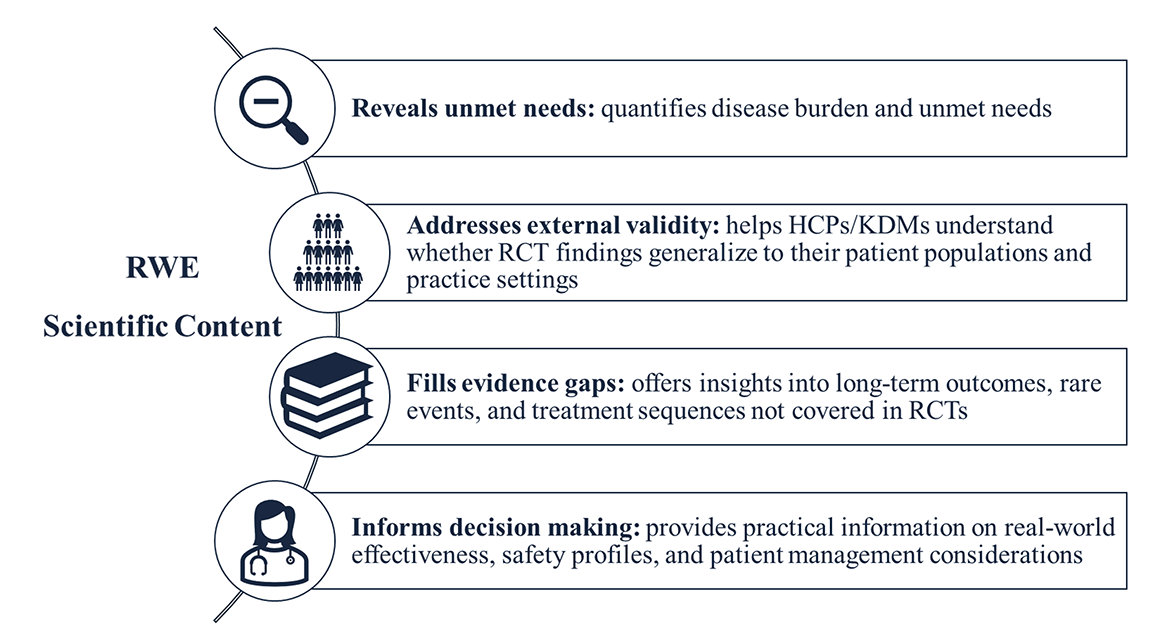
RWE scientific content plays a critical role in bridging the gap between clinical trial evidence and routine clinical practice. It reveals unmet needs by assessing disease burden using measures like event rates and healthcare utilization, while demonstrating the limitations of standard of care, such as its real-world effectiveness, safety, and tolerability profile. It addresses the external validity of RCTs by helping HCPs and KDMs consider how medical products perform in their own patient populations and practice settings. It fills important evidence gaps by providing insights on long-term outcomes, rare events, and treatment sequences that RCTs may not capture. Finally, it informs decision making by delivering practical, actionable information on real-world effectiveness, safety profiles, and patient management considerations. Together, these aspects of RWE scientific content support more informed, pragmatic decisions by HCPs and KDMs (Figure 1).
Figure 1. The Role of RWE Scientific Content in Scientific Exchange
Best Practices and an Example
As mentioned above, best practices for RWE scientific content should align with the principles set forth in FDA guidance and the PhRMA Code regarding communications by pharmaceutical or biotechnology companies with HCPs and KDMs. Such content should be based on high-quality RWE, address relevant data gaps in scientific exchange, clearly cite the original publication or poster, and be presented in a truthful, nonmisleading, balanced, and nonpromotional manner. It should also be tailored for knowledgeable HCPs and KDMs, while remaining easy to understand and practical for medical affairs teams to use in time-limited communications.
These principles may sound straightforward, but in practice, they require vigilance by scientific content experts to keep them in mind and apply them to every decision, big or small. The following hypothetical example illustrates how this works in practice.
Rosie is a scientific content expert at a pharmaceutical company. Her US medical affairs counterpart, Jimmy, told her HCPs had been asking questions about the RWE for effectiveness of the company’s Product A that was launched 2 years earlier.
Rosie searched for RWE posters and publications and found a conference poster based on a small sample of patients from 1 hospital. The reported real-world survival results were much better than the RCT results, but the methodology was not described in sufficient detail for her to assess study quality. She also found a publication based on a nationally representative EHR dataset with a large sample size and detailed, standard methodology reporting. Its survival results were similar to the RCT results. Rosie chose the larger, nationally representative publication because it provided stronger and more reliable evidence, even though the results were less favorable.
Jimmy shared the HCPs’ preferences for a study to be summarized in a 3-page fact sheet. Rosie began by including only the essential background points needed to support the study rationale, given that HCPs were likely already familiar with the disease. She took the same approach to the methodology section, including only the information needed to support
HCPs’ understanding of the study design, reserving space to present the results in detail.
Rosie used accurate and clear tables and visuals to present the results, ensuring that medical affairs experts could easily demonstrate and explain the findings to HCPs and that HCPs could quickly comprehend them. Jimmy suggested listing the real-world survival results line by line alongside the RCT results and overlaying the real-world and clinical trial survival curve for easier comparison; Rosie explained that she could not do this because the real-world study population differed from the clinical trial population, and presenting the data this way could mislead HCPs into thinking the results were directly comparable.
Jimmy also suggested adding the authors’ interpretations of the findings, such as that Product A may work better in the real world because real-world patients were sicker but had similar survival to clinical trial results. Rosie explained that the authors’ claims were based on their interpretation of available data, rather than on research designed to test the validity of that interpretation. While such claims may be acceptable in a publication, including them in scientific content is not advisable because it could be viewed as nonfactual, misleading, and promotional.
Rosie also noticed that only a small amount of space remained to present the study’s limitations. She considered using a smaller font size for the limitations section to make it fit, but then remembered that the need to present balanced information extends to visual presentation. By reducing the size of the figures in the summary without affecting their readability, she made room to include the limitations section in the same font size as the rest of the content. Rosie added the citation to finalize the content and submitted it for review.
This example is simplified; in real-world content development, more issues will likely arise, and at times these high-level guiding principles will be insufficient to guide sound judgment. In such cases, it may be necessary to consult other experts, management, or the company’s legal department for further guidance.
Discussion
While posters and publications remain important mechanisms for disseminating RWE, scientific content offers greater flexibility and can be tailored more deliberately to specific audiences, objectives, and communication channels. At the same time, it must remain truthful, balanced, nonmisleading, and nonpromotional.
However, there are currently no specific guidelines providing detailed instructions for scientific content development. Scientific content experts should therefore develop strong RWE knowledge to support sound decisions regarding source material selection and content creation, while adhering to existing high-level principles. When in doubt, they should seek guidance from colleagues, management, or legal.
Real-world evidence scientific content informs decision making by delivering practical, actionable information on real-world effectiveness, safety profiles, and patient management considerations.
In the long-term, more detailed guidance and best practices should be developed to ensure that scientific content development is consistent, scientifically rigorous, and standardized, while also helping to mitigate risk and improve efficiency and productivity. Government agencies may continue to provide high-level guiding principles, while professional societies like ISPOR may play an important role in convening task forces composed of stakeholders with relevant expertise to establish more detailed guidance and best practices.
For HEOR researchers, particularly those working within pharmaceutical and biotechnology companies, it is essential to recognize that the dissemination of their research extends beyond posters and publications. Close collaboration with scientific content experts and proactive sharing of updates on recent presentations and publications, can accelerate scientific content development and better support the decision-making needs of HCPs and KDMs.
As RWE and other HEOR scientific content assume an increasingly prominent role in the scientific exchange activities of pharmaceutical and biotechnology companies, scientific content development is likely to evolve from a discipline led primarily by professionals with pharmacy or clinical training to one that incorporates more experts with HEOR backgrounds.
The participation of HEOR researchers in this space are welcome, as their subject matter expertise can substantially strengthen content development. However, success in this role also requires adaptability to the distinct demands of scientific content creation, including the ability to integrate scientific rigor with effective storytelling and data visualization, as well as collaboration across a broad range of internal and external stakeholders. This work requires ongoing learning from diverse expertise and continuous refinement of scientific content development capabilities. However, optimizing the impact of RWE can facilitate decision making and advance patient access to quality care.
Disclosures: Nan Qiao is an employee of Merck Sharp & Dohme (MSD). The views expressed in this article are her own and do not necessarily reflect the views of MSD.