
The Inflation Reduction Act and Medicare Drug Pricing: What It Means for Patients, Innovation, and Access
 A Turning Point in US Drug Pricing
The Inflation Reduction Act (IRA), enacted in 2022, introduced major changes to prescription drug pricing in the United States.1 Central to the legislation is a new mandate enabling the Centers for Medicare & Medicaid Services (CMS) to negotiate prices for high-cost drugs without generic or biosimilar competition.2
This negotiation authority is exercised through Medicare, beginning with 10 high-spending Medicare Part D drugs (retail prescriptions) whose negotiated prices took effect in 2026 and expanding to physician-administered medicines covered under Medicare Part B starting in 2028. The program is designed to expand in subsequent years, with additional drugs selected annually for negotiation: 15 Part D drugs for 2027, 15 (including Part B) for 2028, and 20 annually thereafter.
Beyond price negotiations, the IRA introduced a series of consumer-focused provisions including a $35 monthly insulin cap, a $2000 annual out-of-pocket cap under Medicare Part D, free access to recommended adult vaccines, and inflation-based rebates.2
Early experience with the Inflation Reduction Act suggests it is delivering on its most visible promise: lowering out-of-pocket costs for patients.
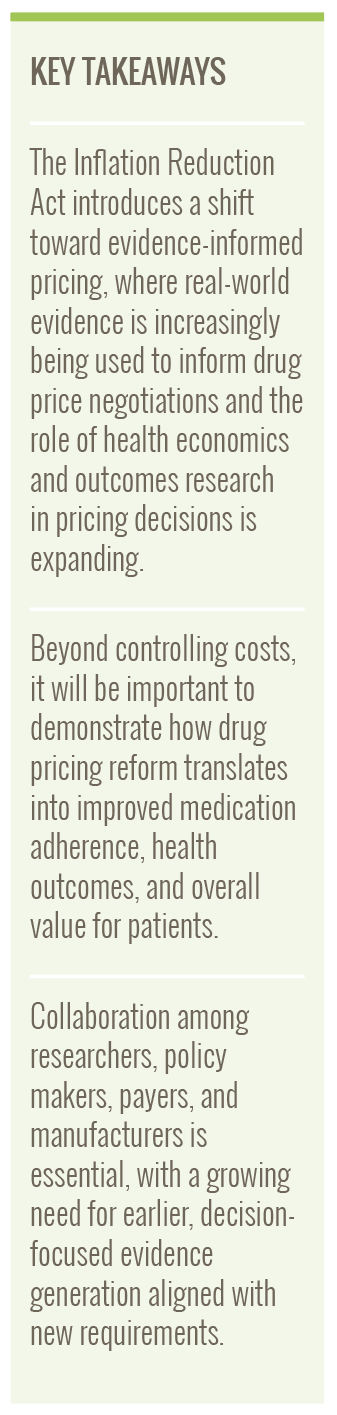
From a health economics and outcomes research (HEOR) perspective, the IRA marks a structural shift toward evidence informed pricing, with clinical benefit, comparative effectiveness, and real-world evidence (RWE) increasingly shaping Medicare drug prices. Emerging analyses suggest that CMS is increasingly relying on longitudinal data, comparative effectiveness research, and real-world utilization patterns in determining “maximum fair price,” signaling a transition toward an evidence-intensive environment more aligned with international health technology assessment (HTA) systems.3,4
However, the IRA is more than a set of cost-control measures. It introduces a shift that elevates the importance of HEOR assessments—such as cost-effectiveness analyses, patient-reported outcomes, or subgroup analyses—as key inputs into pricing decisions.
What’s Working: Immediate Benefits for Patients
Early experience with the IRA suggests it is delivering on its most visible promise: lowering out-of-pocket costs for patients.5,6 Essential medications are more affordable and their costs are more predictable for Medicare beneficiaries, particularly those living with chronic conditions such as diabetes and cardiovascular disease. Most notably, the IRA introduced a cap on annual out-of-pocket spending for prescription drugs under Medicare Part D, set at $2000 starting in 2025. This cap is expected to benefit more than 3 million Medicare beneficiaries annually. Negotiated prices are projected to save patients $1.5 billion in 2026 alone.6
CMS estimates show that, had the prices negotiated for 2026 been in effect during 2023, aggregate net spending on prescription drugs would have decreased by an estimated $6 billion, representing a 22% reduction.7 Furthermore, analyses of CMS negotiation materials indicate that RWE was cited across Maximum Fair Price explanation documents, although its prevalence and sources varied and the evidentiary weighting remains undisclosed.8 For patients, affordability improvements are not only financial but also clinical. Although direct post-IRA evidence on adherence is still emerging, extensive pre-IRA literature links lower cost sharing to improved adherence and outcomes, suggesting that affordability gains may translate into health benefits.9,10 These developments underscore the growing role of HEOR—including adherence modeling, budget impact analysis, and distributional cost-effectiveness frameworks—in connecting affordability to patient outcomes.
The Trade-Off Question: Innovation Under Pressure
While the affordability gains are clear, they come with important questions about long-term consequences, particularly regarding pharmaceutical innovation.11 Emerging evidence from modeling studies suggests that manufacturers may respond by shifting investment strategies. Larger pharmaceutical companies could potentially prioritize products with lower development risk and faster returns. Smaller and mid-sized biotech firms, often responsible for breakthrough advances in oncology, rare diseases, and neurodegenerative conditions, may face tougher funding environments as future revenues become less predictable.12
Alzheimer disease research offers a clear example of this tension.13 Developing treatments in this space requires substantial investment, long timelines, and high clinical uncertainty. For example, recent disease-modifying therapies for Alzheimer disease have required decades of research investment with uncertain clinical success, and pricing constraints introduced by the IRA may further complicate return-on-investment expectations in such high-risk areas.13
Cost-containment policies do not operate in isolation. For the health economics and outcomes research community, this creates a need to adapt how value is quantified in the context of Inflation Reduction Act negotiations.
Quantitative modeling studies suggest IRA-related pricing provisions may reduce the long-term economic value captured from innovative therapies, particularly in therapeutic areas with
long development timelines and extended product life cycles.14 In practice, manufacturers may adapt by prioritizing indications with shorter time-to-market or modifying life-cycle management strategies.
The inclusion of small-molecule oncology therapies such as ibrutinib in the first wave of IRA negotiations illustrates this dynamic. As small molecules are subject to negotiation earlier in their life cycle than biologics, manufacturers may face compressed revenue windows, which could influence portfolio strategies. Early industry responses suggest a potential shift toward biologics or therapies with longer exclusivity periods, raising questions about future investment in certain classes of oncology treatments. It is important to note, however, that these projections are based on early evidence and modeling assumptions, and the full impact of the IRA on innovation and investment behavior will become clearer as real-world data emerge over time.
These dynamics underscore that cost-containment policies do not operate in isolation. For the HEOR community, this creates a need to adapt how value is quantified in the context of IRA negotiations. For example, standard cost-effectiveness models may under-value therapies for conditions like Alzheimer disease if they do not account for benefits such as delaying disease progression, reducing caregiver burden, or providing financial risk protection. Expanding HEOR frameworks to explicitly capture these elements through scenario analyses, severity weighting, or inclusion of broader societal outcomes can help ensure that high-risk innovations are more accurately reflected in negotiated prices.
Access and Equity: Uneven Gains
Another key insight from early research is that the benefits of the IRA are not evenly distributed. Medicare beneficiaries see clear reductions in out-of-pocket costs, but patients outside Medicare may not benefit directly. This creates the potential for widening access gaps across the healthcare system.11
Equity challenges also emerge in how coverage is implemented across plans. For example, widely used anticoagulants such as apixaban and rivaroxaban illustrate how lower negotiated prices do not automatically translate into better patient access.15 While Medicare’s maximum fair price is expected to reduce overall costs, formulary placement and cost-sharing differences may still affect what patients pay. For patients requiring long-term anticoagulation, even modest increases in out-of-pocket costs can lead to missed doses or treatment discontinuation that can increase the risk of stroke and hospitalization.16 Early analyses of the first 10 drugs selected for negotiations (including widely used therapies in cardiovascular and metabolic disease) also suggest that access and savings may vary across therapeutic classes and patient subgroups, emphasizing the importance of distributional analyses.17
Evidence generation will need to shift from primarily postlaunch, payer-focused analyses to earlier, negotiation-driven strategies that produce evidence tailored to specific populations and pricing decisions.
At the same time, the IRA is accelerating the use of RWE to monitor these effects. As mentioned earlier, reviews of CMS negotiation documentation indicate that a substantial proportion of cited evidence includes observational studies and Medicare claims analyses, demonstrating how RWE could have a potential role in comparative effectiveness assessment and pricing decisions.8,18 A recent review presented at ISPOR 2025 highlighted emerging shifts in spending distribution and beneficiary financial exposure under IRA provisions,19 underscoring the need for ongoing claims-based monitoring to assess equity impacts across income and risk strata.
Collectively, these dynamic developments demonstrate the need for HEOR studies that align with the evidentiary needs and timelines of IRA price negotiations. In practice, this includes generating RWE using Medicare claims and observational data to assess comparative effectiveness and/or treatment patterns. Simulations that assess the impact of formulary placement or drug switching could also inform decision making. Such analyses can help identify how the IRA’s effects on access, clinical outcomes, and out-of-pocket burden vary across patient populations, which can help facilitate equitable pricing and coverage decisions.
Looking Ahead
The IRA is likely to reshape not only pricing but also evidence generation and decision-making processes across the US healthcare system. Several policy directions merit consideration:
- Establish transparent evidentiary standards, including clear guidance on acceptable comparative effectiveness evidence, real-world data quality, and the role of cost-effectiveness thresholds in price-setting.3,20
- Ensure negotiated prices translate into lower patient cost sharing and improved access by aligning plan design and limiting cost-shifting.15
- Evidence generation will need to shift from primarily postlaunch, payer-focused analyses to earlier, negotiation-driven strategies that produce evidence tailored to Medicare populations and CMS pricing decisions.
These strategies reflect the need for policies to evolve alongside emerging evidence, carefully balancing affordability, patient access, and impact on innovation to ensure sustainable improvements in health outcomes.
The Bottom Line
The Inflation Reduction Act is already reshaping the US pharmaceutical landscape. It has delivered meaningful, immediate relief to patients, yet its long-term success will depend on thoughtful and adaptive policy stewardship. The path forward from an HEOR perspective is to ensure that negotiated prices reflect not only costs, but also meaningful differences in clinical benefit, patient outcomes, and overall value for patients.
References
1. United States Congress. Inflation Reduction Act of 2022, H.R. 5376, 117th Congress. 2022. https://www.congress.gov/bill/117th-congress/house-bill/5376/text Published August 16, 2022. Accessed May 14, 2026.
2. Centers for Medicare & Medicaid Services. Inflation Reduction Act lowers health care costs for millions of Americans. https://www.cms.gov/newsroom/fact-sheets/inflation-reduction-act-lowers-health-care-costs-millions-americans Published October 5, 2022. Accessed May 14, 2026.
3. O’Brien J, Hansen J. Section 50 of the Inflation Reduction Act drug price negotiation program: Considerations for the Centers for Medicare & Medicaid Services, manufacturers, and the health economics and outcomes research community. Value Health. 2023;26(12):1681-1685. doi: 10.1016/j.jval.2023.09.2995
4. Tunis SR, Shafrin J, Than KS, et al. Use of real-world evidence in the Medicare Drug Price Negotiation Program: A checklist for the Centers for Medicare and Medicaid Services and manufacturers. Health Affairs Scholar. 2025;3(3):qxaf030. doi: 10.1093/haschl/qxaf030
5. AARP Public Policy Institute. Most Medicare Part D enrollees who reach the new $2,000 out-of-pocket spending cap will see substantial savings despite premium changes. https://www.aarp.org/pri/topics/health/prescription-drugs/medicare-part-d-enrollees-new-out-of-pocket-spending-cap/ Published January 16, 2025. Accessed May 25, 2026.
6. Nania R. Millions on Medicare will save on prescription drugs in 2025. AARP. https://www.aarp.org/medicare/medicare-out-of-pocket-cap-savings-2025/ Published January 16, 2025. Accessed May 25, 2026.
7. Centers for Medicare & Medicaid Services. Medicare Drug Price Negotiation Program: Negotiated prices for initial price applicability year 2026. https://www.cms.gov/newsroom/fact-sheets/medicare-drug-price-negotiation-program-negotiated-prices-initial-price-applicability-year-2026 Published August 15, 2024. Accessed May 25, 2026.
8. Winberg D, Du L, Shi L. Real-world evidence in the first round of the US Inflation Reduction Act drug price negotiations: A citation analysis of CMS Maximum Fair Price explanation documents [Published online ahead of print March 23, 2026]. Value Health. doi: 10.1016/j.val.2026.03.006
9. Goldman DP, Joyce GF, Zheng Y. Prescription drug cost sharing: associations with medication and medical utilization and spending and health. JAMA. 2007;298(1):61-69. doi: 10.1001/jama.298.1.61
10. Schneeweiss S, Patrick AR, Pedan A, et al. The effect of Medicare Part D coverage on drug use and cost sharing among seniors without prior drug benefits. Health Aff. 2009;28(2):w305-w316. doi: 10.1377/hlthaff.28.2.w305
11. Dusetzina SB, David FS. Cancer drug access and innovation under the Inflation Reduction Act—a balancing act. JAMA Oncol. 2024;10(12):1614‑1615. doi:10.1001/jamaoncol.2024.4745
12. Ezell S, Kann L, Barbosu S. The Inflation Reduction Act is negotiating the United States out of drug innovation. Information Technology and Innovation Foundation. https://itif.org/publications/2025/02/25/the-inflation-reduction-act-is-negotiating-the-united-states-out-of-drug-innovation/ Published February 25, 2025. Accessed May 25, 2026.
13. Li N, Rawal S, Young HN, Villa Zapata L. Innovation, affordability, access: Alzheimer disease drugs and the Inflation Reduction Act. Am J Manag Care. 2024;30(6):e169-e171. doi: 10.37765/ajmc.2024.89563
14. Zhou EW, Chaves da Silva PG, Quijada D, Ledley FD. Considering returns on federal investment in the negotiated “maximum fair price” of drugs under the Inflation Reduction Act: an analysis. Institute for New Economic Thinking. Working Paper Series No. 219. https://ssrn.com/abstract=4834934 Published February 28, 2024. Accessed May 4, 2026.
15. Sydor AM, Rivera E, Popovian R. Could the Inflation Reduction Act maximum fair price hurt patients? J Health Econ Outcomes Res. 2024;11(2):154-160. doi: 10.36469/001c.125251
16. Latremouille-Viau D, Wang A, Cheng D, et al. Impact of increased patient out-of-pocket costs on oral anticoagulant discontinuation among Medicare beneficiaries with atrial fibrillation treated with apixaban. Curr Med Res Opin. 2025;41(11):2077-2087. doi: 10.1080/03007995.2025.2583758
17. Varghese I, Celli J, Kardel P, Sheetz C. Evaluating healthcare costs and demographics of Medicare Part D beneficiaries impacted by first top 10 drugs selected for price negotiations under the Inflation Reduction Act (IRA). [ISPOR abstract PT9] Value Health. 2024;27(Suppl):S348. doi: 10.1016/j.jval.2024.03.2157
18. Jaksa A, Arena PJ. The potential role of real-world evidence in Centers for Medicare & Medicaid Services’ future price negotiations: Recommendations for a robust framework. J Manag Care Spec Pharm. 2024;30(6):604-607. doi: 10.18553/jmcp.2024.30.6.60
19. Pushkarna D, Fazeli MS, del Aguila M, Pourrahmat M. The Inflation Reduction Act: Evaluating impact on Medicare drug pricing, innovation, and access to therapies. [ISPOR abstract HPR156] Value Health. 2025;28(6 Suppl):S221-S222. doi: 10.1016/j.jval.2025.04.880
20. Doshi JA, Li P, Klebanoff MJ, Lin JK. Inflation Reduction Act provisions and Medicare Part D out-of-pocket costs for specialty drugs. JAMA Health Forum. 2025;6(5):e251387. doi: 10.1001/jamahealthforum.2025.1387