
ISPOR 2026-2027 Top 10 HEOR Trends Report
ISPOR—The Professional Society for Health Economics and Outcomes Research (HEOR) continues to monitor healthcare trends and conduct horizon scanning around the world.
The “ISPOR 2026-2027 Top 10 HEOR Trends” marks the sixth publication of the Society’s report that is published every 2 years and is based on input from its members and strategic curation from its Health Science Policy Council.
A summary of the ISPOR 2026-2027 Top 10 HEOR Trends and the full report are both available below.
What Are the Top Trends in Healthcare?
2026-2027 Top 10 HEOR Trends 
Executive Summary...
ISPOR—The Professional Society for Health Economics and Outcomes Research (HEOR) monitors healthcare trends and conducts horizon scanning around the world. Publication of the “ISPOR 2026-2027 Top 10 HEOR Trends” is an output of those efforts. This report is the Society’s sixth publication of the biennial report, which is based on input from stakeholders within the global HEOR community with strategic curation by ISPOR’s Science Officers and its Health Science Policy Council.
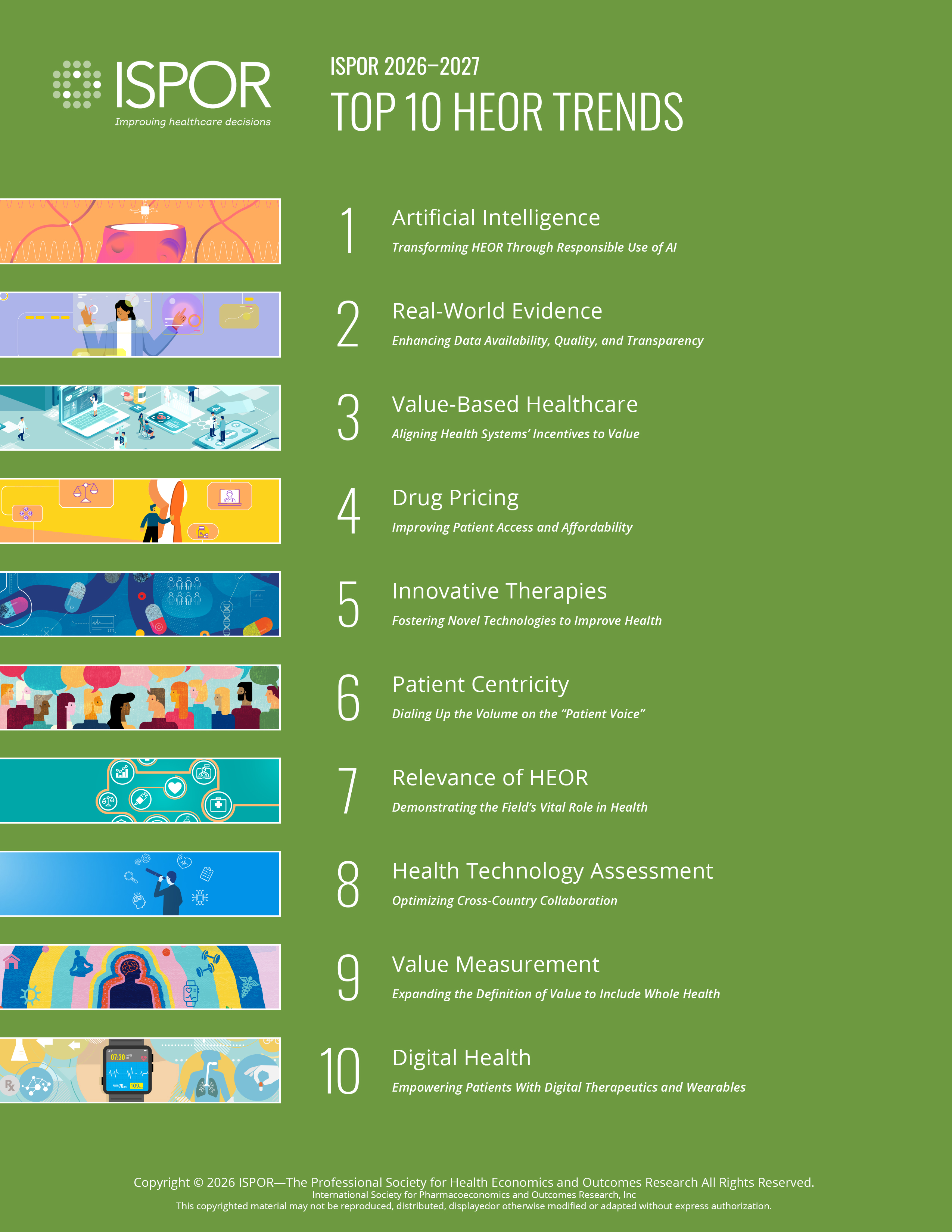
Artificial intelligence (AI) rose to the #1 spot on this trends report. As AI has grown to permeate virtually every aspect of everyday life, it is not surprising that this trend has moved from the #3 trend to the top of the list. This report focuses on how responsible use of AI can transform the field of HEOR.
Real-world evidence (RWE) moved to #2 on this trends list. As RWE continues to expand in use, this report centers on the issue of enhancing data availability, quality, and transparency.
Value-based healthcare (VBHC) is new to the trends list and appears at #3 in the 2026-2027 report. VBHC is not a new concept, but has grown in importance as global pressures make it increasingly difficult to provide the best possible care for patients.
A perennial issue appearing in the trends list is drug pricing, which appears in the #4 spot in this report. Also returning to the list is the topic of innovative therapies that is now the #5 trend. Patient centricity is another returning topic that moved up to #6 on the trends list. The relevance of HEOR is a new topic to the trends list that appears as #7 and centers on the field’s vital role in health. Health technology assessment reappears on the list as #8 after falling off the previous report. Also resurfacing at #9 on the list is value measurement with a focus on the expansion of the definition of value to include whole health. Rounding out the list at #10 is digital health that is also accelerating due to the impact of AI.
As healthcare decisions become increasingly complex and innumerable challenges face healthcare systems around the globe, the field of HEOR has never been more important. ISPOR’s vision is for a world where healthcare is accessible, effective, efficient, and affordable for all. The Society and its members will continue their work on these and other HEOR-related topics toward that vision and its mission to improve healthcare decisions for patients around the world.
#1 Artificial Intelligence...

Transforming HEOR Through Responsible Use of AI
Coming in as the top trend in the 2026-2027 report is artificial intelligence (AI), which was #3 in the 2024-2025 report. Since the last report, the use of AI has expanded throughout virtually every aspect of the healthcare industry, from biopharma clinical trials to health economics and outcomes research (HEOR). ISPOR CEO Rob Abbott noted in an interview about AI and HEOR that AI is already proving to be extremely useful in the field of HEOR.1 It can perform systematic literature reviews in a fraction of the time, structure complex datasets, and accelerate analysis. It is equally important, however, to note that human oversight is essential to ensure that AI-generated insights truly serve patients’ best interests.
Two main types of AI are being used across all industries: large language models (LLMs), which take large quantities of text and qualitative data and synthesize it into meaningful nuggets; and machine learning (ML), which essentially trains a computer to do prediction modeling. A recent example of the latter can be found in a 2025 study in The Lancet Digital Health, which details the development of a model using multimodal wearable sensors, host-response biomarkers, and machine learning to predict systemic inflammation following controlled exposure to a live attenuated influenza vaccine without relying on symptoms.2
The ubiquitous example of an LLM is ChatGPT, but many LLMs have been developed, such as Google Gemini, Meta AI, and DeepSeek. Healthcare-specific LLMs are in development as well, which can help pharmaceutical companies and contract research organizations streamline patient recruitment, optimize protocol design, and improve predictive modeling for trial outcomes.
Agentic AI models—that can complete tasks autonomously by planning, reasoning, and taking specific actions—are proliferating as well. They can act as personal digital agents by being trained to understand users’ writing styles and taking actions on decisions that need to be made on a daily basis, such as independently scheduling meetings and inviting those who need to be involved. These agentic AI models are expected to accelerate the impact of AI in HEOR, enabling HEOR professionals to do more and better research as well as enhancing communications.
With the automated use of big data comes great responsibility in the form of AI policies to guide its use, including privacy and protections. Human oversight will be crucial, such as for quality control of results. For example, verification is needed to identify hallucinations. A prominent recent example of this was the report on chronic diseases released by the Make America Healthy Again Commission in the United States, which cited multiple studies that did not actually exist.
ISPOR’s Artificial Intelligence Working Group is currently working on AI policy, with the goal of creating a reactive and responsive framework for health technology assessment bodies to govern AI use. The National Institute for Health and Care Excellence in the United Kingdom has already taken note,3 coming out with an AI policy citing ISPOR’s PALISADE checklist, a series of considerations that researchers can use to explore whether ML adds value to traditional approaches to research.4
#2 Real-World Evidence...

Enhancing Data Availability, Quality, and Transparency
Formerly #1 on the previous report, real-world evidence (RWE) has come in at #2 for the 2026-2027 trends report. The use of RWE in regulatory assessments has expanded significantly. The European Medicines Agency (EMA), in its “Real-world evidence framework to support EU regulatory decision-making,” notes that 59 RWE studies were conducted during the reporting period, with 33 completed and 26 ongoing, representing a 47.5 percent increase from the previous year.5 These studies addressed topics that included drug utilization, safety, and disease epidemiology. The US Food and Drug Administration has a long history of using RWE and real-world data (RWD) to monitor and evaluate the postmarket safety of medical products. One of the main success stories is the demonstration project called RCT-Duplicate, which found that randomized controlled trials (RCTs) can be effectively emulated with RWD.
As the use of RWE expands, so does the need for data availability. Over the next 2 years, data will continue to be added to the world’s RWD repositories. One of the continuing challenges is that many of these data sources are disparate. The European Union (EU) has DARWIN EU, a research repository of data from the EU that represents a regional effort to aggregate RWD and make it available. For continued and future use of RWE, there must be continued emphasis on the transparency of the data. According to a paper summarizing the report from the Council for International Organizations of Medical Sciences Working Group XIII, relevant stakeholders have to put into place transparent processes of planning, reporting, and assessing RWE, and suggests that templates be used for facilitating study protocol development and enhancing transparency and reporting.6
ISPOR has taken a leading position on ensuring transparency with the HARPER (HARmonized Protocol Template to Enhance Reproducibility) template created in collaboration with the International Society of Pharmacoepidemiology, which gives RWE scientists ways to disclose details, such as research questions, objectives, and methods; study design; data sources; and more.
This template has been taken up by the International Council for Harmonisation (ICH) Technical Requirements for Pharmaceuticals for Human Use ICH M14 Guideline,7 urging its use, as well as being recommended by the EMA, the US Centers for Medicare and Medicaid Services (CMS), and other healthcare authorities. In 2025, CMS issued a guidance that HARPER+, a framework based on HARPER but adapted for medical devices and Medicare coverage criteria, is now required for any device company doing a real-world evidence study.8
ISPOR is also ahead of the curve in ensuring the integrity of RWD and RWE by awarding badges to recognize transparency in research for papers published in its scientific journals Value in Health and Value in Health Regional Issues. By awarding and displaying Open Science Badges on select published articles, ISPOR recognizes and rewards researchers who demonstrate transparency by preregistering their studies, openly sharing data, and/or making research materials publicly available. Other related ISPOR resources and initiatives include the RWE Registry, a fit-for-purpose platform to promote transparent reporting for RWE studies; its RWE Strategic Initiative; and its RWD topical webpage.
#3 Value-Based Healthcare...

Aligning Health Systems' Incentives to Value
At #3 and new to ISPOR’s top 10 trends list is value-based healthcare (VBHC). Despite its first appearance on the list, the concept is not new. According to an article that appeared in NEJM Catalyst, VBHC is “a healthcare delivery model in which providers, including hospitals and physicians, are paid based on patient health outcomes.”9 The goal of VBHC is to align financial incentives in the system to drive practice that optimizes outcomes at the lowest cost.
Drivers for this trend include continued global pressure to provide care for citizens in systems that are under financial constraints, labor shortages worldwide, and needs for care that exceed what is currently able to be provided. Efforts to date focus on value of care in inpatient and outpatient provider settings, fueled by major policies that incentivize value such as the Centers for Medicare and Medicaid Services’ pay-for-performance measures in the United States.
Health economics and outcomes research (HEOR) plays a pivotal role in advancing value-based healthcare by providing the evidence needed to assess the clinical, economic, and humanistic outcomes of medical interventions. In a value-based model, reimbursement and care decisions are increasingly tied to patient outcomes rather than service volume, making HEOR essential for quantifying value. HEOR methodologies—such as cost-effectiveness analysis, real-world evidence generation, and patient-reported outcomes—help stakeholders determine which treatments deliver the best outcomes relative to their costs.
Given the increasing cost of new therapies, VBHC initiatives should be applied like HEOR is—at the point of approval/consideration for adoption into the system. HEOR, in turn, should embrace VBHC’s emphasis on the diffusion of innovation into provider systems, by including implementation requirements of the innovation such as nursing time, storage, wastage, or throughput implications for the practice. Collectively, health technology assessment bodies are beginning to consider these as opportunity costs that should be factored into decisions regarding new treatments and technologies.
Several international organizations, such as the World Economic Forum, have established platforms to facilitate the transition to VBHC and the elements needed for its successful application. Others, such as the European Commission, have provided positions on defining value in VBHC, and organizations such as the International Consortium for Health Outcomes Measurement have progressed the VBHC field by setting global standards for outcomes measurement.
ISPOR is currently preparing a report from its VBHC Implementation Special Task Force, which will provide examples around how to successfully implement and scale VBHC. ISPOR is in a unique position to enhance healthcare systems’ understanding of VBHC as a strategy to improve their effectiveness and resilience.
#4 Drug Pricing...

Improving Patient Access and Affordability
Making its appearance again in the top 10 trends (from #2 in the 2024-2025 report), drug pricing continues to be increasingly pertinent as pricing pressures are being faced globally. Lack of affordability has made governments get more involved, including efforts such as the Trump administration’s attempt to introduce most-favored-nation prescription drug pricing for patients in the United States.10 External reference pricing has been implemented in some European countries for years,11 but usually in the form of negotiating directly with pharmaceutical companies rather than setting prices directly.
The ISPOR Strategic Plan 2030 identifies affordability as one of the key future drivers and challenges in healthcare.12 Drug pricing can be an important factor in affordability that impacts public and private payers as well as patients. One of the key challenges impacting drug pricing continues to be a lack of price transparency in many markets.
As high prices for innovative drugs in oncology and rare diseases strain government and private healthcare budgets alike, value-based pricing (VBP) has emerged, in which the price of a drug is linked to its perceived value in the market. According to PwC, there are 6 pricing models that have emerged for VBP that include (1) financial risk-based contracts; (2) health outcomes-based contracts; (3) the mortgage model, in which purchasers can spread the cost of an expensive therapy over time; (4) the subscription or “Netflix” model, which lets purchasers pay a set amount for unlimited patient access to specific products for a set period of time; (5) indication-specific pricing, where the price is based on the indication or therapeutic area it is prescribed to treat; and (6) volume-based pricing, which is often used for preventative therapies such as vaccines.13
As the price of innovative therapies continues to rise, governments will continue to get more involved in regulating drug pricing. According to an article in Pharmaceutical Technology using data from Global Data, 1000 risk-sharing agreements were made in the last decade across 28 countries and roughly 100 companies, with 59% being for oncology drugs, and 56% established in the United Kingdom.14 In the United States, Medicare drug price negotiation is in effect, and international reference pricing (IRP) is now a potential approach for the first time. If the United States broadly implements IRP, it could have a significant impact globally. According to the Brookings Institute, if IRP is implemented, it could lower drug prices in the United States while increasing prices in comparator nations.15 However, the confidential discounting agreements between pharmacy benefit managers and manufacturers creates a situation where the transaction price is largely unobservable. In Europe, 39 countries have signed the Joint Procurement Agreement, and the European Commission is working through the draft of the Critical Medicines Act, with the aim to improve the availability, supply, and production of critical medicines in the European Union.
As drug pricing concerns persist and more governments step in to propose policies to lower prices, health economics and outcomes research plays a critical role by informing drug pricing issues.
#5 Innovative Therapies...

Fostering Novel Technologies to Improve Health
A returning topic that appeared as #4 in the previous report is the trend of innovative therapies. This issue continues to generate questions about how to best stimulate innovation in a world where the health needs are great and yet incentives are facing increased government challenges, from cuts to research and development (R&D) funding to price controls for marketed products.
According to a Consensus Study Report in the United States by the National Academies of Sciences Committee, there is currently misalignment between investment, disease burden, and unmet need. Additionally, when it comes to aligning unmet need and R&D investment, experts say they truly do not understand which policies have leverage despite more than 4 decades of initiatives, such as the US 1983 Orphan Drug Act and Priority Review Vouchers designed to foster new drug innovation.16 The World Economic Forum notes that, “Healthcare needs new funding models and with this, new forms of collaboration, risk tolerance, and long-term thinking— qualities often in short supply in traditional funding architectures.”17
Biopharma pipelines are dominated by rare disease therapies. In 2024, the US Food and Drug Administration’s Center for Drug Evaluation and Research approved 50 new drugs that had active ingredients not previously approved by the FDA, 26 of which had previously received an orphan drug designation.18 Many of these new drug therapies, however, find it difficult to gain market access due to payers and health technology assessment bodies seeking data above and beyond what regulators require for approval.
The incentives for innovation are rapidly changing. A white paper published by the USC Schaeffer Institute for Public Policy & Government Service notes that the United States market has historically accounted for 64 to 78 percent of worldwide pharmaceutical profits, which have driven drug innovation that ultimately benefits patients around the globe.19 A number of significant health policy changes in the United States are reducing biopharma profits, including the Medicare drug price negotiation program and proposals for other ways to reduce US drug prices such as international reference pricing.
An additional trend impacting innovation in healthcare is the shift in where global drug development is happening. Where Europe and the United States were once key locations to conduct clinical trials, global drug development is shifting East. The emergence of China as a leader in drug development is changing the global landscape of medical innovation.20 In 2017, there were just over 600 clinical trials initiated in China. By 2023, that number was nearly 2000.21 As policy makers examine the costs of innovative therapies versus their effectiveness and how to ensure patient access, the field of health economics and outcomes research (HEOR) will play a critical role in gathering evidence.
ISPOR continues to develop its policy function to serve as a valuable resource for HEOR insights that can inform health policy. As an example, ISPOR held its first-ever Policy Retreat in 2025. A summary of this retreat was published in Value & Outcomes Spotlight.
#6 Patient Centricity...

Dialing Up the Volume on the "Patient Voice"
Climbing up from the #8 spot in the previous trends report is patient centricity—putting patients’ needs, priorities, and experiences front and center in healthcare. Regulators are actively issuing guidance on patient engagement, and many have been driven by advancements in how to involve patients in data-driven and evidence-based ways. The European Medicines Agency (EMA) released a draft reflection paper in 2025 on patient experience data, which encourages developers of medicines to gather and include data reflecting patients’ real-life perspectives and preferences throughout the lifecycle of medicines, and describes general principles on how to generate, collect, and analyze these data.22 The EMA has also published an engagement framework that formalizes patient involvement.23 The US Food and Drug Administration is developing a series of patient-focused drug development guidance documents to address how stakeholders can collect and submit patient experience data and other relevant information from patients and caregivers for medical product development and regulatory decision making.24 Canada’s Drug Agency issued guidance on providing patient input for reimbursement reviews.25
Advances in digital health tools and technologies to collect data, such as wearable devices, can help to further integrate the patient voice into medical research. Wearables can provide more convenient ways to track patient data and facilitate broader clinical trial participation, while also empowering patients with data and expanding access to care. Regulators and health technology assessors value patient-generated health data as these provide further insights into relevant patient outcomes and help to inform coverage and value decisions
Patient centricity already plays a vital role in rare diseases, where patients and caregivers have long been advocating for themselves to get access to diagnostics and treatments. To instill patient centricity into the healthcare system overall, however, calls for multistakeholder efforts. One of those leading the way is the not-for-profit collaborative initiative PFMD, which is building a patient engagement network called Synapse with the goal of bringing together the most active organizations, people, initiatives, and resources in patient engagement. This growing emphasis on patient partnership marks a significant shift from studying patients to partnership with them throughout the research and evidence lifecycle.
While much of the drive for patient engagement initiatives has been for rare diseases, there is a pressing and growing need for more initiatives in chronic diseases. According to the Centers for Disease Control and Prevention, 6 in 10 Americans have at least one chronic disease, and 4 in 10 have 2 or more chronic diseases.27 Patient engagement is an important risk factor for health outcomes in chronic diseases, and should be quantified as part of a comprehensive health risk appraisal.28 Health economics and outcomes research measurements that can encompass patient experiences beyond the clinic will be key to identifying how to improve outcomes.
ISPOR is actively working to create an environment where the expertise and knowledge of patients worldwide are valued and harnessed for better research and ultimately better health outcomes. The Society also offers a Patient-Centered Research topical webpage and has issued a number of its own reports on patient-centered research.
#7 Relevance of HEOR...

Demonstrating the Field's Vital Role in Health
A new topic to the top 10 trends is the relevance of health economics and outcomes research (HEOR) to health, healthcare, and the well-being of patients. Healthcare decision making is becoming increasingly complex due to the plethora of data and potential decision pathways. HEOR insights can provide the vital information needed to cut through that noise. This is ever more essential as health systems around the world are struggling to survive with myriad challenges, including rising and unsustainable healthcare costs, workforce shortages and burnout, and issues such as global conflict and climate change, all of which can dramatically impact health.
In the United States, the healthcare system is described as “a clash among competing forces,” as healthcare professionals focus on payment for services and autonomy, care facilities seek high-margin services and low supply costs, and suppliers focus on intellectual property protections and volume.29 In Europe, challenges include a rapidly aging population, underinvestment in healthcare systems, and shocks such as climate change and the Ukraine war. Southern and Southeast Asia are experiencing an unprecedented increase in aging population; by 2050, the region will be home to 1.3 billion age 60 and older, which will strain healthcare systems with growing comorbidities such as osteoarthritis, chronic obstructive pulmonary disease, diabetes, and dementia.30 China’s challenges include an insufficient medical insurance fund, nonuniform insurance reimbursement policies, a poor integrity system, and a lack of supervision in the management of the medical insurance fund.31 For those responsible for paying for and evaluating care, the only resource that can help make sense of the volume of complex data needed to make the best possible decisions are the insights provided by HEOR.
HEOR is an essential resource for healthcare stakeholders. Life sciences companies rely on scientifically robust evidence to demonstrate the value of their medicines, diagnostics, and devices. Regulators can use real-world evidence when evaluating therapies in rare diseases to augment randomized controlled trials with small numbers of patients. Policy makers require HEOR insights to make sound health policy decisions that best serve their citizens. Assessors depend on evidence from HEOR studies to inform their work. Payers require HEOR to determine which therapies to cover and what budget impact a new medication may have on their financials. Healthcare providers and patients rely on HEOR insights to help determine treatment protocols to offer the best possible health outcomes. In sum, HEOR is the science that can help inform and improve virtually every healthcare decision, with the potential to transform healthcare at the systems level.
ISPOR is leading a number of ongoing initiatives to help healthcare stakeholders better understand HEOR and how these insights can help them improve their healthcare decisions. The Society’s Amplify HEOR Initiative has created an HEOR Ambassador Program in which global thought leaders in the field can speak at events and with the media to advance the awareness and understanding of the field. ISPOR also recently launched a new website—HEOR Explained—that provides information, video, and infographics to help anyone with an interest in healthcare better understand what HEOR is, how it is used, and its impact on people and healthcare systems.#8 Health Technology Assessment...

Optimizing Cross-Country Collaboration
This topic is making a reappearance from the 2022-2023 Trends report, where it then also appeared as #8, after falling off the 2024-2025 report. As more innovative health technologies are being reviewed for approval, health technology assessment (HTA) and payer organizations around the world are having to make decisions based on limited evidence and uncertainty about long-term outcomes. For low- and middle-income countries, their resource constraints make it particularly difficult to assess products’ value and affordability. One way to tackle these challenges is for HTA bodies to collaborate and share information.
Many European HTA bodies have collaborated on cross-border HTA projects since the mid-1990s, leading to a more formal and sustainable collaboration with legislative foundation in the 2000s in the European Union (EU). In January 2025, the EU began implementing the HTA Regulation, starting with Joint Clinical Assessments (JCA) for new cancer medicines as well as advanced therapy medicinal products, and Joint Scientific Consultations (JSC), in which health technology developers can consult with several HTA bodies on how to structure clinical investigations and studies of a drug or device to meet the information and evidence needs for a subsequent JCA. The JCA and JSC frameworks are expected to help streamline the standardization of HTA processes and tools, particularly for new methods that do not have processes and tools available for implementation.
Another impetus for cross-border and multistakeholder HTA collaboration is the use of artificial intelligence (AI), which can be used to support workflows. Collaboration will be needed to identify the best practices for using AI in HTA to align best practices and determine what quality assurance processes are needed.
One area ripe for HTA cross-collaboration is that of managed entry agreements, which are closed-loop systems to assess a drug in real time to evaluate what is the true value to the system. These agreements can be used to examine different payment models for high-cost, potentially one-off therapies, such as gene therapies.32 While some studies have shown managed entry agreements to have limited impact on drug expenditure, such as a recent study examining this in Italy,33 these agreements have the potential to provide HTA agencies, clinicians, patients, and manufacturers with a dynamic view of how a drug is actually doing in the real world and the outcomes it can provide. One example in Ireland are the managed access protocols (MAPs), which are intended to support access to high-cost medicines while providing oversight, governance, and budgetary certainty to the payer. Ireland’s MAP case studies were for liraglutide, dupilumab, and calcitonin gene-related peptide monoclonal antibodies, but now cover more than 30 therapies and diseases/conditions.34
For nearly 2 decades, ISPOR has convened global HTA leaders to understand and tackle pressing opportunities and challenges. The Society also recently held its first-ever Global HTA Roundtable and published a report summarizing its findings in a 2025 issue of its HEOR magazine Value & Outcomes Spotlight.35 ISPOR also offers guidance reports and other content on its HTA topical webpage.
#9 Value Measurement...

Expanding the Definition of Value to Include Whole Health
The issue of value measurement makes a reappearance after having appeared in the #7 spot in the 2024-2025 Trends report. Interest in this topic is driven by the need health systems around the world have for an expanded definition of value to guide and inform the design and prioritization of health programs and investments.
Fleshing out and implementing ways to consider whole health is important, because historically, health economics and outcomes research (HEOR) and healthcare overall have primarily concentrated on traditional measures of physical or mental health. Whole health expands the focus to include other factors that impact wellness and quality of life, for example, financial security, access to housing, or the ability to access and prepare healthy food. Solutions to many of these problems may lie outside of the traditional healthcare system.
Some healthcare systems have already incorporated some aspects of whole health. The Department of Veterans Affairs’ (VA) Whole Health System in the United States has been a leader that initially focused on people with chronic pain, mental health needs, and disabilities at 18 sites.36 It now extends to all VA medical centers with an expanded scope of services and conditions. A number of countries and their HTA organizations have been expanding their HTA pathways to incorporate broader metrics. Australia’s 2024 health technology assessment review calls for incorporating patient/consumer input, equity, unmet need, severity, and public health value.37 The United Kingdom’s National Institute for Health and Care Excellence (NICE) is considering productivity and environmental metrics in its 2021-2026 strategy.38 The Netherlands’ ZIN – The National Health Care Institute (Zorginstituut Nederland) engaged in a 3-year pilot project on the impact of technology on health system productivity.39 And Denmark’s 2025-2027 HTA priorities include climate and environmental metrics.40
In its Strategic Plan 2030, ISPOR incorporates the concept of whole health as one of the key drivers in health. Whole health and the role of HEOR was defined in a recent article in Value in Health written by ISPOR leaders. The authors note that, “Whole health considers all aspects of a person’s life—including physical, mental, social, financial, environmental, and spiritual factors—as contributors to their overall wellbeing.”41 Ultimately, healthcare policies and systems that incorporate a whole health approach would be “people-centered, comprehensive, upstream-focused, equitable, accountable, and grounded in overall well-being,” helping patients not just be absent of illness but achieve overall life satisfaction.
To measure whole health effectively, HEOR experts will need to both develop new methods and determine how to better use existing methods. For example, significant gaps exist in methods to assess unmet needs, create pathway-based assessments, and incorporate multisector and societal perspectives. Additionally, measures need to consider time horizons that are consistent with the time required for patients to experience the value of health interventions.
ISPOR has been deeply engaged in value measurement for decades. The Society’s Value Flower framework42 captures some nontraditional aspects of value and has also been expanded upon by other researchers to include additional value elements. The Society continues to advance conversations about and measurements of whole health, offering resources on its Whole Health webpage.
#10 Digital Health...

Empowering Patients With Digital Therapeutics and Wearables
Rounding out the trends list is the topic of digital health, with the ability for digital therapeutics and wearables to provide sources of real-world data, the essential component for the real-world understanding of patient outcomes. ISPOR Strategic Plan 203012 identifies digital health and its influence on the transformation of health as one of the key future drivers and challenges in the years to come.
An interesting use of digital technology in research involves digital twins—virtual models that can help physicians better understand healthcare populations. Digital twins have the potential to strengthen ongoing research in synthetic control arms, providing researchers with an efficient way to study a variety of different health-improving interventions and their impacts.43
Patients are increasingly navigating their healthcare by using artificial intelligence (AI) such as ChatGPT, although there are concerns about the quality of the information available. Many mental health apps are now available, with the US Food and Drug Administration (FDA) approving 10 by late 2024.44 These apps include Rejoyn, the first FDA-approved app for depression; Endeavor Rx, a video game treatment for children with ADHD; and Nightware, aimed at improving sleep through treating post-traumatic stress disorder. Additionally, wearable AI is expected to enhance patient safety and clinical decision making, using advanced algorithms to provide real-time clinical guidance.45 The potential is great for information provided by digital therapeutics and wearables, along with accurate information from AI chatbots, to empower patients in managing their own health.
Digital therapeutics and wearables are particularly valuable in low- and middle-income countries (LMICs) where healthcare system capacities and resources are significantly constrained. According to the World Economic Forum, digital therapeutics can make a great impact on preventable diseases such as respiratory infections, malaria, and tuberculosis, by providing remote monitoring of patients, telemedicine, and other tools that can increase access to care.46 A 2024 Bulletin by the World Health Organization states health digitalization in LMICs in the African Region alone could produce health cost savings of up to $11 billion by 2030.47 For LMICs, cell phone-based technologies can help them “leapfrog” and bypass intermediary stages of technology and rapidly adopt advanced systems. As digital health continues to become more accepted, uptake of these technologies will increase, and the evidence will grow.
Data from digital therapeutics and wearables can also help inform the real-world understanding of patients’ health outcomes. Real-world evidence frameworks are needed to guide data standards, quality, analysis, and reporting from these digital technologies.
ISPOR is very involved in digital health. The organization’s Strategic Initiative on digital health covers the broad scope of the matter, looking not only at interventions such as mHealth products but also healthcare delivery and data/health IT management. ISPOR’s Digital Health Special Interest Group is active and recently published a scientific article on a framework for defining digital health interventions.48 And its Digital Health, Devices, and Diagnostics topics resource includes articles on how patients are increasingly reporting their outcomes, accessing ePROs and ePRAMs through mobile devices.
Infographic
Methodology - Developing Top 10 HEOR Trends...
ISPOR—The Professional Society for Health Economics and Outcomes Research is an international, multistakeholder, scientific and educational nonprofit organization that is recognized globally as the authority in health economics and outcomes research (HEOR) and its use in decision making to improve health. ISPOR is the primary source for scientific conferences, peer-reviewed and indexed publications, good practices guidance, education, collaboration, and tools/resources in the field. As the leading professional society in HEOR, ISPOR is uniquely positioned to provide direction on trends in the field. ISPOR’s Health Science Policy Council; Chief Science Officer Laura T. Pizzi, PharmD; Associate Chief Science Officer Mitch Higashi, PhD; and Council liaison Newell McElwee, PharmD, MSPH, have led efforts in developing this list of the “ISPOR 2026-2027 Top 10 HEOR Trends.”
ISPOR’S HEALTH SCIENCE POLICY COUNCIL
The ISPOR Health Science Policy Council serves as an advisory council to the Board of Directors to ensure that the Society addresses key research issues in the field. The Health Science Policy Council was established in 2004 and is composed of invited members, including ISPOR past presidents, Avedis Donabedian Lifetime Achievement Award honorees, and other key thought leaders from the ISPOR membership base. In addition to its involvement in the HEOR trends initiative, the Health Science Policy Council also serves as an advisory body for the Society through horizon-scanning efforts and critical review and oversight of proposals for ISPOR’s Good Practices Reports.
METHODOLOGY
The methodology for development of the “ISPOR 2026-2027 Top 10 HEOR Trends” included:
Topic Exploration
Comprehensive exploration—to generate a “long list” of potential topics—was conducted by a thorough examination of HEOR-related topics at a variety of industry conferences (including ISPOR conferences and other industry events), articles in scientific journals, research/industry blogs, and articles in trade publications.
Review and Vetting
ISPOR’s science team and Health Science Policy Council reviewed and vetted the “long list” of topics to generate a “short list” of potential HEOR trends for survey inclusion consideration.
Thought Leader Survey
A survey of ISPOR stakeholders was conducted to rate the topics curated by the Science Officers and Health Science Policy Council. The survey captured input from thought leaders globally to prioritize the topics the respondents viewed as most important over the upcoming 2-year time frame. Respondents also provided their input on subtopics related to certain themes that added nuance to the topic summaries.
The methodology used to develop the Top 10 Trends was updated for the survey informing the 2026-2027 report and is reflected in this report. ISPOR engaged McKinley Advisors’ market research practice group as consultants to review the methodology and recommend enhancements. The following updates were made for the survey used for this report: The survey distribution was significantly expanded to a broader audience to enhance representativeness by including the Society’s entire database (both members and other stakeholders). To help drive response rates, survey respondents are now acknowledged as part of the online report and provided with an early view of the trends list prior to public distribution. Additional demographic questions were included in the survey to allow for a more nuanced interpretation of the results. Survey language was adjusted to reinforce that topics should be rated through the lens of emerging and strategic priorities over the next several years to further emphasize a future-oriented focus. The order of the survey topics was randomized. A “No Opinion” option was added to the response options to allow respondents to skip topics they were unfamiliar with in order to reduce the risk of random or uninformed responses and to increase the overall validity of the datasets.
Finalization
The ISPOR Science Officers and Health Science Policy Council reviewed and finalized selections for the Top 10 list based on the survey results.
References...
1. Tracy D. Where AI delivers value in healthcare and where the hype falls short. PharmExec.com. Published August 19, 2025. Accessed October 19, 2025. https://www.pharmexec.com/view/ai-deliversvalue-healthcare-hype-falls-short
2. Hadid A, McDonald EG, Ding Q, et al. Development of machine learning prediction models for systemic inflammatory response following controlled exposure to a live attenuated influenza vaccine in healthy adults using multimodal wearable biosensors in Canada: a single-centre, prospective controlled trial. Lancet Digital Health. Published July 2025. Accessed October 18, 2025. https://www.thelancet.com/journals/landig/article/PIIS2589-7500(25)00068-8/fulltext
3. National Institute for Health and Care Excellence. Use of AI in evidence generation: NICE position statement. Published August 15, 2024. Accessed October 18, 2025. https://www.nice.org.uk/position-statements/use-of-ai-in-evidence-generation-nice-positionstatement
4. Padula WV, Kreif N, Vanness DJ, et al. Machine learning methods in health economics and outcomes research—The PALISADE Checklist: A Good Practices Report of an ISPOR Task Force. Value Health. 2022;25(7):1063-1080.
5. European Medicines Agency. Real-world evidence framework to support EU regulatory decision-making. 3rd report on the experience gained with regulator-led studies from February 2024 to February 2025. Published February 2025. Accessed October 18, 2025. https://www.ema.europa.eu/en/documents/report/real-worldevidence-framework-support-eu-regulatory-decision-making-3rdreport-experience-gained-regulator-led-studies-february-2024-february-2025_en.pdf
6. Hennessey S, Atsuta Y, Hill S, Rago L, Juhaeri J. Real-world data and real-world evidence in regulatory decision making: Report summary from the Council for International Organizations of Medical Sciences (CIOMS) Working Group XIII. Pharmacoepidemiol Drug Saf. 2025; 34(3): e70117. doi.org/10.1002/pds.70117
7. ICH. ICH M14 draft Guideline reaches Step 2 of the ICH process. Published May 24, 2024. Accessed October 19, 2025. https://ich.org/news/ich-m14-draft-guideline-reaches-step-2-ich-process
8. CMS.gov. Proposed Guidance Document: Study Protocols That Use Real-world Data. Published January 17, 2025. Accessed October 19, 2025. https://www.cms.gov/medicare-coverage-database/view/medicare-coverage-document.aspx?mcdid=39
9. NEJM Catalyst. What is value-based healthcare? Published January 1, 2017. Accessed October 19, 2025. https://catalyst.nejm.org/doi/full/10.1056/CAT.17.0558
10. The White House. Delivering most-favored-nation prescription drug pricing to American patients. Published May 12, 2025. Accessed October 15, 2025. https://www.whitehouse.gov/presidentialactions/2025/05/delivering-most-favored-nation-prescription-drugpricing-to-american-patients/
11. Kanavos P, Fontrier A-M, Gill J, Kyriopoulous D. The implementation of external reference pricing within and across country borders. Published 2017. Accessed October 17, 2025. https://www.lse.ac.uk/business/consulting/assets/documents/the-implementation-ofexternal-reference-pricing-within-and-across-country-borders.pdf
12. ISPOR Strategic Plan 2030. Published July 29, 2024. Accessed October 21, 2025. https://www.ispor.org/docs/default-source/ispor-goodpractices-for-outcomes-research-index/ispor-strategic-plan-2030_web_001202400716.pdf?sfvrsn=6d764c17_2
13. PWC. Six drug pricing models have emerged to improve product access and affordability. Published September 23, 2019. Accessed October 19, 2025. https://www.pwc.com/us/en/industries/healthindustries/library/6-drug-pricing-models.html
14. Watt A. Risk-sharing agreements are grown at a rate of 24%. Pharmaceutical Technology. Published February 10, 2023. Accessed October 19, 2025. https://www.pharmaceutical-technology.com/pricing-and-market-access/risk-sharing-agreements/
15. Linke Young C, Frank RG, Sachs, R. International reference pricing for prescription drugs. Brookings Institute. Published July 9, 2025. Accessed October 19, 2025. https://www.brookings.edu/articles/international-reference-pricing-for-prescription-drugs/
16. Berwick D, MacKenzie E, Helman A, Schumm S, eds., for the Committee on Strategies to Better Align Investments in Innovations for Therapeutic Development With Disease Burden and Unmet Needs.Consensus Study Report. Published May 2025. Accessed October 15, 2025. https://nap.nationalacademies.org/read/29157/chapter/1#xviii
17. Bishen S. Why we need innovation and new funding models in the face of falling global health spend. World Economic Forum. Published May 19, 2025. Accessed October 19, 2025. https://www.weforum.org/stories/2025/05/falling-global-health-spendinnovation-new-funding-models/
18. Center for Drug Evaluation and Research. Advancing health through innovation: New drug approvals 2024. Published January 8, 2025. Accessed October 15, 2025. https://www.fda.gov/news-events/fdavoices/cder-brings-many-safe-and-effective-therapies-patients-andconsumers-2024
19. Goldman D, Lakdawalla D. The Global Burden of Medical Innovation. USC Leonard D. Schaeffer Institute for Public Policy & Government Service. Published January 13, 2018. Accessed October 19, 2025. https://schaeffer.usc.edu/research/global-burden-of-medicalinnovation/#:~:text=U.S.%20consumers%20spend%20roughly%20three,Download%20the%20full%20paper%20here
20. Licholai G. Global drug development shifts East. Forbes. Published June 25, 2025. Accessed October 14, 2025. https://www.forbes.com/sites/greglicholai/2025/06/25/global-drug-development-shifts-east/
21. Jain H. China’s clinical trial boom. Data Briefs. Asimov Press. Published April 24, 2025. Accessed October 19, 2025. https://www.asimov.press/p/china-trials
22. European Medicines Agency. Patient experience data (PED) reflection paper. Published September 18, 2025. Accessed October 14, 2025. https://www.ema.europa.eu/en/documents/scientific-guideline/reflection-paper-patient-experience-data_en.pdf
23. European Medicines Agency. Engagement Framework: EMA and patients, consumers and their organisations. Published January 20, 2022. Accessed October 19, 2025. https://www.ema.europa.eu/en/documents/other/engagement-framework-european-medicinesagency-and-patients-consumers-and-their-organisations_en.pdf
24. US Food and Drug Administration. FDA Patient-Focused Drug Development Guidance Series for Enhancing the Incorporation of the Patient’s Voice in Medical Product Development and Regulatory Decision Making. Published March 21, 2025. Accessed October 19, 2025. https://www.fda.gov/drugs/development-approval-processdrugs/fda-patient-focused-drug-development-guidance-seriesenhancing-incorporation-patients-voice-medical
25. Canada’s Drug and Health Technology Agency. Guidance for Providing Patient Input. Published January 2024. Accessed October 19, 2025. https://www.cda-amc.ca/sites/default/files/Drug_Review_Process/Guidance%20for%20Providing%20Patient%20Input.pdf
26. Ellis LD. Exploring the promise of wearable devices to further medical research. Harvard Medical School. Published May 19, 2023. Accessed October 19, 2025. https://learn.hms.harvard.edu/insights/all-insights/exploring-promise-wearable-devices-further-medicalresearch
27. Centers for Disease Control and Prevention. About Chronic Diseases. Published October 4, 2024. Accessed October 19, 2025. https://www.cdc.gov/chronic-disease/about/index.html
28. Simmons LA, Wolever RQ, Bechard EM, Snyderman R. Patient engagement as a risk factor in personalized health care: a systematic review of the literature on chronic disease. Genome Med. 2014;6(2):16. doi.org/10.1186/gm533
29. Stead WW. Healthcare culture in the United States. In: Engineering a Learning Healthcare System: A Look at the Future. Washington, DC: The National Academies Press. 2011:121. doi.org/10.17226/12213
30. Sengupta D. Evolving healthcare in Southern and Southeast Asia. Open Access News. Published July 10, 2025. Accessed October 24, 2025. https://www.openaccessgovernment.org/evolving-healthcarein-southern-and-southeast-asia/192850/#:~:text=Asia%20is%20facing%20an%20unprecedented%20increase%20in,is%20approximately%20one%20in%20every%20four%20people
31. Chen C, Liu M. Achievements and challenges of the healthcare system in China. Cureus. 2023;15(5):e39030. doi.org/10.7759/cureus.39030
32. Callenbach MHE, Vreman RA, Leopold C, Mantel-Teeuwisse AK, Goettsch WG. Managed entry agreements for high-cost, one-off potentially curative therapies: A framework and calculation tool to determine their suitability. Pharmacoeconomics. 2024;43(1):53-66. doi.org/10.1007/s40273-024-01433-4
33. Trotta F, Guerrizio MA, Di Filippo. Financial outcomes of managed entry agreements for pharmaceuticals in Italy. JAMA Health Forum. Published December 28, 2023. Accessed October 19, 2025. https://jamanetwork.com/journals/jama-health-forum/fullarticle/2813297
34. Gorry C, Daly M, Barrett R, et al. Utilising health technology assessment to develop managed access protocols to facilitate drug reimbursement in Ireland. Appl Health Econ Health Policy. 2024;22(6):771-781. doi.org/10.1007/s40258-024-00904-1
35. Lenahan K, Daw J, Higashi M. The Importance of Global Collaboration and Knowledge Exchange: Summary Report of the Global ISPOR HTA Roundtable. Value & Outcomes Spotlight. Published March/April 2025. Accessed October 19, 2025. https://www.ispor.org/publications/journals/value-outcomes-spotlight/vos-archives/issue/view/affordability-and-access/the-importance-of-globalcollaboration-and-knowledge-exchange--a-summary-report-of-theglobal-ispor-hta-roundtable
36. Meisnere M, South-Paul J, Krist AH, eds. Achieving Whole Health: A New Approach for Veterans and the Nations. Washington DC: National Academies Press; 2023.
37. Australian Government. Health Technology Assessment Policy and Methods Review. Published September 2024. Accessed October 19, 2025. https://www.health.gov.au/our-work/hta-review
38. Sharma M, Walpole S, Shah K. Spotlight environmental sustainability: a strategic priority for NICE. J Public Health. 2022;44(4):e593-e595. Accessed October 19, 2025. https://academic.oup.com/jpubhealth/article/44/4/e593/6671209
39. Wolff H, Burke C, Kulakova M, Matthijsse S, Horgan J. New Guidance on HTA in the Netherlands. Lumanity. Published January 31, 2024. Accessed October 19, 2025. https://lumanity.com/perspectives/newguidance-on-hta-in-the-netherlands/
40. Danish Medical Council. Mission, vision and strategy. Published May 2025. Accessed October 19, 2025. https://medicinraadet.dk/om-os/organisation/mission-vision-og-strategi
41. Pizzi L, Abbott RM, Onukwugha E. Taking health economics and outcomes research forward: Expanding the definition of value to include whole health. Value Health. Published May 2025. Accessed October 26, 2025. https://www.ispor.org/publications/journals/valuein-health/abstract/Volume-28--Issue-5/Taking-Health-Economicsand-Outcomes-Research-Forward--Expanding-the-Definition-of-Value-to-Include-Whole-Health
42. Neumann PJ, Garrison LP, Willke RJ. The History and Future of the “ISPOR Value Flower”: Addressing Limitations of Conventional Cost-Effectiveness Analysis. Value Health. Published April 2022. Accessed October 19, 2025. https://www.ispor.org/publications/journals/value-in-health/issue/Volume-25--Issue-4
43. Scott J. What are digital twins and how can they be used in healthcare? HealthTech. Published January 10, 2024. Accessed October 26, 2025. https://healthtechmagazine.net/article/2024/01/what-are-digital-twins-and-how-can-they-be-used-healthcare
44. Marschall A. Which Mental Health Apps Are FDA-approved? Verywellmind. Published November 20, 2024. Accessed October 19, 2025. https://www.verywellmind.com/fda-approval-andmental-health-apps-5193123#:~:text=As%20of%20November%202024%2C%20the%20FDA%20has%20approved%20six%20mental%20health%20apps%2C%20listed%20below
45. Mahajan A, Heydari K, Powell D. Wearable AI to enhance patient safety and clinical decision-making. NPJ Digit Med. 2025;8:176. doi.org/10.1038/s41746-025-01554-w
46. Horlacher M, Rosch N. How digital tools can reduce health inequity in low- and middle-income countries. World Economic Forum. Published March 11, 2025. Accessed October 19, 2025. https://www.weforum.org/stories/2025/03/digital-tools-reduce-healthinequity-low-middle-income-countries/#:~:text=Digital%20health%20solutions%20can%20make%20a%20big,a%20study%20in%20the%20journal%20Reproductive%20Health
47. Monzelun DJ, Omutoko L, Oduor P, et al. Digitalization of health in low- and middle-income countries. Bull World Health Organ. 2024;103(2):148-154. doi.org/10.2471/BLT.24.291643
48. Zrubka Z, Champion A, Holtorf AP, et al. The PICOTS-ComTeC Framework for defining digital health interventions: An ISPOR Special Interest Group Report. Value Health. 2024;27(4):383-396.
Acknowledgements...
The Society would like to thank all of the members of the Health Science Policy Council and its committees for their thought leadership and advisory role in guiding the development of the “2026-2027 Top 10 HEOR Trends” report. A special thank you to Council member Newell McElwee, PharmD, MSPH who served as the liaison for the Council in developing the trends report.
ISPOR HEALTH SCIENCE POLICY COUNCIL AND ASSOCIATED COMMITTEES
EXECUTIVE COMMITTEE
Deborah Marshall, PhD
Chair, Health Science Policy Council
University of Calgary
Calgary, AB, Canada
Peter Neumann, ScD
Chair-Elect, Health Science Policy Council
Tufts Medical Center
Boston, MA, USA
Maarten IJzerman, MSc, PhD
Past Chair, Health Science Policy Council
Erasmus School of Health Policy & Management
Rotterdam, The Netherlands
SCIENCE/RESEARCH COMMITTEE
F. Reed Johnson, PhD
Co-Chair, Science/Research Committee
Duke University
Durham, NC, USA
Vivian Lee, PharmD
Co-Chair, Science/Research Committee
The Chinese University of Hong Kong
Sha Tin, Hong Kong
Alan Balch
National Patient Advocate Foundation
Hampton, VA, USA
Eric Barrette, MA, PhD
Medtronic
Minneapolis, MN, USA
Andrew Briggs, DPhil
London School of Hygiene & Tropical Medicine
London, England, UK
J. Jaime Caro, MD
Thermo Fisher Scientific
Lincoln, MA, USA
Amanda Cole, PhD
Office of Health Economics
London, England, UK
Paolo Angelo Cortesi, PhD
University of Milan-Bicocca
Monza, Italy
William H. Crown, PhD
Brandeis University
Waltham, MA, USA
Jessica Daw, MBA, PharmD
Sentara Health Plans
Virginia Beach, VA, USA
Nancy Devlin, PhD
University of Melbourne
Melbourne, VIC, Australia
Eduardo Gonzalez-Pier, PhD
Center for Global Development
Mexico City, Mexico
Jens Grueger, PhD
CHOICE Institute, University of Washington
Freiburg, Germany
Maarten IJzerman, MSc, PhD
Erasmus School of Health Policy & Management
Rotterdam, The Netherlands
Zoltán Kalo, PhD
Semmelweis University
Budapest, Hungary
Stacey Kowal, MSc
Genentech
Alameda, CA, USA
Soumana Nasser, PharmD
Lebanese American University
Byblos, Lebanon
Hwee-Lin Wee, PhD
National University of Singapore
Singapore, Singapore
TASK FORCE REVIEW COMMITTEE
Joseph Cappelleri, MS, PhD, MPH
Co-Chair, Task Force Review Committee
Pfizer Inc
Newington, CT, USA
Mark Sculpher, PhD
Co-Chair, Task Force Review Committee
University of York
York, England, UK
Rachael Fleurence, PhD
Value Analytics Labs
Boston, MA, USA
Louis P. Garrison, PhD
The Comparative Health Outcomes, Policy, and Economics (CHOICE) Institute
Mercer Island, WA, USA
Lorenzo G Mantovani, ScD
University of Milan Bicocca
Monza, Italy
Deborah Marshall, PhD
University of Calgary
Calgary, AB, Canada
Bradley Martin, PharmD, RPh, PhD
University of Arkansas for Medical Sciences
Little Rock, AR, USA
Juliet Nabyonga-Orem
World Health Organization
Kampala, Uganda
Eberechukwu Onukwugha, PhD
University of Maryland
Baltimore, MD, USA
Brian O’Rourke, PharmD, CD, OMM
Brian O’Rourke Health Care Consulting Inc
Ottawa, ON, Canada
Julia F. Slejko, PhD
University of Maryland
Baltimore, MD, USA
Lotte Steuten, MSc, PhD
Office of Health Economics
London, England, UK
Praveen Thokala, MASc, PhD
University of Sheffield
Sheffield, England, UK
Adrian Towse, MA, MPhil
Office of Health Economics
London, England, UK
Zsombor Zrubka, MBA, MD
Óbuda University
Budapest, Hungary
ISPOR thanks all the respondents who contributed to the survey that helps inform the Top 10 Trends Report.

Previous Top 10 HEOR Trends Reports
Subscribe to HEOR News and Events
Connect with the global community of healthcare stakeholders and stay informed on the latest and greatest happenings in the world of HEOR.
Note Regarding Chrome and PDF Downloads:
Chrome has a known issue regarding automatic download of PDFs into a Chrome browser window (vs downloading into the Adobe Acrobat/PDF application). If the PDF is not correctly downloading when using a Chrome browser, you can download in Chrome by changing your settings or by using an alternate browser type (eg, Internet Explorer, Firefox, etc). Instructions for changing your Chrome settings for PDF download can be found here.